


The Dot&Dot Twist looks appealing because it promises “custom support.” You can bend it, twist it, and shape it however you want. In theory, that means better comfort than a fixed U-shaped pillow.
In practice, whether it actually works on long flights depends on how well it holds shape, how much you move in your sleep, and whether it can stop your head from falling forward. Here’s how it performs in real airline seats.
Below is the full breakdown.

Category: Travel Pillows
Author: Product Developer (Independent, No Sponsorships)
Written by a product developer who reviews travel gear with zero sponsorships.
Clear, technical breakdowns of materials, ergonomics, and real-world use.
Table of Contents
- Design Overview
- My Take (from a product developer)
- Real-World Limitations
- What Travelers Are Saying
- Final Scores
- Verdict
- FAQ
✔ Good for side-leaning and flexible setups
✖ Weak for forward head support
✖ Requires active adjustment
Best for: deliberate sleepers who don’t move much
Avoid if: you want hands-free stability
If you just want to put something on and fall asleep, this isn’t that pillow.
On paper, the Dot&Dot looks clever. In practice, it only works if you’re willing to keep adjusting it throughout the flight.
When I tested it on longer trips, it was fine for short stretches, but it never fully “disappeared” the way better pillows do.
It’s not bad. It’s just conditional. If your sleep is light or restless, it will frustrate you. Travelers who want more structured chin support usually do better with brace-style or chin-support designs. In practice, it works if you’re willing to keep adjusting it, and fails if you’re not.
Design Overview
The Dot&Dot Twist Travel Pillow is built around shape control rather than a fixed U-form. Its twistable design lets you bend and position the pillow to suit your sleeping posture instead of locking you into one orientation. The memory foam provides surface comfort, while the structure holds its shape once adjusted.
Support isn’t pre-defined. It’s created by how you twist and place the pillow around your neck, head, or shoulder. You can use it for forward chin support, side bracing, or angled support against a seat or window.
This is not a passive, self-adjusting pillow. It works best when you deliberately set it into position and stay there. Comfort comes from the foam; stability comes from the shape you create.
Key design elements:
- flexible, twistable pillow body with shape-holding design
- adjustable form that stays in place once bent
- memory-foam outer layer for surface comfort
- no fixed U-shape
- front snap closure to secure the pillow in a closed loop for U-shape–style use
- can be configured for forward, side, or angled support
- works as neck pillow, side brace, or lumbar support
- soft fabric cover with smooth skin contact
- fully machine-washable construction
- compact size suitable for carry-on travel
My Take (from a product developer) on the Dot&Dot Twist Memory Foam Travel Pillow
From a product-developer perspective, the Dot&Dot Twist takes a very different approach to support than fixed-shape travel pillows. Instead of relying on foam geometry alone, it combines a flexible internal structure with memory foam to let the user create support where they need it. How well it works depends less on softness and more on how deliberately you shape and position it.
How Is the Dot&Dot Twist Actually Built, and Does the Shape Hold?
The Dot&Dot Twist Travel Pillow is built around shape retention, not a fixed ergonomic form. Structurally, it isn’t a classic U-shaped neck pillow and it isn’t just a soft foam tube. Inside the memory foam is a long, segmented internal spine that allows the pillow to be bent, twisted, and positioned, then hold that shape until you change it.
Here’s what the structure actually does:
- Internal spine defines the behaviorThe flexible “bone” running through the core is what gives the pillow its adjustability. You’re not relying on foam resistance alone. The spine provides positional memory, letting the pillow stay bent instead of slowly collapsing.
- Memory foam handles comfort, not controlThe foam adds surface softness and pressure relief, but it doesn’t create structure by itself. Support comes from the spine holding the shape you set, with the foam cushioning around it.
- Support is user-created, not pre-engineeredThere’s no default neck cradle or chin shelf. You create support by twisting, wrapping, or bracing the pillow against your neck, jaw, shoulder, or seat. That makes it versatile, but inconsistent between users. A front snap closure also allows the pillow to be closed into a loop, making it behave more like an adjustable U-shape when needed.
- Works across multiple positions, not automaticallyThe design adapts to upright, side-leaning, or reclined use, but only after manual adjustment. If you move a lot during sleep, the pillow doesn’t self-correct.
- Structure favors adaptability over precisionThe Dot&Dot prioritizes flexibility and multi-use positioning over guided alignment. It can do many things reasonably well, but it doesn’t enforce posture the way structured neck braces or chin-support designs do.
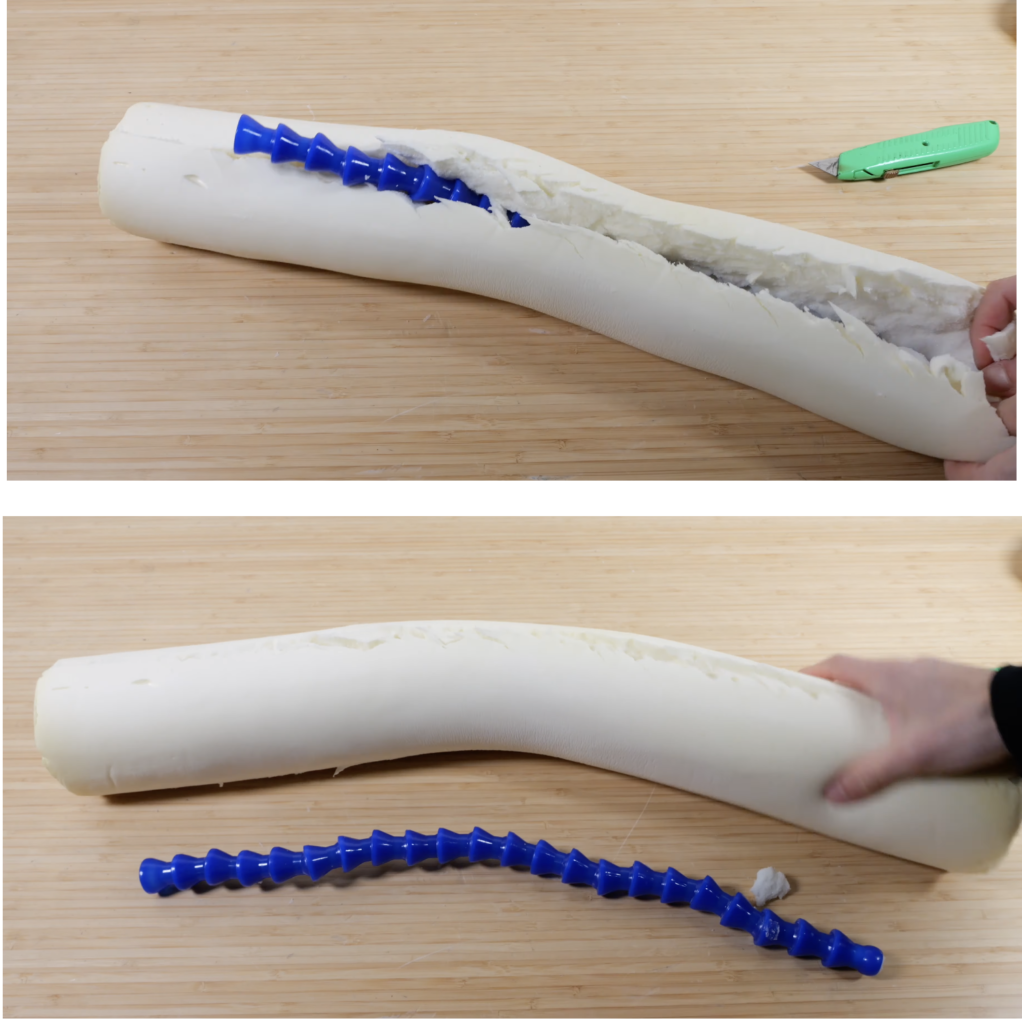
Source: publicly available YouTube demonstration. All rights belong to the original creator.
Overall, the Dot&Dot’s structure rewards deliberate setup. It’s best understood as a configurable support tool rather than a wear-and-forget travel pillow.
Does the Memory Foam and Fabric Feel Comfortable Over Long Flights?
The Dot&Dot Twist uses a standard memory foam core wrapped around a flexible internal spine. The foam provides initial softness and pressure relief, but its behavior changes as it warms, becoming more pliable over time.
The outer cover is cotton. It feels soft against the skin and is reasonably breathable for short to medium use, though it’s not a premium textile. Stitching and finishing are functional rather than refined, which is consistent with the pillow’s price point.
Because the foam surrounds a plastic segmented core, the pillow’s comfort depends more on how it’s positioned than on the material quality itself. The materials are adequate and practical, but they are not the main source of support or long-term stability.
In practice, comfort depends more on setup than on the foam itself.
Does the Dot&Dot Twist Lose Shape or Support Over Time?
The Dot&Dot Twist is designed to handle repeated bending rather than constant compression. Its segmented internal spine tolerates twisting and repositioning well, which prevents sudden breakage and allows the pillow to keep holding shape through frequent adjustments.
The weak point over time is the memory foam. With repeated bending at the same stress points and prolonged heat exposure during long trips, the foam gradually softens and can begin to show surface fatigue or cracking along the bend line. This is wear-related degradation, not immediate failure, but it does reduce firmness and shape resistance as the pillow ages.
The cotton cover and stitching are functional but basic. They hold up to regular use and washing, but they aren’t reinforced for heavy abuse.
Overall, durability is acceptable for regular travel use, with gradual softening rather than catastrophic failure. It’s not a long-term structural support device, but it survives repeated trips better than foam-only pillows that rely entirely on material stiffness.
Does This Pillow Really Prevent Your Head From Falling Forward?
The Dot&Dot Twist’s ergonomics are driven by manual positioning, not built-in posture control. When shaped deliberately, the pillow can brace the head from the side, support a leaned position, or act as a soft neck rest. Stability comes from how well the internal spine is bent and anchored against an external surface, such as a seatback or window.
In upright sleeping, forward head control is limited. Although the pillow includes a front snap that allows it to close into a loose U-shape, this closure does not create meaningful chin support. The snapped fabric sits under the chin but lacks structure or resistance, so it doesn’t prevent forward head drop. It functions more as a positioning aid than a true support mechanism.
Bottom line: it won’t reliably stop your head from falling forward.
As a result, the Dot&Dot works best for side-leaning or reclined positions, where the pillow can be shaped to block lateral movement. For upright economy seats, it requires frequent reshaping and does not actively hold the head in alignment. Ergonomically, it favors adaptable comfort over enforced posture, making it better for resting than for sustained, hands-free sleep.
In practice, it works better with a window than in the middle seat.
Real-World Limitations
Here’s where the Dot&Dot Twist Memory Foam Travel Pillow starts showing its real boundaries:
• Support depends entirely on setup
If you don’t deliberately shape and place the pillow, it behaves like a soft foam tube. There’s no built-in alignment or default support doing the work for you.
• No true chin support in U-shape mode
Even when snapped closed in front, the fabric connection doesn’t create a rigid chin shelf. It reduces gap, but it won’t stop forward head drop on its own.
• Doesn’t adapt automatically when you move
Once you change posture, the pillow doesn’t self-correct. Side support, forward support, and reclined support all require manual reshaping.
• Foam fatigue shows at bend points over time
Repeated twisting in the same area stresses the memory foam. Over long use, firmness and surface integrity degrade where the pillow is most often bent.
• Heat buildup during long sessions
The memory foam softens as it warms, which reduces resistance and makes the pillow feel less supportive late in long flights.
• Precision is lower than structured designs
Because support is user-created rather than engineered into the shape, results vary. Small setup differences lead to big comfort differences.
• Works best when you stay still
The pillow rewards deliberate sleepers. Restless sleepers who shift unconsciously will lose support unless they reset it.
Travelers who want more structured chin support usually do better with brace-style designs like the Trtl or BCOZZY, especially on longer flights where airline rules and seat design matter.
What Travelers Are Saying (Amazon, YouTube, Reddit)
What Do Users Like About the Dot&Dot Twist Travel Pillow?
- Holds a custom shape better than expected
People like that it stays where you bend it instead of springing back like a normal foam pillow. - More versatile than a standard U-pillow
Gets used as neck support, side brace, chin-rest attempt, lumbar roll, and “window buffer” depending on the seat. - Useful for side-leaning sleep
When they build a thicker side and lean into it, it works like a mini headrest against the seat/window. - Comfort is genuinely decent at first contact
The memory foam feel wins early impressions, especially for short naps and softer support. - Better for awkward seats than fixed-shape pillows
People mention it helps in seats where a U-pillow doesn’t fit well against the headrest. - Internal structure is seen as the “real feature”
The bendable core is what travelers credit for the pillow doing anything different from generic foam. - Packability is “manageable” for a non-inflatable
Not tiny, but people like that it can be shaped around other items or clipped/strapped, instead of being a bulky U-ring. - Multi-use value
Even if it’s not perfect as a neck pillow, people feel they can repurpose it (lumbar, knee support, desk nap), so it doesn’t feel like a one-job product.
What Complaints Appear Most Often in Reviews?
- Does not reliably stop forward head drop
Even with the snap closed, the front section is soft fabric over foam, not a structural chin shelf. Heads still fall forward for many users. - Requires active setup and patience
It works only if you deliberately twist and position it. People expecting “put it on and sleep” are often disappointed. - Support quality varies wildly by user
Because support is user-created, results depend heavily on neck length, posture, and how well someone understands shaping it. - Memory foam softens quickly with heat
Over time, the foam becomes more pliable, reducing resistance and making the pillow feel less supportive on long flights. - Internal spine can be felt through the foam
Some users notice pressure points where the segmented core presses through, especially when tightly bent. - Shape can drift if you move during sleep
The pillow does not self-correct. Restless sleepers often lose the position they set. - Bulkier than it looks once packed
It compresses, but not neatly. It tends to take up awkward space in a bag compared to inflatable or slimmer designs. - Durability issues with repeated bending
Long-term use can lead to foam cracking or tearing near high-stress bend points, especially around the center curve.
Final Scores
Scores reflect engineering performance, not just comfort.
How Good Is the Support and Stability?
Support & Stability: 6/10
The adjustable shape allows targeted support, but there is no true structural chin stop. Stability depends entirely on how well it’s shaped and how still you remain.
How Comfortable Are the Materials?
Material & Comfort: 6.5/10
The memory foam feels soft initially and the cotton cover is pleasant on skin, but materials are clearly mid-range. Foam softens with heat and stitching quality is functional, not premium.
Is It Easy to Use in Tight Seats?
Ease of Use: 5.5/10
Effective only with deliberate setup. Twisting and positioning takes trial and error, and the pillow does not self-adjust once you move.
How Portable Is It for Travel?
Packability: 6/10
More flexible than rigid foam pillows, but bulkier than expected. It compresses awkwardly and doesn’t pack as cleanly as inflatables or slim designs.
Does It Stay Comfortable on Long Flights?
Long-Haul Performance: 5.5/10
Comfort holds for short stretches, but support degrades as foam warms and posture shifts. Works better as a configurable comfort aid than a true long-flight support solution.
Verdict
The Dot&Dot Twist Travel Pillow is a configurable comfort tool, not a precision support device. Its strength lies in flexibility. You can shape it to suit different positions and body types, but that same flexibility limits how much real stability it can provide over long flights. It rewards deliberate setup and stillness, not passive or restless sleep.
It sounds flexible on paper, but in practice, that flexibility becomes a responsibility over long flights.
Best for:
Travelers who like to customize their setup, change positions intentionally, or want a multi-use pillow that can function as neck, side, or lumbar support. Also a reasonable choice for short to medium flights where comfort matters more than strict alignment.
Not ideal for:
Long-haul flyers who need hands-free head support, travelers prone to forward head drop, or anyone looking for a “put it on and sleep” solution. Also not great for those who move frequently during sleep.
Bottom line:
If you value adaptability over structure and are willing to actively shape your support, the Dot&Dot Twist can work well. If your goal is reliable, set-and-forget stability on long flights, a more structured travel pillow will serve you better.
FAQ
Does the Dot&Dot Twist Memory Foam Travel Pillow provide real neck support on planes?
It provides positional support, not structural neck bracing. Stability depends on how well you shape and anchor it rather than on built-in geometry.
How does the internal segmented spine affect stability?
The spine allows the pillow to hold a bent shape instead of slowly collapsing. It controls position, not alignment.
Is this pillow effective at preventing forward head drop?
Only partially. Without a true chin shelf, forward head drop is reduced by positioning, not mechanically blocked.
Does the snap closure meaningfully improve chin support?
No. The snap mainly keeps the pillow closed in a U-like loop. It does not create load-bearing chin support.
How long does it take to configure the Dot&Dot Twist correctly?
Usually a few minutes of trial and error. Small shape changes significantly affect comfort and stability.
Is the Dot&Dot better for upright or reclined seating?
It performs best when you can lean sideways or brace against a surface. Upright, unsupported seating exposes its limits.
Does the pillow adapt automatically if you change sleeping position?
No. Any position change requires manual reshaping. It does not self-correct during sleep.
Is this a good option for long-haul flights?
It can work for long flights if you stay relatively still. For restless sleepers, consistency drops over time.
Is the Dot&Dot good for people with neck pain?
It can help with light positional support, but it doesn’t provide rigid alignment. If your neck pain requires consistent stabilization, brace-style pillows tend to work better than fully flexible designs.
Does the Dot&Dot work if you move a lot while sleeping?
Not reliably. Because the pillow relies on manual shaping, frequent movement usually breaks the setup and requires readjustment.