


The Trtl Pillow Plus is one of the most unusual travel pillows on the market, replacing soft foam cushioning with a wearable neck-brace concept designed for upright sleep on planes. Instead of asking whether it feels plush, the real question is whether this rigid, adjustable design can actually keep your head from dropping forward during long flights. This review breaks down how the Trtl Pillow Plus performs in real airline seats, who its structure works for, and where its brace-style support starts to feel restrictive or impractical.
Category: Travel Pillows
Author: Product Developer (Independent, No Sponsorships)
Written by a product developer who reviews travel gear with zero sponsorships.
Clear, technical breakdowns of materials, ergonomics, and real-world use.
Table of Contents
- Design Overview
- My Take (from a product developer)
- Design-Level Constraints (Independent of User Preference)
- What Travelers Are Saying
- Final Scores
- Verdict
- FAQ
Design Overview
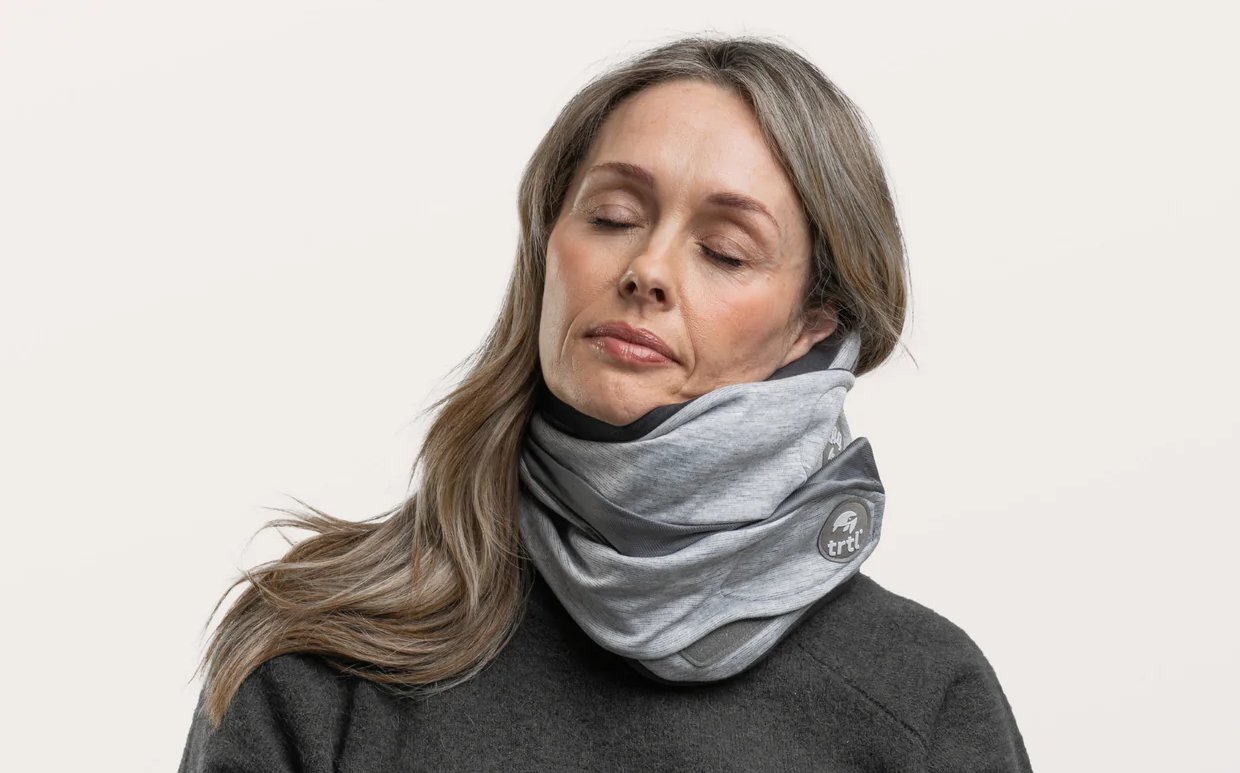
The Trtl Pillow Plus is a structured travel pillow built around a rigid internal neck brace rather than soft padding. It supports the head by bracing the chin and jaw on one side, creating a stable leaning position without adding bulk behind the neck.
The brace is wrapped in a stretchy fabric shell with a soft fleece contact surface, with a thin foam layer to reduce pressure against the skin. The Plus version adds two adjustment toggles that change the height of the internal support, allowing the brace to sit higher or lower depending on neck length and seating position.
Key design elements:
- Internal rigid plastic neck-support frame (brace-style design)
- Adjustable height mechanism with two internal toggles
- Stretchy polyester–spandex outer wrap
- Fleece-lined interior for skin contact
- Thin foam layer between fabric and plastic frame
- Scarf-style wrap with two Velcro fastening points
- Designed for upright seating and forward head control
- No traditional foam “pillow” bulk
This sets the mechanical foundation. The real question is how that foundation behaves once you actually try to sleep in it, which is where My Take comes in next.
My Take (from a product developer) on the Trtl Plus Travel Pillow
From a product-developer perspective, the Trtl Pillow Plus is built around structural neck support rather than cushioning volume. Instead of surrounding the neck with foam, it uses an internal plastic support frame to hold the head in a controlled leaning position. The “Plus” version refines this concept by adding adjustability and softer contact layers, but the core idea remains the same: stabilize the head mechanically rather than letting it sink into padding.
Design & Structure
The Trtl Pillow Plus is built around a rigid internal plastic support frame, not cushioning volume. Instead of surrounding the neck with foam, the structure holds the head in a controlled leaning position, functioning more like a lightweight neck brace than a traditional pillow.
The core of the design is a curved plastic support plate that runs vertically along one side of the neck. This plate is responsible for resisting lateral head drop and maintaining alignment when the head tilts. Unlike U-shaped pillows, there is no rear support element and no attempt to cradle the neck evenly from all sides. Support is intentionally directional.
What distinguishes the “Plus” version structurally is adjustability of the internal frame height. Two external adjustment toggles allow the plastic support to be raised or lowered inside the wrap, changing where the head contacts the structure. This does not change the shape of the frame itself, but it does alter how high the head is propped during a lean.
Stability is handled through dual Velcro attachment points rather than a fixed loop or snap. These two patches allow the wrap to be secured around the neck with variable overlap, preventing movement of the support plate during use. The structural integrity of the pillow depends on this anchoring. If the wrap loosens, the frame loses positional control.
Overall, the Trtl Plus prioritizes mechanical alignment over adaptive comfort. Its structure is fixed in function but adjustable in placement, and its effectiveness depends on correct positioning rather than passive conformity.
How Do the Materials Affect Long-Flight Comfort?
The Trtl Pillow Plus uses a layered material system wrapped around its internal plastic support frame.
The outer wrap is a polyester–spandex blend, giving it stretch and elasticity. This stretch is functional rather than cosmetic. It allows the fabric to conform tightly around the internal frame and the neck without wrinkling or bunching, and it accommodates the height adjustments made via the internal toggles.
The surface that comes into direct contact with the neck is a soft, fleece-like textile. This inner-facing layer is designed for comfort against bare skin and helps reduce friction between the neck and the rigid support beneath. It feels noticeably softer than the exterior fabric and is clearly intended as the primary comfort interface.
Between the fleece contact layer and the plastic support frame sits a thin foam buffer. This foam does not provide structural support or shape retention. Its role is strictly transitional: softening the edge feel of the plastic frame and preventing pressure points where the structure meets the neck and jaw.
Importantly, there is no bulk foam core and no memory foam behavior. Comfort is achieved through surface materials and buffering layers, not through compressive cushioning.
Does the Trtl Plus Travel Pillow Hold Its Shape Over Time?
That frame is the load-bearing component, and it is designed to handle repeated lateral forces from head weight without relying on foam compression or fabric tension to maintain shape.
The adjustable height mechanism uses mechanical toggles integrated into the frame. These introduce moving parts, which adds complexity compared to the original Trtl, but the adjustment system itself is simple and low-stress once set. Long-term durability depends more on avoiding frequent re-adjustment than on daily wear.
The fabric wrap and fleece contact layer hold up reasonably well to regular use. Stretch fabrics tend to recover shape better than rigid knits, but they can lose elasticity over time, especially with frequent washing. Because the cover is not a simple slip-off design, washing introduces more handling stress than with standard pillows.
The thin foam buffer between the frame and the neck is not a structural risk point. It may compress slightly with extended use, but its role is comfort smoothing, not support, so degradation here does not cause functional failure.
Overall, the Trtl Plus is built to fail slowly rather than suddenly. Structural integrity comes from the frame, while fabric wear and elasticity loss are the most likely long-term changes. It’s durable for repeated travel use, but not immune to gradual softening and cosmetic wear over time.
Does it Prevent Head Slumping in Window and Aisle Seats?
The internal plastic frame is shaped to hold the head in a fixed lean angle, transferring load from the neck muscles into the shoulder and upper torso rather than distributing it evenly around the neck.
The adjustable height system allows the support frame to sit higher or lower along the jawline. This changes where the head contacts the structure, affecting leverage rather than softness. When adjusted correctly, the frame intercepts head movement before forward slump occurs. When misaligned, pressure concentrates along the jaw or side of the neck instead of stabilizing it.
The wrap-style design secures the pillow using two Velcro patches, anchoring the structure in place. This prevents drift during upright sleep but also limits passive movement. The pillow does not adapt automatically if posture changes. Any shift in lean direction requires repositioning the wrap and re-securing the closure.
Because there is no rear cushioning or bilateral symmetry, support is directional and position-specific. The pillow is designed to function while the head remains oriented toward one side. If the user changes sides, the entire structure must be rotated and reattached.
Neck contact is mediated by a fleece-covered surface with a thin foam buffer. This reduces hard-edge pressure from the frame but does not create adaptive contouring. Ergonomic performance is therefore governed primarily by frame geometry and alignment, not by material compliance.
In ergonomic terms, the Trtl Plus behaves more like a wearable support device than a pillow. Support quality depends on correct placement and sustained posture rather than passive comfort.
Design-Level Constraints (Independent of User Preference)
Here’s where the Trtl Plus Travel Pillow starts showing its real boundaries:
- Side-only support geometry
The internal plastic frame supports your head in one controlled lean direction. It cannot provide symmetric 360° support like a U-pillow, so it is inherently posture-specific. - Fit is bounded by neck length + jaw height
Even with the two height toggles, the brace has a limited “sweet spot.” If your jawline sits above or below the brace’s effective shelf, you either get weak support or awkward pressure. - Load concentrates on a small contact zone
A brace design creates a pressure point at the jaw/side-of-neck instead of spreading load across a large foam surface. The thin foam layer helps, but it does not change the physics. - Head movement is mechanically restricted
Because the support comes from a structured frame, micro-adjustments (turning your head, re-centering) are less forgiving. When you shift, you often need to re-seat the brace. - Adjustability adds setup complexity
The height toggles are useful, but they add one more “dial it in” step. If you set them wrong, you can create either neck tilt or jaw pressure without realizing why. - Warmth buildup is structurally likely
A polyester/spandex wrap plus fleece-like contact area is cozy, but it reduces airflow. This design tends to run warmer than breathable mesh U-pillows, especially on long hauls. - Bulk headphones conflict is real
The brace+wrap architecture occupies the same space as over-ear headphone cups. Even if ear pressure is reduced, large headphones often fight the geometry and push things out of alignment.
What Travelers Are Saying (Amazon, YouTube, Reddit)
What Do Users Like About Trtl Pillow Plus?
- Works better than U-shaped pillows for upright sleeping
Frequent flyers often mention switching from classic U-pillows because the Trtl Plus keeps the neck more stable when the seat doesn’t recline much. - Adjustability is noticed and used
The added height toggles are repeatedly mentioned as a real improvement over the original Trtl, especially for taller users or longer necks. - More compact than foam pillows
Travelers appreciate that it packs flatter and takes less space than bulky memory-foam options, even if it’s not ultra-small. - Comfort improves once positioned correctly
Initial skepticism often turns positive after users figure out placement and tension. Several reviews mention a short learning curve. - Good for window and aisle seatsUnlike window-dependent pillows, many users report it works even without a wall to lean on, as long as the brace is adjusted properly.
What Complaints Appear Most Often in Reviews?
- Pressure concentration on jaw or neck
Some report localized pressure where the internal support frame presses, especially if tension is set too tight or neck length doesn’t align well. - Takes time to figure out
A common complaint is that comfort depends heavily on setup. Users who don’t experiment with height toggles or wrap tension often dislike it at first. - Can feel restrictive
The wrap-and-secure design limits natural head movement. Restless sleepers or frequent position changers find it confining. - Interferes with headphones/earphones
The wrap-around support frame occupies space along the jaw and side of the head, which can interfere with the fit and seal of bulky over-ear headphones. - Not ideal for side switching
Changing lean direction requires rewrapping or readjusting the pillow, which some find disruptive during sleep. - Doesn’t feel plush or “pillowy”
Many users expect cushioning and are surprised by the firm, brace-like feel. Those looking for softness often find it uncomfortable. - Price sensitivity
Several reviewers note that expectations are higher due to the price, and dissatisfaction feels stronger when comfort isn’t immediate.
Final Scores
Scores reflect engineering performance, not just comfort.
How Good Is the Support and Stability?
Support & Stability: 8.0 / 10
Very stable once positioned correctly. The internal frame does real work holding the head in a fixed lean, but stability depends on correct height adjustment and wrap tension.
How Comfortable Are the Materials?
Material & Comfort: 6.5/10
Soft fleece contact layer helps, but comfort is limited by the rigid support underneath. Stretchy cover improves fit, not softness. Comfortable for support, not for lounging.
Is It Easy to Use in Tight Seats?
Ease of Use: 6/10
Once set up, it’s straightforward. Initial adjustment takes time, toggles are not intuitive, and removing or refitting requires attention rather than instinct.
How Portable Is It for Travel?
Packability: 8.5/10
Compact, lightweight, and easy to stow compared to foam pillows. One of its strongest practical advantages for frequent flyers.
Does It Stay Comfortable on Long Flights?
Long-Haul Performance: 6/10
Effective for side-leaning sleep in upright seats, especially when the pillow is positioned correctly. On very long flights, staying comfortable either involves briefly waking to reposition or remaining in one posture for extended periods, which can feel restrictive over time. The fixed support structure delivers stability, but limits adaptability as movement becomes necessary.
Verdict
The Trtl Pillow Plus is a niche product executed deliberately. It doesn’t try to feel like a pillow. It tries to solve one specific problem: keeping your head from collapsing when you sleep upright. When the internal frame is adjusted correctly and the wrap is secured, it does that job better than most soft travel pillows. But its benefits come with setup, commitment to a fixed posture, and tolerance for a more structured feel.
Best for:
• Travelers who sleep upright and tend to lean to one side
• Long-haul economy flyers who want head stability over plush comfort
• People who find traditional U-shaped pillows too bulky or ineffective
• Those willing to adjust and configure their support rather than “put it on and forget it”
Not ideal for:
• Restless sleepers who change positions frequently
• Anyone seeking soft, cushiony comfort around the neck
• Travelers who dislike firm contact or structured pressure points
• Users expecting a traditional pillow-like feel
Bottom line:
The Trtl Pillow Plus works when you use it the way it’s designed to be used. It’s not universally comfortable, but it is mechanically effective. If you want controlled head support rather than softness, it delivers.
FAQ
Does the Trtl Pillow Plus actually support the neck on long flights?
Yes, but only in a specific way. The Trtl Pillow Plus supports the neck by mechanically bracing the head in a side-leaning position rather than cushioning it. It’s effective when aligned correctly, but it doesn’t adapt automatically as posture changes.
How is the Trtl Pillow Plus different from a normal U-shaped travel pillow?
Unlike U-shaped pillows that rely on foam volume, the Trtl Pillow Plus uses an internal plastic support frame to hold the head at a controlled angle. Support comes from structure, not padding.
Can you sleep upright with the Trtl Pillow Plus in economy seats?
It works best for upright or slightly reclined seats where side-leaning is possible. It is less effective for straight-back, forward-facing sleep because it does not provide front chin support.
Does the adjustable height system on the Trtl Pillow Plus make a real difference?
The dual height toggles allow the internal support frame to sit higher or lower against the neck. This helps fine-tune alignment, but it does not change the fundamental side-support nature of the design.
Is the Trtl Pillow Plus comfortable for long-haul flights?
Comfort depends on tolerance for fixed support. On long flights, users typically need to wake briefly to reposition or stay in one posture for extended periods, which can feel restrictive over time.
Can you move or change positions while wearing the Trtl Pillow Plus?
Not passively. Any meaningful change in sleeping position requires repositioning the pillow. It works best when you commit to one side rather than shifting frequently during sleep.
Does the Trtl Pillow Plus work without leaning against a window or seat?
It can provide some support, but stability improves significantly when there is a solid surface to lean against. Without lateral contact, the support effect is reduced.
Is the Trtl Pillow Plus better than memory foam for neck support?
It depends on the problem you’re solving. The Trtl Pillow Plus offers more controlled head positioning than foam pillows, but less adaptability and pressure relief. It trades softness for mechanical stability.