


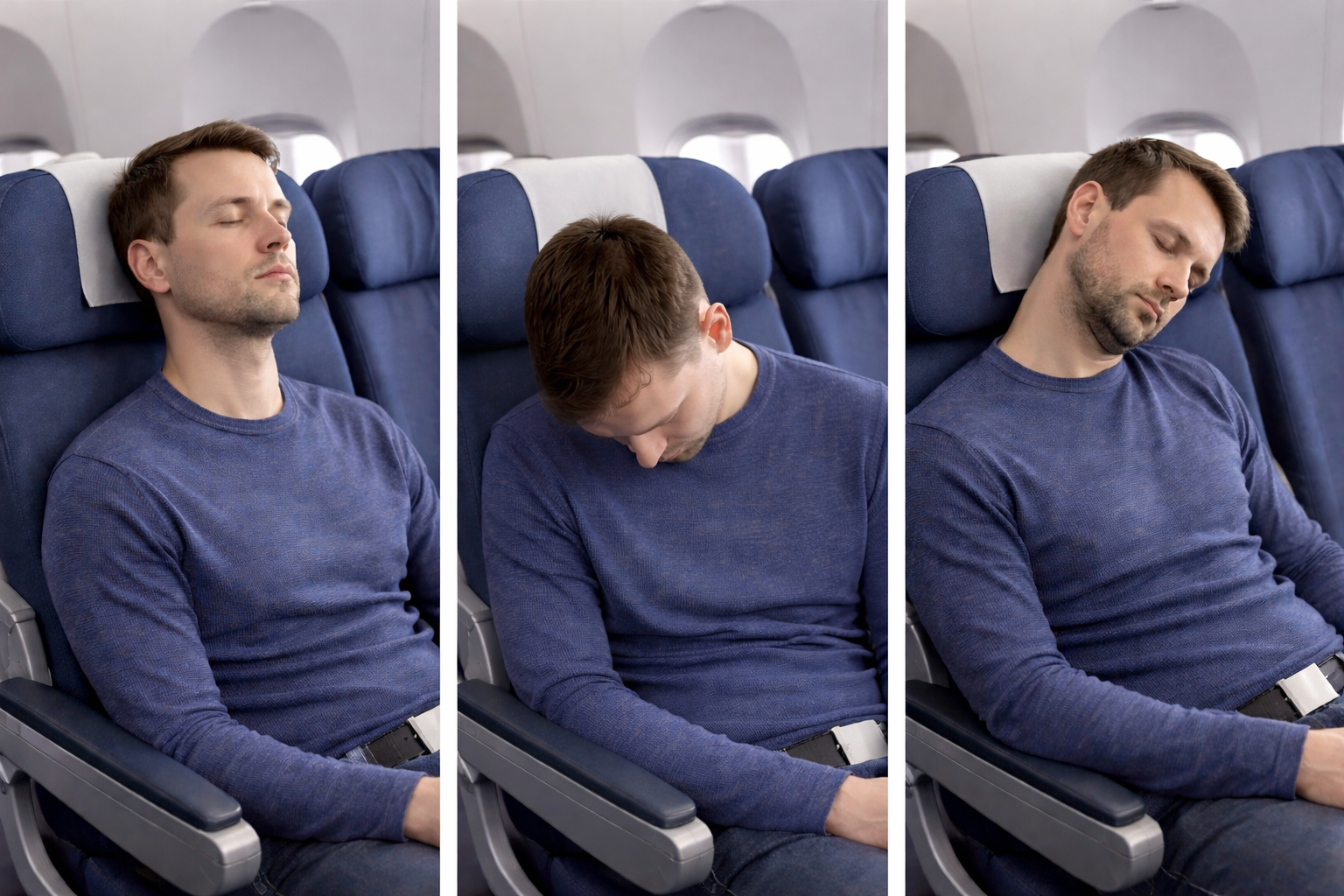
Most travel pillows fail for one simple reason: they aren’t designed for how people actually sleep on planes. The best travel pillow depends far less on brand and far more on sleeping position. On flights, people sleep upright in economy seats, slump forward with the chin dropping toward the chest, or lean sideways against a window or seat wall. Each position places very different demands on neck support, and most pillow designs only address one of them, if any.
This guide breaks down the three sleeping positions that actually happen on planes and explains which travel pillow designs work for each one in practice. Instead of ranking pillows by softness or popularity, the focus here is on mechanics: how support is created, where it fails, and why choosing the right pillow depends more on how you sleep than on brand or hype.
Category: Travel Pillows
Author: Product Developer (Independent, No Sponsorships)
Written by a product developer who reviews travel gear with zero sponsorships.
Table of Contents
- The Three Real Sleeping Positions on Planes
- Best Travel Pillows for Upright Sleeping
- Best Travel Pillows for Forward Sleeping (Chin-to-Chest)
- Best Travel Pillows for Side Sleeping (Window Lean)
- Why Most Travel Pillows Fail on Long Flights
- How to Choose Based on How You Actually Sleep
- Final Recommendations by Sleeping Position
- FAQ
The Three Real Sleeping Positions on Planes
Despite what travel pillow marketing suggests, there aren’t many ways people actually sleep on planes. In real cabins, with limited recline and narrow seats, most passengers fall into one of three positions. Each one places very different demands on neck support, which is why a pillow that works in one scenario often fails completely in another.
Upright sleeping happens when the seat stays mostly vertical and the head remains centered. The main problem here is stability. Without a firm stop, the head drifts, muscles stay engaged, and fatigue builds quickly. Pillows that rely on softness alone tend to collapse under sustained load in this position.
Forward sleeping is the classic chin-to-chest slump. This isn’t a comfort choice so much as a mechanical failure. Gravity pulls the head forward, and unless something actively resists that motion, the neck ends up bearing the load. Many U-shaped pillows simply aren’t designed to counter forward rotation for more than a short time.
Side sleeping occurs when leaning against a window or seat wall. This is often the most stable posture, but only if the pillow can fill space consistently and maintain lateral support. If the support compresses or shifts, the head drops and the neck twists.
Most people default into one of these three positions because of seat geometry and fatigue, not because they planned it that way.
Best Travel Pillows for Upright Sleeping
Upright sleeping is the hardest position for travel pillows to handle and, for most economy travelers, the most unavoidable one. When the seat remains nearly vertical, the neck is forced to stabilize the head continuously. Without real resistance, muscle fatigue builds fast. The central problem here isn’t comfort. It’s controlling slow, uncontrolled head movement over time.
In upright seats, structural resistance matters more than cushioning. Pillows that rely purely on foam volume or inflatable loft tend to fail gradually. They feel supportive at first, but as muscles relax, the head begins to drift.
Designs that perform best upright are those that physically block movement rather than absorb it. Brace-style or mechanically guided pillows use internal structure to create a clear stopping point for the chin and jaw. Instead of cradling the neck, they limit how far the head can fall forward or sideways. This reduces muscular effort, especially during longer stretches of stillness. The trade-off is rigidity. These designs only work well when properly aligned to the user’s neck and posture, and they tolerate movement poorly.
This is why brace-based designs (for example, the Trtl pillow) tend to outperform soft wraps in upright seats, and why firmer contoured U-shaped pillows like the Cabeau Evolution S3 can work only when their rear profile stays thin and side walls remain supportive. In both cases, performance comes from resisting motion, not from plushness.
Traditional U-shaped memory foam pillows sit somewhere in the middle. When designed with a thin rear section and firm lateral sides, they can slow head drift without pushing the head forward. When the back is too thick, however, they create the opposite problem by forcing the chin toward the chest, which makes upright sleeping worse rather than better.
Wrap-style pillows without structure, such as loop or scarf designs, struggle the most in this position. Without a fixed stop, they rely on friction and careful placement. In upright seats, gravity eventually wins unless the user constantly readjusts. These designs are far better suited to side-leaning than true upright rest.
One quiet reality most travelers discover mid-flight is this: upright sleeping exposes design weaknesses quickly. If a pillow doesn’t actively resist movement, its support degrades rather than stabilizes. For travelers who know they’ll spend hours upright, choosing a pillow that prioritizes stability over softness makes a measurable difference in fatigue by the end of the flight.
Best Travel Pillows for Forward Sleeping (Chin-to-Chest)
Forward sleeping, where the chin drops toward the chest, is the most mechanically demanding position for any travel pillow. Unlike side leaning or light recline, gravity acts directly on the neck in a single axis. If nothing physically stops that motion, the head will fall forward no matter how soft or plush the pillow feels at first. This is where most travel pillow designs fail quickly.
For forward sleeping, a defined stopping point matters more than surface comfort. Pillows that rely on foam volume, fabric wraps, or inflatable loft without a structural barrier tend to compress over time. As muscles relax, the chin keeps moving until the neck takes over again. The failure is gradual but inevitable.
These are design examples, not universal recommendations:
Brace-based designs exist specifically to address this. The Trtl Pillow is a clear example of the mechanical approach. Instead of cushioning the neck evenly, it uses an internal support frame to block forward chin collapse on one side. When properly aligned, the brace creates a hard limit on how far the head can fall forward.
This doesn’t make it universally comfortable or suitable for everyone, but it clearly illustrates the underlying principle: forward sleeping requires mechanical resistance, not just padding. Once that resistance is misaligned or removed, the design stops working.
A different approach can be seen in the J-Pillow, which uses shape rather than a rigid brace. Its extended lower arm sits under the chin while the upper section braces against the side of the head, forming a three-point support system when paired with a window or seat wall. This design shows that forward sleeping can also be managed through geometry, but only when an external surface completes the support triangle. Without that side contact, chin support alone is not enough to resist forward collapse.
What both examples reveal is the same constraint: forward sleeping demands either a physical block or a controlled load path. A lot of pillows may feel comfortable early on, but comfort without resistance doesn’t hold posture.
One quiet reality here is that forward sleeping exposes design honesty very quickly. If a pillow can’t explain exactly how it stops the chin from falling, it probably doesn’t. In this position, support either exists structurally or it doesn’t.
Best Travel Pillows for Side Sleeping (Window Lean)
Side sleeping against a window or seat wall is the most forgiving sleeping position on a plane, but it still exposes clear differences in pillow design. In this posture, the pillow is not fully responsible for holding the head upright. The aircraft wall becomes part of the support system. The pillow’s real task is to fill space, manage pressure, and keep the neck from collapsing inward over time.
For side sleeping, shape adaptability and surface contact matter more than mechanical stiffness. Pillows that can conform to the space between your head and the window tend to work better than rigid designs. The goal is not to block movement completely, but to slow it and distribute load across a wider area of the jaw, cheek, and side of the neck.
Loop-style designs like the Infinity Pillow demonstrate this principle clearly. By wrapping or stacking the pillow, users can build up material exactly where their head rests against the window. Early comfort is usually high because pressure is spread broadly rather than concentrated. The limitation appears over time. As the fill compresses and the loop loosens, support gradually degrades and requires active reshaping. The design works, but it depends on ongoing user input.
Chin-support-oriented U-shaped designs like the BCOZZY illustrate a different side-sleeping approach. Instead of building volume outward, the pillow stabilizes the head from below by supporting both sides of the chin. When leaned against a window, this reduces inward neck collapse and limits rotation. The support is more consistent than loose-fill designs, but less adaptable. If the window height or seat angle doesn’t align well, pressure can feel uneven rather than cushioned.
What side sleeping makes obvious is this: external surfaces do most of the work. A pillow that feels mediocre upright can feel suddenly effective once a window is involved. That doesn’t mean the design is stronger. It means the posture is more forgiving.
Window leaning makes many pillows feel better because the wall is doing part of the stability work.
Why Most Travel Pillows Fail on Long Flights
Most travel pillows don’t fail at takeoff, they fail after time. That’s when materials warm, pressure builds, and your posture drifts a few degrees at a time.
Failure #1: Support decays. Memory foam softens, inflatables lose firmness, and fabric fills compress. When resistance drops, the pillow stops doing work and your neck quietly takes over again.
Failure #2: The design only works in one posture. Many pillows are built for either upright, forward, or window-leaning. On long flights, even small position changes reroute the load path and the “good” setup stops lining up with your head and jaw.
Failure #3: Bulk solves one problem and creates another. Thick backs can push the head forward in upright seats, while overbuilt sides can force awkward angles. You get support, but not alignment.
If you want the deeper breakdown of why these failures happen and how different designs break down over hours, I cover that in detail in Why Most Travel Pillows Fail on Long Flights.
How to Choose Based on How You Actually Sleep
Choosing a travel pillow works best when you stop asking what sounds comfortable and start looking at how you actually sleep on planes. Most disappointments come from a mismatch between posture and design, not from poor materials or build quality.
Start with how upright you’ll be. If you’re usually stuck in economy with minimal recline, designs that actively resist head movement matter more than cushioning. Structural or brace-based pillows limit how far the head can drift and reduce muscular effort over time. Softer wraps and plush U-shaped pillows may feel comfortable early on but tend to fade as muscles relax.
Next, consider where your head naturally goes when you fall asleep. If it drops forward, chin support and a defined stopping point are critical. If you lean toward a window, adaptability and surface contact matter more than rigidity. No pillow handles both equally well.
Be honest about how much you move. Highly structured designs demand alignment and tolerate movement poorly, while softer, shapeable pillows forgive repositioning but require ongoing adjustment. Neither approach is universally better. They solve different problems.
Finally, factor in flight length. Short flights reward quick comfort. Long flights expose design weaknesses. If a pillow relies on you constantly fixing it, that cost adds up over hours.
For the full seat-type and neck-length decision tree, use the complete guide here.
Final Recommendations by Sleeping Position
If you mostly sleep upright, prioritize designs that actively resist movement rather than cushion it. Upright posture exposes drift quickly, so pillows with structural limits or firm lateral control perform more reliably than soft, shapeable options. Comfort here comes from stability, not plushness.
For forward sleeping (chin-to-chest), the key requirement is a clear stopping point. Designs that create mechanical resistance under the chin or along the jaw handle this best. Soft wraps and standard U-shapes tend to fail gradually as gravity takes over. This position is unforgiving, and even good designs work only when alignment is right.
If you usually sleep sideways against a window, adaptability matters more than rigidity. Pillows that can conform to uneven gaps and distribute pressure across the side of the face and neck tend to feel better over time. The aircraft wall does part of the work here, so filling space and managing pressure become the priority.
The quiet truth is that no single pillow excels in all three positions. The best choice depends less on brand or hype and more on which posture you default to once you stop consciously adjusting. Match the design to the position you actually end up in, not the one you hope to maintain.
FAQ
What is the best travel pillow for long flights?
The best travel pillow depends on how you actually sleep on a plane. Upright sleepers need designs that resist head movement, forward sleepers need chin support, and side sleepers need pillows that adapt to window gaps. There is no single option that works equally well for everyone.
Are travel pillows worth using on long flights?
They can be, but only when the design matches your sleeping position. Pillows that rely on softness alone often feel good early on but fail to control head movement over time, leading to neck fatigue.
Why does my head keep falling forward when I sleep on planes?
Forward head drop happens when there is no physical stop under the chin. As muscles relax, soft pillows compress and gravity pulls the head down. Preventing this requires resistance, not extra padding.
Can a U-shaped travel pillow prevent neck pain?
It depends on the rear profile, side firmness, and how you sleep. Thick-backed U-pillows often push the head forward in upright seats, while firmer, contoured designs can work better for side leaning or light recline. Shape alone doesn’t guarantee support.
What travel pillow works best for side sleeping on a plane?
Side sleeping against a window is the most forgiving position. Pillows that can conform to uneven gaps and spread pressure across the cheek and neck tend to perform better than rigid designs in this posture.
Can one travel pillow work for all sleeping positions?
In practice, no. Designs that work upright often feel restrictive on the side, while adaptable pillows that work well at the window usually fail in upright seats. Most compromises become obvious after the first hour.
How do I choose the right travel pillow for my body?
Start with your default sleeping position, not marketing claims. Consider whether you lean forward, sit upright, or rest against a window, and how much you move during sleep. The right pillow solves one problem clearly rather than many problems poorly.