


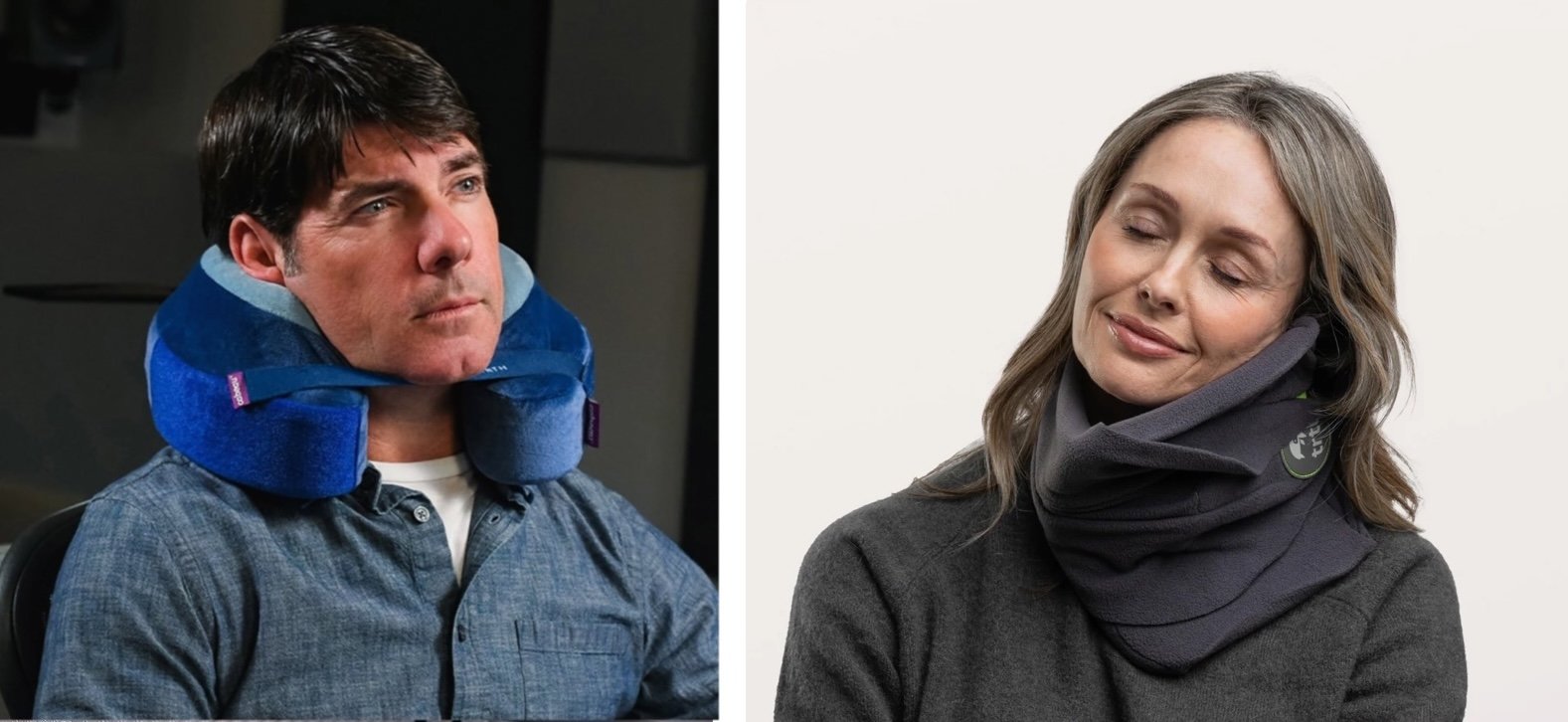
Trtl vs Cabeau Evolution Earth travel pillow compares two popular designs. Finding out the truth requires looking past the marketing and into the raw mechanics of head stabilization. These two designs attempt to solve the ‘head-bob’ through opposite engineering paths: the Trtl uses a structured internal brace to create a side-loading cantilever, while the Evolution Earth relies on a 360-degree memory foam chassis with an integrated chin strap to arrest forward fall.
Having analyzed how small alignment errors in these systems accumulate into significant neck strain during long-haul flights, I’ve moved the focus of this teardown to sustained load-bearing performance in real economy seats. My goal is to determine where these structures actually fail under the weight of an adult head once the initial ‘out-of-the-box’ comfort wears off. (For a breakdown of how airline enforcement affects these specific designs, see our seat-strap and airline rules analysis)
Category: Travel Pillows
Author: Product Developer (Independent, No Sponsorships)
Written by a product developer who reviews travel gear with zero sponsorships.
Clear, technical breakdowns of materials, ergonomics, and real-world use.
Table of Contents
- Support Design: Brace Wrap vs Foam-Based Neck Cradle
- Neck Support & Stability
- Ergonomics in Real Airline Seats
- Comfort Over Time
- Ease of Use & Adjustability
- Who Each Pillow Is Actually For
- Final Verdict
- FAQ
Support Design: Brace Wrap vs Foam-Based Neck Cradle
The Trtl is built around a rigid internal brace wrapped in soft fleece. Instead of surrounding the neck, it creates a single-sided support column that holds the jaw and cheek at a fixed leaning angle. Stability comes from structural resistance and horizontal tension in the wrap, not cushioning. The design behaves more like a wearable support device than a traditional pillow.
The Evolution Earth follows a foam-based cradle approach. It uses contoured memory foam, raised sidewalls, and a thin flat back to support the head from multiple directions. Forward control is handled through an elastic chin strap rather than a rigid frame. Support is distributed around the neck rather than concentrated on one side.
These approaches reflect different priorities. The Trtl emphasizes positional control through structure. The Evolution Earth prioritizes softness and surface contact through shaped foam. One resists movement. The other absorbs it.
Neck Support & Stability
The Trtl and the Evolution Earth approach head stabilization through opposite structures. One relies on a rigid side brace and fixed lean angle. The other distributes support through foam geometry and surface contact. In both cases, stability depends on how closely the user’s posture matches the intended loading pattern.
Does It Prevent Forward Head Drop in Upright Seats?
The Trtl manages forward head drop by holding the jaw against an internal frame on one side. When the seat remains upright and the lean angle matches the brace geometry, forward collapse is limited. Recline reduces that effect and allows the head to slide past the support surface.
The Evolution Earth relies on its elastic chin strap and contoured foam to interrupt forward movement. When strap position aligns correctly, forward drift slows. When it does not, the head settles against the front edge of the pillow and support weakens.
Which Design Controls Side Lean Better?
Side stability on the Trtl comes from structural resistance. The curved frame resists lateral bending and keeps the head centered on one side. This creates predictable support in still postures, but offers no redundancy if alignment shifts.
The Evolution Earth uses tall foam sidewalls to cradle the jaw and cheeks. When neck height matches the geometry, lateral movement is limited. When it does not, contact shifts toward the ears and upper cheek, reducing usable support.
What Happens When You Shift or Change Position?
Movement exposes the main differences. On the Trtl, changing sides requires unwrapping and rebuilding the system. Minor posture changes alter pressure distribution along the jaw and cheek and often break the initial setup.
On the Evolution Earth, movement causes the pillow to migrate upward or rotate slightly around the neck. Small shifts change strap position and sidewall contact. Restoring alignment usually requires repositioning rather than minor adjustment.
Where Each Design Breaks Down First:
Both designs lose stability through gradual misalignment. The Trtl fails when lean angle, seat position, and brace alignment drift out of sync. The Evolution Earth fails when strap placement and foam contact no longer match neck geometry. In both cases, support degrades quietly until discomfort forces intervention.
The Cabeau offers more ‘cradle,’ but keep in mind that memory foam is basically a neck-heater. If you’re on an older plane with bad airflow, you’re going to wake up sweaty. The Trtl is cooler, but it’s essentially a plastic brace. It’s not ‘comfy’ in the traditional sense, it’s just effective at stopping the ‘head-bob.
Ergonomics in Real Airline Seats
The Trtl and the Evolution Earth respond very differently to changes in seat geometry. Backrest angle, headrest contour, and available lateral space determine how their support systems load the neck and jaw. Small variations in these parameters can shift both designs from stable to inconsistent.
Does It Hold Your Head in Fully Upright Economy Seats?
In near-vertical economy seating, the Trtl performs closest to its intended configuration. The internal brace holds the jaw at a fixed lean angle and limits forward collapse when posture remains steady. Stability drops when the seat reclines unevenly or when the user shifts position.
The Evolution Earth relies more on foam contact and strap placement in this posture. When neck height and strap position align, forward and lateral movement is reduced. When they do not, the pillow rides upward and loses effective contact.
What Changes When the Seat Is Slightly Reclined?
Even moderate recline alters load paths for both designs. The Trtl loses some mechanical advantage as the head slides past the support surface and no longer rests fully on the frame.
The Evolution Earth becomes more forgiving in mild recline, as reduced forward load makes chin support less critical and improves perceived stability.
Does Window vs Aisle Seating Change Stability?
Window seats provide lateral resistance that benefits both pillows. The Trtl gains additional rotational stability, and the Evolution Earth relies less on sidewall compression.
Aisle seats remove that boundary. Both designs must manage side load independently, and instability becomes more noticeable during service movement and passenger traffic.
Comfort Over Time
With both the Trtl and the Evolution Earth, comfort changes gradually over multi-hour flights rather than failing suddenly. Early impressions are usually positive. Long-term consistency is where the differences become clear.
On the Trtl, comfort is closely tied to pressure distribution along the jaw and cheek. During the first hour, the fleece exterior and structured frame feel stable and controlled. As time passes, localized pressure becomes more noticeable, especially for users who remain in the same leaning position. Heat buildup in the wrap and limited airflow can also contribute to fatigue. Once discomfort develops, recovery usually requires removing and rewrapping the device.
The Evolution Earth begins with a softer, more conventional pillow feel. The memory foam adapts quickly, and contact is spread across the neck, jaw, and sidewalls. Over time, the elastic chin strap becomes the weak link. For many users, it sits too high to provide reliable forward control, and small shifts in posture pull it out of position. As foam warms and compresses, the pillow becomes more dependent on that unstable strap for alignment. Pressure then migrates toward the ears, cheeks, or upper neck, which usually shows up as a dull ache behind the ear after an hour or two. Readjustment restores comfort briefly, but each cycle increases reliance on precise strap placement, making long-term stability harder to maintain.
In both designs, comfort erosion is gradual rather than sudden. Neither fails catastrophically, but both become more sensitive to posture and alignment over time. As materials warm and supports drift out of position, maintaining a stable contact pattern requires increasing effort, and long-term comfort becomes harder to sustain.
Ease of Use & Adjustability
Both pillows appear simple, but real usability depends on how much effort is required to maintain a workable setup over time. The difference lies less in initial adjustment and more in how tolerant each design is to imperfect positioning.
The Trtl requires deliberate setup. The wrap must be stretched horizontally, aligned with the jaw, and secured at the correct tension. Once in place, it holds its shape reliably. Switching sides or changing posture, however, requires unwrapping and rebuilding the system. In tight rows, this process feels intrusive and discourages adjustment.
The Evolution Earth is faster to put on. The U-shape settles naturally around the neck, and the chin strap provides a basic adjustment range. Fine-tuning that fit is harder. Small changes in strap position or pillow height alter pressure distribution, and many users need several attempts to reach a stable configuration.
In both cases, adjustment is ongoing rather than fixed. Neither offers a durable “set-and-forget” state. Effective use depends on the user’s willingness to monitor fit and intervene when alignment drifts, which becomes increasingly difficult during longer flights and deeper sleep.
Who Each Pillow Is Actually For
The Trtl is best for travelers who can maintain a consistent upright posture, prefer sleeping on one side, and prioritize compact packing over cushioning. It works most reliably on short to medium flights, in seats with limited recline, and for users who are comfortable committing to a fixed leaning position. If you rarely change sides and want a low-bulk support system that stays put when aligned correctly, the Trtl is the more predictable option.
The Evolution Earth suits travelers who prefer a traditional pillow feel, recline slightly, and are willing to fine-tune fit throughout a flight. It performs best for users whose neck height and jaw position align naturally with its foam geometry and chin strap. If you value initial softness and tolerate periodic readjustment, it can feel more comfortable in the first hours than the Trtl.
If you sleep restlessly, change posture frequently, or expect a pillow to compensate for slouching and unstable seating, neither design will perform consistently. These pillows reward controlled sleep behavior and penalize movement. They are tools for managing posture, not substitutes for it.
Decision rule:
- If you sleep on one side, stay upright, and want maximum compactness → choose the Trtl.
- If you recline slightly, prefer foam cushioning, and accept ongoing adjustments → choose the Evolution Earth.
- If you shift often or rely on pillows to “fix” posture → avoid both.
Final Verdict
The Trtl and the Evolution Earth solve the same problem using opposite mechanical strategies, and each works only when user behavior matches its design assumptions.
The Trtl delivers the most reliable stability when posture is controlled and seat geometry is upright. Its internal brace limits lateral and forward movement more consistently than foam-based designs, but at the cost of adaptability and long-term pressure comfort. For disciplined sleepers who value portability, it is the more mechanically dependable option.
The Evolution Earth prioritizes surface comfort and familiar pillow feel, but depends heavily on precise chin strap positioning and favorable neck proportions. It feels better initially for many users, yet loses consistency as materials warm and alignment drifts. Over longer sessions, its stability is less predictable than the Trtl’s.
Decision summary:
If you want maximum positional stability → choose the Trtl.
If you prefer cushioning and mild recline comfort → choose the Evolution Earth.
If you expect a pillow to adapt to movement and fatigue → avoid both.
The Bottom Line: If you travel with just a personal item and hate carrying extra junk, the Trtl is your only real choice. It’s the ‘minimalist’s brace.’ But if you actually want to feel like you’re leaning on a pillow and don’t mind the massive footprint in your bag, the Cabeau Evolution Earth wins on pure comfort. Personally? I’ll take the bulk of the Cabeau for a 10-hour red-eye, but for a 3-hour hop, the Trtl is the only one I won’t regret packing.
Between the two, the Trtl is the safer technical choice for users who fit its use profile. The Evolution Earth is better viewed as a comfort-first option with higher variability
FAQ
Is the Trtl or the Cabeau Evolution Earth better for upright economy seats?
Neither is ideal for fully upright seating. The Trtl performs more predictably when users can maintain a stable side-leaning posture. The Evolution Earth depends on strap placement and foam alignment, which becomes harder to sustain in near-vertical seats.
Which pillow works better for long-haul flights?
Both can work on long flights under stable conditions, but neither is consistently reliable over many hours. The Trtl tends to accumulate pressure at fixed contact points, while the Evolution Earth becomes more sensitive to strap drift and foam compression.
Can either pillow adapt well to frequent position changes?
No. The Trtl requires rewrapping to change sides, and the Evolution Earth requires repositioning to restore alignment. Restless sleepers will need frequent adjustments with both.
Is one option better for shorter necks or smaller frames?
The Trtl is generally more predictable for shorter necks, as it relies on brace placement rather than vertical foam height. The Evolution Earth’s geometry and strap position are less forgiving when proportions fall outside its intended range.
Do these pillows work for side sleepers on planes?
Only in limited situations. The Trtl supports a fixed side-lean but restricts switching sides. The Evolution Earth lacks stable lateral support for sustained side sleeping in narrow seats.
Which pillow is easier to use during boarding and setup?
The Evolution Earth is quicker to put on initially. The Trtl requires more deliberate positioning and tension control. Over time, both demand ongoing attention.
Which is the safer overall choice?
Neither is something you can buy and forget about. Both are conditional designs that perform well only when anatomy, seating, and travel habits align. Outside those conditions, comfort and stability degrade gradually rather than improving with use.