


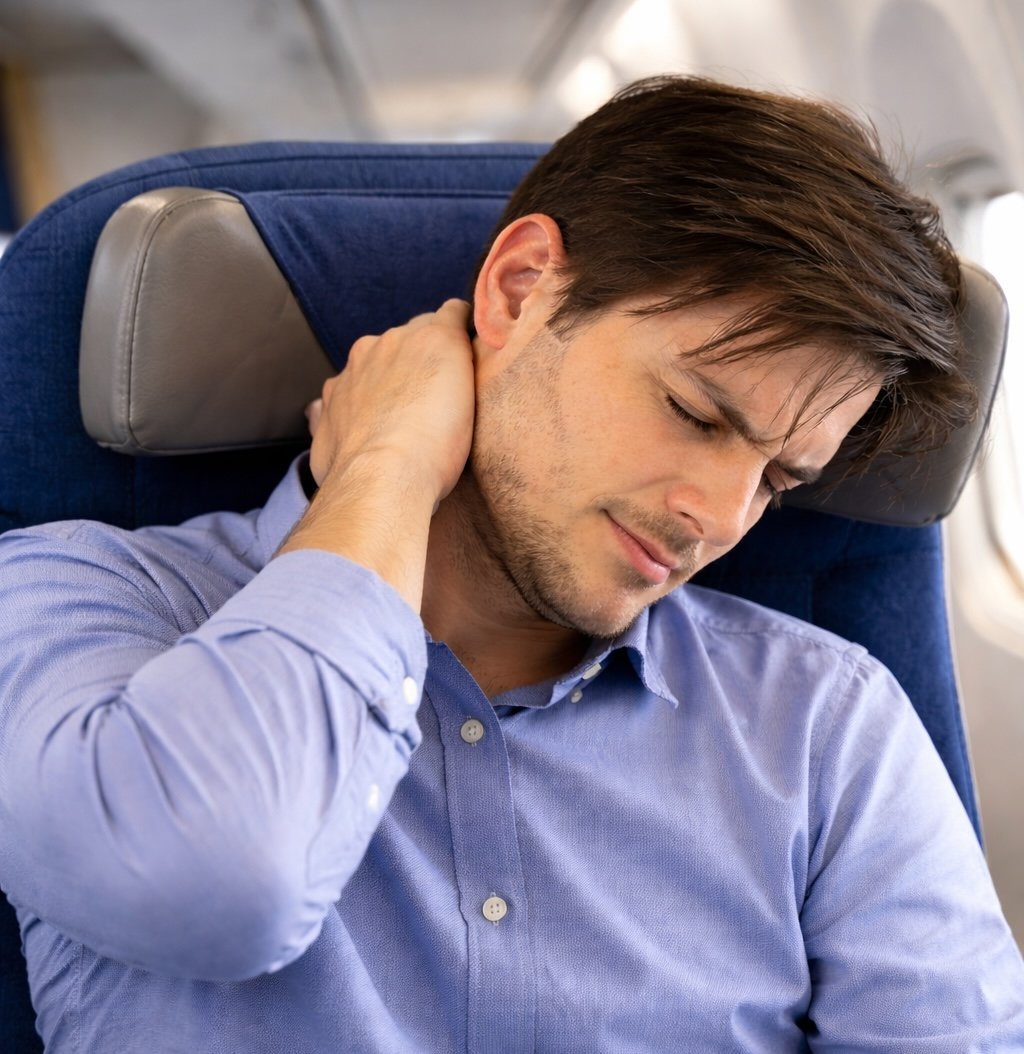
Airline headrests neck pain is one of the most common sources of discomfort on long flights, especially in economy class seating. Winged padding and forward-angled supports often push the head out of neutral alignment instead of stabilizing it. Many pillows feel fine at first, then lose effectiveness as heat, movement, and posture drift set in. This guide explains how headrests affect neck alignment, why most designs underperform, and what actually holds up in real flight conditions.
If you want to see how airline rules shape which pillow designs even work in practice, our breakdown of seat-strap travel pillow regulations explains this in detail.
Category: Travel Pillows
Author: Product Developer (Independent, No Sponsorships)
Written by a product developer who reviews travel gear with zero sponsorships.
Clear, technical breakdowns of materials, ergonomics, and real-world use.
Table of Contents
- How Airline Headrests Are Designed
- How Airline Headrests Cause Neck Pain in Economy Seats
- The Forward-Head Problem in Economy Seats
- Why Most Travel Pillows Fail Against Airline Headrests
- When Headrests Help (And When They Don’t)
- What Actually Works Instead
- How to Choose Around Bad Headrests
- Conclusion: Comfort vs Real Support
How Airline Headrests Are Designed
Modern airline headrests are built around cost, space efficiency, and visual comfort rather than long-term neck support. In economy class cabins, headrests must fit within strict seat pitch limits while remaining lightweight and easy to clean. These constraints shape almost every design decision, often at the expense of ergonomics.
Why Do Most Airline Headrests Have “Wings”?
Winged headrests are designed to limit sideways head movement and create a sense of enclosure in narrow seats. In theory, they help prevent the head from falling outward during light sleep. In practice, the wings are usually too shallow and too soft to provide real lateral stability once muscles fully relax. They guide posture rather than control it.
Why Are Headrests Pushed Forward?
Many modern headrests are angled slightly forward to encourage an upright sitting position and improve screen visibility. This forward bias also helps airlines fit seats closer together without reducing perceived comfort. The downside is that it shifts the head away from its natural neutral position, increasing strain on the neck over time.
Why Is Padding So Thin?
Headrest padding is kept thin to reduce weight, simplify maintenance, and meet fire-safety standards. Thick foam compresses unevenly, traps heat, and degrades faster under heavy use. As a result, most headrests rely on firm, shallow cushioning that feels supportive at first but provides little long-term pressure relief.
Why Do Headrests Vary So Much Between Aircraft?
Seat manufacturers design headrests to fit different cabin layouts, aircraft models, and airline branding requirements. Variations in recline angle, headrest height, and wing depth mean that the same pillow or posture can work well on one aircraft and fail completely on another. This inconsistency makes reliable neck support difficult across fleets.
How Airline Headrests Cause Neck Pain in Economy Seats
Neck pain in compact cabin layouts is rarely caused by a single bad posture choice. It develops gradually as seat design, gravity, and muscle fatigue interact over several hours. Modern airline headrests often accelerate this process by encouraging positions that feel stable at first but overload the neck over time.
Why Does Forward Head Posture Develop So Easily?
Most economy seats place the head slightly in front of the torso due to shallow backrests and forward-angled headrests. As neck muscles relax, the head drifts further forward, increasing the load on the cervical spine. Even small forward shifts multiply the stress placed on supporting muscles and joints.
How Does Muscle Fatigue Change Head Position Over Time?
During the first part of a flight, travelers subconsciously correct poor posture. They lift their head, adjust their shoulders, and reposition themselves. Over time, this effort fades. Once fatigue sets in, the neck relies almost entirely on external support. If the headrest does not provide proper alignment, collapse becomes inevitable.
Why Do Upright Seats Make the Problem Worse?
Unlike beds or fully reclined seats, economy seats keep the spine in a semi-upright position. In this posture, gravity pulls the head forward rather than downward. Without strong rear or chin support, the neck must constantly resist this motion, leading to stiffness and pain after prolonged sitting.
Why Does Side Leaning Still Strain the Neck?
Side leaning feels more comfortable than forward collapse, but it creates uneven loading across the neck and shoulders. Winged headrests may limit outward movement, yet they rarely provide balanced support. As a result, one side of the neck remains under continuous tension for hours.
The Forward-Head Problem in Economy Seats
Forward-head posture is one of the most common and least understood causes of neck pain on flights. In economy seats, the head rarely sits directly above the shoulders. Shallow backrests, limited lumbar support, and forward-angled headrests encourage the head to drift slightly ahead of the spine, even before fatigue sets in.
At first, this shift feels harmless. The neck muscles compensate automatically, keeping the head upright with small, continuous corrections. Over time, those muscles tire. Once that happens, gravity takes over and the head moves further forward, increasing the load on the cervical spine and surrounding tissues. What began as a mild misalignment becomes sustained strain.
Seat geometry makes this worse. Economy seats are designed to keep passengers semi-upright, not fully reclined. In this position, gravity pulls the head forward rather than downward. Without strong rear or chin support, the neck must resist this force for hours.
Most travel pillows do little to prevent this. Soft padding cushions the contact points but does not change the underlying load path. As a result, forward-head posture continues to develop, even when the pillow initially feels comfortable.
Why Most Travel Pillows Fail Against Airline Headrests
Most travel pillows are designed in isolation, as if the seat behind them did not exist. In real cabins, however, the headrest is an active part of the support system. When a pillow presses against it, the two structures compete for control of head position. In most cases, the seat wins.
Soft U-shaped and memory foam pillows rely on compression to feel supportive. They adapt to the neck and shoulders by collapsing slightly under load. When pressed against a forward-angled headrest, this compression increases unevenly. The rear of the pillow flattens first, pushing the head forward instead of stabilizing it. What feels cushioned at first becomes unstable over time.
Wrap-style and scarf-style pillows attempt to solve this through tension rather than padding. When positioned perfectly, they can resist forward movement. The problem is precision. Small changes in seat angle, headrest depth, or posture alter how that tension is distributed. Over long flights, pressure shifts toward the jaw, cheek, or throat, reducing comfort and consistency. We compared how wrap and loop designs behave in real cabins in our Trtl vs Infinity comparison.
Seat-anchored designs move support away from the body and toward the headrest. This can improve stability in ideal conditions, but it increases dependence on seat geometry. Any change in recline, wing position, or strap tension quickly disrupts alignment. The pillow becomes only as reliable as the seat behind it.
In practice, most travel pillows fail not because they are badly made, but because they are not engineered to work with modern headrests over long periods. Comfort masks instability. Time exposes it.
When Headrests Help (And When They Don’t)
Airline headrests are not universally harmful. In specific conditions, they can provide meaningful support. The problem is that those conditions are narrow and inconsistent across aircraft, seat types, and passenger body proportions.
Headrests tend to work best for travelers who are close to the assumed “average” seat fit. Passengers of medium height, with moderate neck length and upright posture, may find that well-positioned wings reduce lateral head movement during light sleep. Window seats can also improve performance by allowing the head to rest partly against the cabin wall, reducing reliance on the headrest alone.
Headrests are more effective on newer aircraft with deeper padding and adjustable wings. Some premium economy and business class seats offer greater rear support and better alignment, which lowers the demands placed on the neck. In these environments, headrests can complement other support systems rather than replace them.
Problems arise when body dimensions or seating conditions fall outside these narrow ranges. Tall travelers often find that the headrest sits too low, while shorter passengers may struggle with forward pressure. Uneven recline, worn padding, and shallow wings further reduce effectiveness.
In most economy cabins, headrests provide partial, short-term assistance rather than reliable long-haul support. They can delay discomfort, but rarely prevent it.
What Actually Works Instead
Effective neck support on long flights comes from controlling movement rather than increasing softness. Designs that succeed over time focus on managing load paths, limiting drift, and maintaining alignment as posture and muscle tension change.
The most reliable solutions keep support anchored to the body rather than the seat. Body-worn designs move with the passenger as posture shifts, reducing dependence on headrest position, recline angle, or seat geometry. When the support structure stays aligned with the neck and jaw, stability remains more predictable across different aircraft and seating layouts. For example, the Cabeau Evolution Earth shows how chin-strap geometry can stabilize forward drift when aligned correctly.
Resistance matters more than cushioning. Materials or geometries that maintain height under sustained load perform better than plush foams that compress with heat and time. Firmer contact may feel less inviting at first, but it preserves alignment once fatigue sets in. Over long flights, this structural consistency outweighs short-term comfort.
Forward head control is another critical factor. Because gravity gradually pulls the head forward in upright seats, effective designs address this motion directly. Support under the jaw, controlled front contact, or rigid side elements that limit rotation tend to outperform purely lateral cushions.
Simplicity also improves reliability. Pillows that work without constant adjustment are more likely to remain effective during sleep. Systems that require frequent tightening, reshaping, or repositioning often fail once the user becomes tired or semi-conscious.
In practice, the best-performing travel pillows accept limits. They do fewer things, but they do them consistently. Instead of promising universal comfort, they prioritize stable geometry, controlled resistance, and minimal dependence on external structures. That restraint is what allows them to function when conditions are imperfect, which is almost always the case on long flights.
How to Choose Around Bad Headrests
Choosing a travel pillow for economy class is less about finding a “perfect” product and more about minimizing the weaknesses of the seat. Because most headrests offer limited long-term support, the goal is to reduce dependence on them rather than trying to compensate for their flaws.
Start by paying attention to how your head naturally moves when you become tired. This is especially important if your goal is sleeping on a plane without neck pain on long or overnight flight. If it tends to fall forward, prioritize designs that provide controlled front or chin support. If it drifts sideways, look for structures that offer stable lateral resistance without relying on soft padding. Avoid pillows that depend heavily on rear contact with the headrest, as their performance will vary widely between aircraft.
Seat position also matters. Window seats allow partial support from the cabin wall, reducing load on the neck. Aisle seats offer more freedom of movement but less external stabilization. If you frequently sit in the aisle, body-worn designs tend to perform more consistently.
Flight duration should guide expectations. On short flights, comfort-focused pillows may be sufficient. On long-haul routes, structural support becomes more important than softness. Designs that feel slightly firm at first usually hold up better over time.
Finally, adjust expectations. No pillow can fully overcome poor seat geometry. The most reliable approach is choosing products that reduce alignment problems rather than promising perfect sleep.
Conclusion: Comfort vs Real Support
Airline headrests and travel pillows are often marketed as comfort solutions, but comfort and support are not the same thing. Comfort is immediate. It comes from softness, surface feel, and short-term pressure relief. Real support only reveals itself over time, when posture shifts, muscles relax, and materials warm under sustained load.
On long flights, most discomfort develops because head and neck alignment gradually breaks down. Forward drift, uneven loading, and reliance on unstable contact points create strain that no amount of plush padding can solve. Pillows that focus only on cushioning tend to fail once fatigue sets in.
Reliable support requires controlled resistance, stable geometry, and minimal dependence on seat design. It may feel less inviting at first, but it preserves alignment when conditions become difficult. Understanding this difference is the key to choosing products that work in real cabins, not just in marketing photos.