


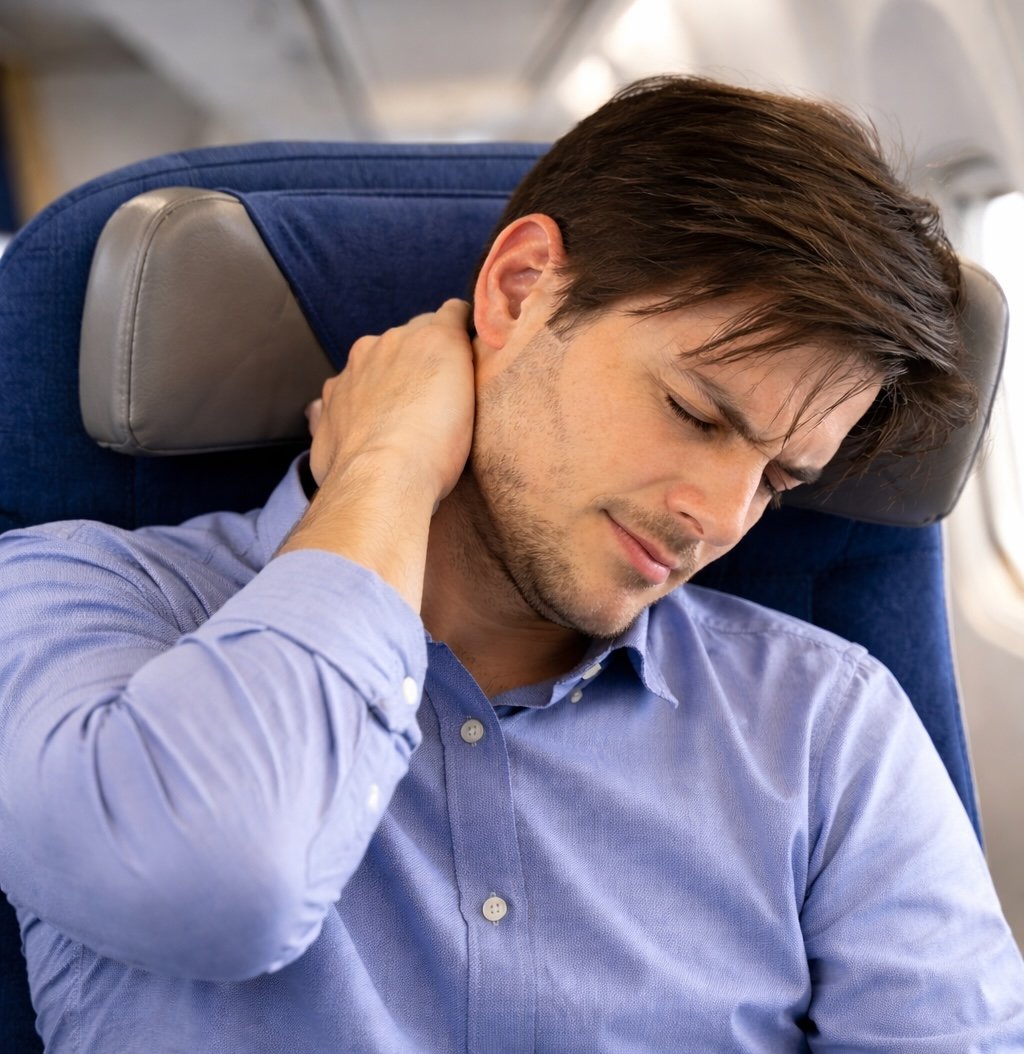
Neck pain in economy seats is one of the most common problems on long flights, especially when trying to sleep upright. Shallow backrests and poorly aligned headrests gradually push the head out of neutral position as muscles fatigue. What feels tolerable at first often becomes painful after several hours in the air.
This guide explains why economy seats strain your neck, which factors make it worse, and what you can realistically control to reduce discomfort on long-haul flights.
For a breakdown of which pillow designs are even permitted in-flight, see my analysis of airline rules for seat-strap travel pillows.
Category: Travel Pillows
Author: Product Developer (Independent, No Sponsorships)
Written by a product developer who reviews travel gear with zero sponsorships.
Clear, technical breakdowns of materials, ergonomics, and real-world use.
Table of Contents
- How Economy Seats Are Actually Designed
- Why Upright Seating Overloads Your Neck
- The Role of Headrests in Neck Support Problems
- Why Pillows Only Partially Solve the Problem
- What You Can Realistically Control in Economy
- What You Cannot Fix (And Should Stop Chasing)
- Conclusion: Managing Discomfort, Not Eliminating It
How Economy Seats Are Actually Designed
Economy class seats are engineered around density, durability, and regulatory limits rather than long-term comfort. Airlines measure success in millimeters: how many rows fit, how much weight is saved, and how quickly seats can be cleaned and maintained. Neck support is a secondary concern.
Seat pitch, the distance between rows, has gradually decreased on many routes. To compensate visually, manufacturers use thinner seat backs and slimmer padding. This creates the impression of space while reducing structural depth. The result is a shallow backrest that offers limited support for the upper spine and shoulders.
Recline angles are also restricted. Most economy seats tilt only a few degrees, keeping passengers in a semi-upright position even during rest. This posture reduces interference with the row behind and simplifies tray table use, but it increases the load placed on the neck during sleep.
Headrests are added primarily for perceived comfort and branding. Winged designs, adjustable panels, and contrasting materials make seats look supportive in marketing photos. In practice, these elements are constrained by space and cost. Wings are shallow, padding is firm, and adjustment ranges are limited.
Materials are chosen for longevity rather than ergonomics. Foams must resist compression, heat, and repeated cleaning. Fabrics must meet fire and durability standards. These requirements favor stiffness over adaptability, which limits how well seats conform to individual body shapes.
Overall, economy seats are optimized for efficiency and uniformity. They are built to fit millions of passengers reasonably well, not to support any one person perfectly. Neck strain is often a side effect of this compromise.
Why Upright Seating Overloads Your Neck
Upright seating places the spine in a position that feels stable for short periods but becomes mechanically demanding over time. In economy cabins, limited recline keeps the torso nearly vertical, forcing the neck to work continuously to maintain head position during rest.
Why Does Gravity Pull the Head Forward in Upright Seats?
When the torso is upright, gravity acts primarily in a forward direction rather than downward. As neck muscles relax, the head naturally drifts ahead of the shoulders. Even small forward shifts increase the load on cervical muscles and joints, requiring constant low-level effort to maintain alignment.
How Does Muscle Fatigue Change Posture During Sleep?
In the early stages of a flight, travelers subconsciously correct poor posture. They lift their head, adjust their shoulders, and reposition themselves. Over time, this self-correction weakens. As fatigue builds, the neck relies more heavily on external support. If that support is misaligned or unstable, posture gradually collapses.
Why Is Partial Recline Not Enough?
Most economy seats recline only slightly. This small adjustment reduces pressure on the lower back but does little to change head mechanics. The neck remains responsible for resisting forward movement, while the headrest provides minimal counterforce. As a result, strain accumulates even when the seat appears “reclined.”
Upright seating is efficient for cabin layout and passenger movement, but it shifts much of the workload onto the neck. Over long flights, this constant demand leads to stiffness, soreness, and reduced tolerance for even minor alignment errors.
The Role of Headrests in Neck Support Problems
Headrests are intended to provide support, but in economy class seating they often function more as positioning guides than true stabilizers. Their primary role is to limit extreme movement rather than maintain long-term alignment during rest.
Most headrests are mounted on shallow backrests with limited depth. This restricts how far they can extend toward the head without reducing usable seat space. As a result, contact usually occurs at a narrow area near the upper neck or lower skull. Instead of supporting the full weight of the head, the headrest creates a small pressure point.
Winged headrests are designed to reduce sideways motion, but their effectiveness depends on precise fit. When the wings are too shallow, they offer little resistance. When they are too firm, they push the head inward, increasing lateral strain. In both cases, stability remains limited.
Forward-angled headrests are used to encourage upright posture and improve screen visibility. While this may feel supportive at first, it shifts the head away from its natural neutral position. Over time, this increases muscular effort and accelerates fatigue.
Adjustability is another constraint. Many headrests allow only small changes in height or wing angle. These narrow ranges rarely accommodate differences in neck length, shoulder width, or sleeping posture. Once a passenger’s body falls outside the intended fit range, alignment deteriorates quickly.
In practice, most economy headrests delay discomfort rather than prevent it. They offer short-term guidance, not sustained structural support. As muscles relax and posture changes, their limitations become increasingly apparent.
Why Pillows Only Partially Solve the Problem
Most travel pillows are designed as standalone comfort products, not as components of a larger support system. In real cabins, however, the seat, headrest, and pillow interact continuously. When these elements are misaligned, the pillow rarely compensates. Instead, it often amplifies existing problems.
Soft U-shaped and memory foam pillows rely on compression to feel supportive. They adapt to the neck and shoulders by collapsing slightly under load. When pressed against a forward-angled headrest, this compression becomes uneven. The rear of the pillow flattens first, allowing the head to drift forward rather than remain centered. What feels comfortable at boarding often becomes unstable after several hours.
This interaction is especially visible in structured foam designs like the Cabeau Evolution Earth, where headrest pressure changes real-world support behavior.
Wrap-style and scarf-style designs attempt to address forward movement through tension rather than padding. When positioned precisely, they can limit collapse. The problem is consistency. Small changes in posture, seat angle, or headrest depth alter how that tension is distributed. Over time, pressure shifts toward the jaw, cheek, or throat, reducing comfort and reliability.
I compare these tension-based designs in detail in my Trtl vs Infinity breakdown.
Seat-anchored pillows move part of the support system away from the body and onto the headrest. This can improve stability under ideal conditions, but it increases dependence on seat geometry. Any change in recline, wing position, or strap tension quickly disrupts alignment.
Across designs, a common pattern emerges. Pillows focus on surface comfort instead of load control. They soften contact points but rarely manage the forces created by gravity, fatigue, and upright seating. As materials warm and muscles relax, structural resistance declines. The head gradually slips into poor alignment, even when the pillow still feels soft.
In practice, most pillows reduce discomfort temporarily without addressing its primary causes. These are structural neck support problems created by airline seats, not by missing cushioning.
What You Can Realistically Control in Economy
While passengers cannot change seat design or cabin layout, several practical factors influence how much strain the neck experiences during a flight. Small adjustments in setup and behavior can significantly reduce discomfort over long periods.
How Does Seat Choice Affect Neck Support?
Window seats provide the most external stabilization. The cabin wall allows the head to rest sideways, reducing forward collapse. Middle seats offer limited benefit, while aisle seats provide almost no lateral support and are frequently disrupted by movement. When sleep is a priority, window seats are usually the most reliable option. Pillows that rely on chin support, such as the BCOZZY, behave very differently in these positions.
How Can Posture Reduce Long-Term Strain?
Maintaining neutral alignment early in the flight delays fatigue. Sitting fully back in the seat, keeping shoulders relaxed, and avoiding forward head tilt helps preserve muscle endurance. Periodic posture resets during waking hours prevent gradual collapse later.
How Do Clothing and Accessories Matter?
Loose hoodies, scarves, or light jackets can be used to create additional padding between the head and seat. This reduces pressure points and improves stability without relying solely on pillows. Bulky collars and stiff fabrics, however, often interfere with alignment.
When Should Pillows Be Adjusted or Repositioned?
Most pillows require minor adjustments as posture changes. Repositioning before full fatigue sets in is more effective than waiting until discomfort develops. Once muscles are fully relaxed, correcting alignment becomes more difficult.
Although none of these measures eliminate structural limitations, they reduce cumulative strain. Managing posture, seat position, and support surfaces consistently is more effective than relying on any single product.
What You Cannot Fix (And Should Stop Chasing)
Some sources of neck discomfort in economy class are structural and cannot be solved with accessories or minor adjustments. Understanding these limits helps prevent wasted effort and unrealistic expectations.
Seat pitch, backrest depth, and recline angle are fixed by cabin layout and airline policy. No pillow or posture strategy can create meaningful space where none exists. When rows are tightly packed, upright positioning and limited movement are unavoidable.
Individual body proportions also impose constraints. Neck length, shoulder width, and torso height determine how well a passenger fits within standardized seat designs. Products optimized for “average” users often perform poorly outside that narrow range. This mismatch cannot be corrected through small tweaks.
Cabin conditions further reduce comfort. Low humidity, temperature fluctuations, vibration, and background noise interfere with muscle relaxation and sleep quality. Even perfect physical support cannot fully counteract these environmental stressors.
Marketing often promotes the idea of complete in-flight comfort through specialized gear. In reality, most solutions offer incremental improvements rather than transformation. Chasing perfect sleep in economy class usually leads to frustration.
Accepting these limitations shifts the focus from eliminating discomfort to managing it effectively. Realistic expectations make practical strategies more successful and reduce disappointment over unavoidable constraints.
Conclusion: Managing Discomfort, Not Eliminating It
Economy class seating is built for efficiency, not for sustained rest. As a result, neck discomfort on long flights is usually the product of multiple small stresses accumulating over time rather than a single design flaw. Upright posture, limited recline, shallow headrests, and muscle fatigue interact in ways that no accessory can fully reverse.
Travel pillows, seat selection, and posture adjustments can reduce strain, but they work within narrow limits. The most reliable improvements come from understanding how these constraints operate and adapting accordingly. Managing alignment, reducing forward drift, and minimizing pressure points are more effective than chasing perfect comfort.
Realistic expectations lead to better outcomes. When travelers focus on managing discomfort instead of eliminating it, they make smarter choices, waste less money, and experience fewer frustrations during long-haul flights.