


Some passengers use travel pillows through takeoff without a word. Others get stopped and told to put them away on the same airline. It’s not random. It just looks that way. If your pillow is soft and stays close to your body, you’re usually fine. Most problems come from bulk, positioning, or visibility.
During takeoff and landing, airlines require passengers to sit upright with seat belts fastened and tray tables stowed. But where do travel pillows fit into these rules? Many travelers wonder whether wearing a neck pillow is allowed, restricted, or quietly tolerated by cabin crew. The answer depends on safety regulations, airline policy, and how a pillow affects posture and visibility.
If you want a detailed breakdown of written policies and regulatory guidance, see my full analysis of seat-strap travel pillow rules. This guide explains when travel pillows are permitted, what flight attendants actually enforce, and how to avoid having your pillow removed at critical phases of flight.
Category: Travel Pillows
Author: Product Developer (Independent, No Sponsorships)
Written by a product developer who reviews travel gear with zero sponsorships.
Clear, technical breakdowns of materials, ergonomics, and real-world use.
Table of Contents
- What Airline Safety Rules Actually Say About Takeoff and Landing
- Do Airline Policies Mention Travel Pillows Directly?
- What Flight Attendants Really Enforce in Practice
- When Travel Pillows Get Flagged During Takeoff or Landing
- Different Types of Travel Pillows and How They’re Treated
- How to Use a Travel Pillow Without Getting Stopped
- International Flights and Airline Differences
- Who This Matters Most For (Use-Case Framing)
- Conclusion: Follow the Rule, Not the Rumor
- FAQ: Travel Pillows and Airline Rules
What Airline Safety Rules Actually Say About Takeoff and Landing
During takeoff and landing, airlines treat the cabin as a controlled safety environment. As a result, airlines apply standardized safety procedures that prioritize posture, restraint access, and unobstructed movement.
Why passengers must sit upright during critical flight phases
Passengers are required to sit upright with seat backs fully raised to reduce injury risk in sudden deceleration scenarios. An upright position aligns the torso with the seat structure, allowing the seat belt to distribute force across the pelvis rather than the abdomen. It also ensures that cabin crew can visually confirm compliance across rows quickly.
How seat belts, head position, and visibility factor into safety rules
Seat belts must remain clearly fastened and accessible at all times. Any item that interferes with belt visibility, restricts head movement, or limits situational awareness may be questioned. Airlines do not typically name travel pillows directly, but safety rules focus on posture, restraint access, and unobstructed head positioning. If a pillow compromises those elements, crew may intervene during takeoff or landing.
Do Airline Policies Mention Travel Pillows Directly?
Most airline policy documents do not reference travel pillows by name. Instead, safety manuals and passenger compliance guidelines focus on broader categories such as “personal items,” “loose objects,” and “carry-on accessories.” These categories are designed to cover a wide range of products without requiring constant updates as new accessories enter the market.
Why most airline manuals don’t name neck pillows
Airline safety documentation is written to remain stable over long regulatory cycles. Naming specific consumer products would require frequent revisions and regulatory approval. Instead, airlines define functional requirements such as maintaining clear access to seat belts, allowing full seat-back movement, and preserving unobstructed passenger posture. Travel pillows are evaluated against these functional standards rather than being listed individually.
Because airlines rarely mention neck pillows directly, enforcement depends on whether your setup interferes with seat belts, posture, or cabin readiness. Policies are written broadly, and real-world decisions are driven by what cabin crew can quickly verify during critical flight phases.
How “loose items” rules are interpreted in practice
In practice, “loose items” rules are applied contextually. Items that can shift, fall, block restraint systems, or interfere with evacuation procedures may be restricted during critical phases of flight. Soft, body-secured travel pillows are rarely challenged. Larger, rigid, or unsecured designs are more likely to be questioned if they compromise movement or visibility.
What Flight Attendants Really Enforce in Practice
This is where most travelers misread the rules and get caught off guard. While airline policies provide a formal framework, actual enforcement during boarding, takeoff, and landing is shaped by time pressure, cabin workload, and situational risk. Flight attendants are responsible for scanning dozens of passengers in seconds, confirming basic compliance, and preparing for possible interruptions. As a result, enforcement focuses on visible safety risks rather than minor comfort accessories.
When cabin crew usually ignore travel pillows
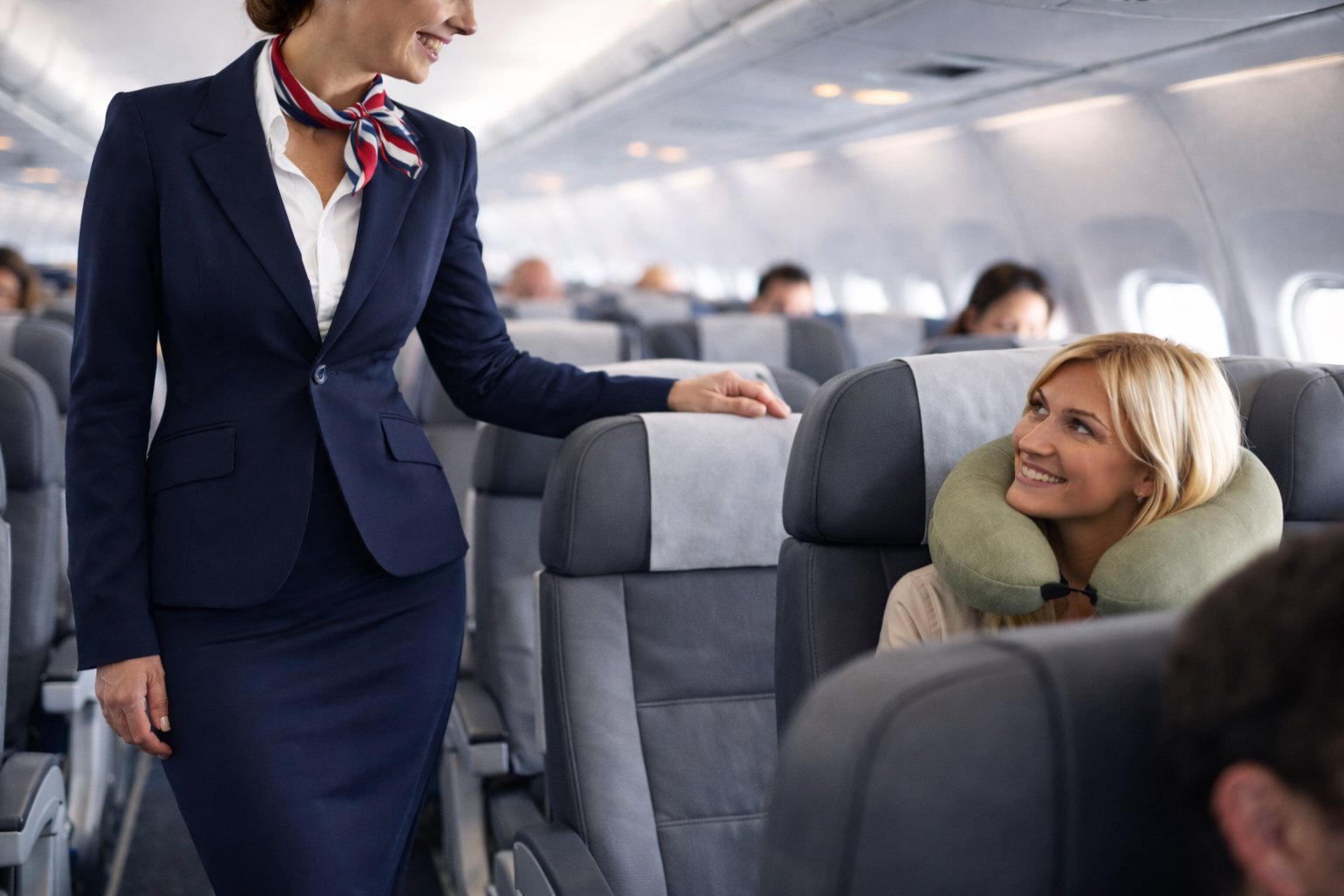
Cabin crew typically overlook travel pillows that remain compact, secured to the body, and do not interfere with seat belts, armrests, or seat backs. Soft U-shaped pillows, lightweight scarves, and flexible loop designs worn close to the neck rarely attract attention. Overlapping arm designs like the BCOZZY fall into this category when worn compactly. If a passenger is seated upright, alert, and clearly compliant with other safety requirements, a small pillow is usually considered inconsequential during critical phases.
When they are likely to ask you to remove one
Intervention becomes more likely when a pillow alters posture, obscures belt visibility, or creates uncertainty about head and torso positioning. Large foam braces, inflated supports, or pillows pressed between the head and seat structure may be questioned. Crew are also more cautious when passengers appear drowsy, unresponsive, or improperly reclined. In these situations, removing the pillow simplifies compliance checks and reduces potential risk during unexpected maneuvers.
When Travel Pillows Get Flagged During Takeoff or Landing
Most travel pillows are tolerated during takeoff and landing when they are positioned correctly. Problems usually arise from a combination of positioning and design, especially when a pillow alters posture or restricts safety checks. Cabin crew focus on posture, restraint access, and visibility. If any of those are compromised, intervention becomes more likely.
Blocking seat belt access or head movement
The most common trigger is interference with seat belt visibility or access. If a pillow covers the buckle area, shifts the belt away from the pelvis, or makes it difficult to confirm proper fastening, crew may ask for removal. Similarly, setups that restrict natural head movement or prevent an upright position can raise concern.
Obstructing tray tables, seat backs, or armrests
Pillows wedged between the passenger and seat structure may prevent the seat from locking fully upright. If a pillow blocks armrests, tray tables, or seat-back mechanisms, it can be viewed as non-compliant during safety checks.
Oversized or rigid positioning
Even soft pillows can become problematic when positioned aggressively. Pressing a pillow tightly between the head and seat, stacking multiple supports, or bracing against the cabin wall can create uncertainty about posture and restraint effectiveness, increasing the chance of intervention.
Different Types of Travel Pillows and How They’re Treated
Whether a pillow is questioned often depends less on its category and more on how it is used, but certain designs are assessed differently during compliance checks. Cabin crew tend to evaluate pillows based on size, rigidity, and how clearly they can verify posture and restraint use.
U-shaped pillows
Traditional U-shaped pillows are the most widely recognized and socially normalized design. When worn loosely and kept compact, they rarely attract attention. Their soft structure allows them to compress easily without affecting belt visibility or head positioning.
Scarf and wrap-style pillows
Scarf and wrap-style pillows are typically viewed as low-risk accessories. Because they sit close to the body and use flexible fabric, they seldom obstruct movement or visibility. Their low profile makes them easy for crew to assess quickly.
Loop and full-neck designs
Loop and full-neck pillows provide more structured support and occupy more space around the neck and shoulders. This can draw additional scrutiny during compliance checks, especially if the design appears rigid or tightly braced against the seat.
How to Use a Travel Pillow Without Getting Stopped
Most issues with travel pillows during takeoff and landing are caused by positioning rather than the pillow itself. Small adjustments in how and when a pillow is worn can significantly reduce the likelihood of intervention.
Best positioning during takeoff and landing
During critical flight phases, the pillow should sit loosely around the neck without pushing the head forward or sideways. It should not press against the seat back or restrict natural head movement. Keep the seat fully upright, armrests down, and the seat belt clearly visible. If the pillow compresses easily and remains close to the body, it is unlikely to attract attention. Some designs make neutral positioning easier than others, as shown in my comparison of adjustable and fixed neck supports.
When to remove and when to put it back on
If a pillow feels bulky, rigid, or difficult to position neutrally, it is best removed before takeoff and landing. Placing it in a seat pocket or on your lap avoids unnecessary scrutiny. Once the aircraft reaches cruising altitude and seat belt signs are off, the pillow can be worn more aggressively for support. Reapplying it after climb-out and before descent minimizes conflict while preserving comfort.
International Flights and Airline Differences
While basic safety procedures are similar worldwide, enforcement styles can vary between regions and carriers. Airlines operating under FAA, EASA, and other international authorities follow comparable rules for takeoff and landing, but crew discretion differs. Some carriers emphasize strict visual compliance, while others adopt a more relaxed, situational approach.
Long-haul international flights often involve larger cabins and higher crew-to-passenger ratios, which can lead to more consistent enforcement. Low-cost and regional carriers may prioritize speed and efficiency, focusing primarily on obvious violations. Cultural norms also play a role, influencing how strictly minor comfort accessories are monitored. For travelers, this means expectations should be adjusted based on route, airline, and cabin environment. For Southwest specifically, it helps to separate ordinary neck pillows from seat-attached designs. A normal pillow may be straightforward, while anything that straps to the seat can become a separate issue once you’re actually using it. I broke down the current Southwest travel-pillow rules in more detail here
Who This Matters Most For (Use-Case Framing)
Understanding how travel pillows are treated during takeoff and landing is especially useful for certain types of travelers who rely more heavily on predictable cabin routines.
Frequent flyers
Frequent travelers benefit from minimizing repeated friction with cabin crew. Knowing when pillows are typically tolerated allows them to settle in quickly, avoid unnecessary adjustments, and maintain consistent comfort habits across different airlines.
Long-haul travelers
On overnight and intercontinental flights, conserving energy matters. Long-haul passengers often want to begin resting as early as possible. Understanding enforcement patterns helps them time pillow use effectively without interrupting early-stage sleep cycles. Travelers who need stronger long-duration support may want to compare structured designs like the Cabeau Evolution Earth and Trtl.
Nervous or first-time flyers
New or anxious flyers are more likely to worry about violating rules unintentionally. Clear guidance reduces uncertainty and allows them to focus on the flight rather than second-guessing their setup during critical phases.
Conclusion: Follow the Rule, Not the Rumor
Most people don’t get stopped because of rules. They get stopped because their setup looks like a problem. Travel pillow use during takeoff and landing is governed less by written product bans and more by practical safety standards. Airlines prioritize clear restraint access, upright posture, and rapid visual verification. When a pillow supports those requirements, it is usually tolerated. When it interferes, it becomes a distraction. That practical focus is why enforcement varies by airline and situation rather than by specific pillow brand.
Rather than relying on social media anecdotes or isolated experiences, travelers benefit from understanding the underlying logic. Positioning, timing, and awareness matter more than brand choice. Following operational rules, rather than rumors, leads to smoother and more comfortable flights.
FAQ: Travel Pillows and Airline Rules
Can I wear a travel pillow during takeoff and landing?
Yes, in most cases you can wear a travel pillow during takeoff and landing if it does not interfere with seat belts, upright posture, or crew visibility checks. Soft, compact designs are usually tolerated.
Will flight attendants make me remove my neck pillow?
Flight attendants may ask you to remove a pillow if it blocks seat belt access, pushes your head forward, or prevents the seat from being fully upright. Large or rigid designs attract more scrutiny than flexible ones.
Are memory foam travel pillows allowed on planes?
Memory foam travel pillows are allowed on planes, but bulkier foam models can be questioned during takeoff or landing if they alter head position or restrict movement.
Do airline rules specifically mention travel pillows?
Most airline policies do not mention travel pillows directly. Rules focus on seat belts, upright seating, and loose items. Enforcement is based on safety compliance rather than pillow brand.
Are travel pillow rules different on international flights?
Basic safety rules are similar worldwide, but enforcement style varies by airline and region. Some crews are stricter during compliance checks than others.
Should I remove my travel pillow before takeoff?
If your pillow feels bulky or changes your posture, removing it before takeoff and putting it back on after climb is the safest approach.