


The best travel pillows for red-eye flights are not the softest. They are the ones that resist gravity for six to eight hours.
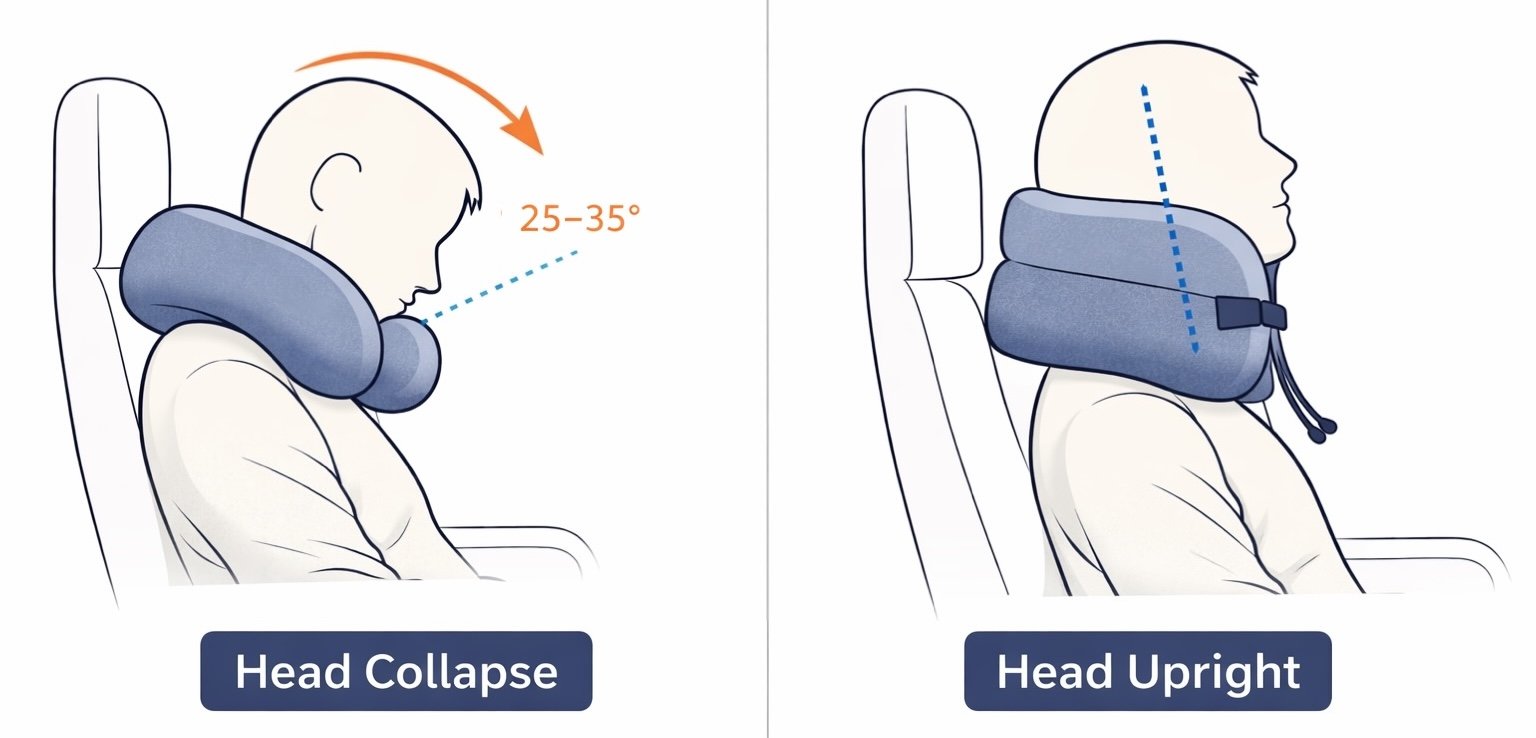
Red-eye flights expose a specific weakness in most travel pillows: progressive head drop under fatigue. Staying upright for six to eight hours is not about softness. It is about structural support that resists chin drop and lateral tilt once your neck muscles fatigue. Many pillows feel comfortable for the first 20 minutes, then gradually compress, shift, or lose alignment. The result is the familiar 3 a.m. head snap forward, the kind that wakes you up just enough to realize you’re still over the Atlantic. In this guide, we break down which travel pillow designs actually maintain vertical head position overnight, and which ones fail once real fatigue sets in. The focus here is simple: upright support over hours, not short-term comfort.
Category: Travel Pillows
Author: Product Developer (Independent, No Sponsorships)
Written by a product developer who reviews travel gear with zero sponsorships.
Clear, technical breakdowns of materials, ergonomics, and real-world use.
Table of Contents
- Why Red-Eye Flights Expose Weak Travel Pillow Design
- What “Head Upright Overnight” Actually Means
- Overnight Stability: Evaluation Criteria
- The Contenders (Quick Overview Table)
- Individual Performance Breakdown
- Which Keeps Your Head Upright the Longest on Red-Eye?
- What Most People Get Wrong About Red-Eye Comfort
- Final Verdict
- FAQ
Why Red-Eye Flights Expose Weak Travel Pillow Design
Red-eye flights create a specific stress condition that most travel pillows are not designed to handle: sustained upright fatigue. During daytime travel, people shift, adjust, and remain semi-alert. On overnight flights, muscle tone gradually drops. The neck extensors weaken, the chin begins to fall forward, and even small design flaws become obvious.
The primary failure mode is forward flexion. Once the head tilts beyond roughly 20–30 degrees, gravity increases the load on the cervical spine. According to research published in the National Library of Medicine on cervical sagittal alignment and biomechanics, forward head posture increases mechanical load on the cervical spine. A soft U-shaped pillow may feel supportive when you first sit down, but over several hours the foam compresses, shifts, or flattens. Without a structured front barrier or sufficient vertical height, the chin drifts toward the chest.
Another weakness exposed on red-eye flights is lateral instability. Cabin vibration, micro-movements during turbulence, and subtle posture shifts compound over time. If a pillow relies only on rear cushioning, the head can roll sideways once muscle fatigue sets in. Designs that do not anchor or contour around the jawline tend to collapse under sustained load.
Red-eye flights remove short-term comfort from the equation. What remains is structural performance. That is why overnight travel reveals which pillows are engineered for sustained support and which are optimized only for initial feel.
What “Head Upright Overnight” Actually Means
Keeping your head upright overnight is not about comfort in the first 15 minutes. It is about maintaining cervical alignment after muscle tone drops, gravity compounds, and the seat limits your posture. Upright support is a sustained mechanical outcome, not a temporary sensation.
Muscle Relaxation & Chin Drop
When you fall asleep, the muscles that hold your head in neutral alignment gradually relax. The cervical extensors lose tension first, allowing the head to tip forward. Even a small forward tilt increases load on the neck due to leverage. Over hours, this becomes cumulative strain.
A travel pillow that truly supports upright sleep must either block forward flexion or redistribute load across the jawline and upper chest. Soft cushioning alone is insufficient. Without a structural front barrier or adequate vertical height, the chin will descend once fatigue sets in. Upright overnight means resisting this progressive chin-to-chest flexion for several hours, not just delaying it briefly.
Seat Recline Angle Constraints
Economy seats typically recline only slightly. This limited angle forces most passengers into a semi-upright position where gravity continues to pull the head forward. Unlike a bed, there is no horizontal surface to absorb load.
Because recline is restricted, the pillow must compensate. Rear cushioning that works in a more reclined position may fail in upright seating. Effective overnight support accounts for the actual seat angle and maintains alignment within that constraint.
Micro-Movements Over 5–8 Hours
Overnight flights involve constant small disturbances: cabin vibration, subtle shifts in posture, minor turbulence, and natural adjustments during sleep. Each micro-movement tests the stability of the pillow.
If the design allows rotation, compression, or gradual displacement, alignment deteriorates incrementally. What begins as neutral posture can end in lateral tilt or forward collapse after several hours.
Head upright overnight therefore means structural stability under sustained load and repeated micro-movements. The pillow must maintain geometry, resist compression, and hold position within real seat conditions. Anything less eventually yields to gravity.
Overnight Stability: Evaluation Criteria
Overnight support is not judged by initial comfort. It is defined by whether a pillow maintains alignment after muscle tone drops and small positional shifts accumulate over several hours. To evaluate stability, I focus on four structural dimensions that directly influence long-duration performance in upright seating.
Upright Retention Over 4–8 Hours
The first criterion is whether the pillow maintains neutral head position over extended duration. Many designs feel supportive during the first phase of use, but gradually compress or deform as load remains constant. Upright retention measures how well the pillow preserves geometry under sustained weight, including foam density, structural height, and forward barrier design. Stability must be maintained not just briefly, but after several hours of continuous use. On my own overnight flights, this is usually the point where most designs quietly start losing shape, even if they felt solid at boarding.
Forward Collapse Resistance
Forward flexion is the primary overnight failure mode. As the chin drops, leverage increases strain on the cervical spine. Collapse resistance evaluates how effectively a pillow prevents this progressive movement. Designs that rely solely on rear cushioning often fail here. Structured fronts, adjustable tension systems, or contoured support surfaces tend to perform better under gravitational load. The goal is not stiffness, but controlled resistance that limits chin-to-chest drift.
Side Drift Control in Upright Seating
Lateral movement becomes more pronounced once fatigue sets in. Small micro-adjustments during sleep can cause gradual head rotation if the pillow lacks lateral containment. Side drift control measures how well the design stabilizes the head against sideways tilt. Wrap-style configurations or higher side walls typically reduce rotational displacement. Stability here prevents asymmetrical strain that develops over hours.
Long-Duration Pressure Points
Finally, stability must be balanced against sustained comfort. Excessive rigidity may prevent collapse but create concentrated pressure at the jawline, collarbone, or sides of the neck. Long-duration performance requires distributing load evenly without introducing new stress points. Materials, edge contours, and surface tension all influence this balance.
Overnight stability is therefore not a single feature. It is the combined result of structural resistance, material behavior under load, and positional control over time. Designs that succeed across all four dimensions are far more likely to maintain upright alignment throughout a red-eye flight.
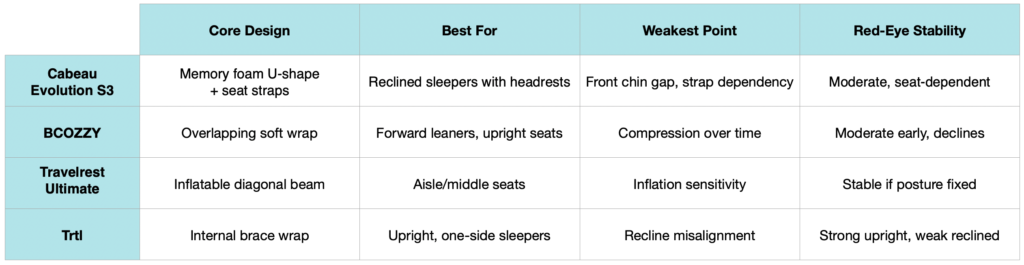
The Contenders (Quick Overview Table)
On red-eye flights, most pillows fail for the same reason: they are optimized for first-touch comfort, not sustained upright stability. Once muscle tone drops and posture drifts, geometry and material behavior matter more than softness.
The four pillows below represent fundamentally different engineering approaches to the “upright overnight” problem:
- A seat-anchored memory foam system
- A soft wrap chin-support design
- A diagonal inflatable support beam
- A rigid internal brace wrapped in fleece
Each solves a different failure mode. Each introduces its own trade-offs. The question is not which is “most comfortable,” but which maintains alignment after four to eight hours in an upright seat.
Quick Comparison
Cabeau Evolution S3
The Cabeau Evolution S3 is built around one mechanical idea: anchoring the pillow to the seat to prevent drift. The elastic headrest straps define its behavior.
When properly attached to a structured headrest, lateral stability improves noticeably. The pillow stays centered rather than sliding down the neck. This reduces side drift during early fatigue phases.
But upright overnight performance exposes two structural limitations.
First, the front tension system creates a permanent gap under the chin. That means chin drop is not truly blocked. If you sleep upright and your head falls forward, there is no dense front barrier to absorb it. The design performs better when reclined because gravity shifts rearward rather than downward.
Second, the seat-strap system is conditional. If the aircraft seat lacks a proper headrest, which also affects airline enforcement in practice, the straps slide down the seat-back. In that case, the S3 behaves like a standard U-shape.
The raised sidewalls provide cheek contact, but for shorter necks, they can press into the ears.
Overnight verdict:
Stable if reclined and properly anchored. Less reliable in upright seating where forward head drop dominates.
BCOZZY Travel Pillow
BCOZZY takes the opposite approach: no rigid structure, just a layered wrap that stacks under the chin.
Mechanically, it improves one thing very well: forward head drop. By overlapping the arms, you can build a soft barrier under the chin. For upright sleepers who lean slightly forward, this can delay collapse effectively.
But the system relies entirely on tension and soft polyester fill. Over time, that fill compresses. On longer flights, the stacked section flattens, and the wrap loosens. The support that felt solid in the first hour often requires rebuilding mid-flight.
Lateral stability is weaker. Under side pressure, the fill collapses more quickly. Side sleeping is not its strength.
Overnight verdict:
Strong early forward support in upright seats. Performance declines as material compression accumulates.
Travelrest Ultimate
The Travelrest Ultimate abandons neck wrapping entirely. It creates a diagonal inflatable beam across the torso.
Structurally, this solves a different problem: what to do in aisle and middle seats with no wall. Instead of resisting forward drop, it gives you a surface to lean into.
When inflation is correct and posture remains consistent, stability can be surprisingly good. The beam holds its shape as long as internal air pressure remains balanced.
But inflation is both strength and weakness. Slight under-inflation leads to instability. Slight over-inflation creates rigidity and pressure points. Over hours, air shifts subtly with movement.
Side switching is awkward. Because the pillow anchors cross-body or to the seat, repositioning breaks rest.
For red-eye flights, this pillow works best for travelers who remain still and lean consistently in one direction.
Overnight verdict:
Highly effective for fixed posture in aisle seats. Less forgiving for restless sleepers.
Trtl Travel Pillow
The Trtl travel pillow is not a cushion. It is an internal support brace wrapped in fleece.
Its thermoplastic rib acts as a cantilevered support. When upright, it provides strong lateral head stability without bulk. For travelers who lean to one side and remain mostly upright, it can outperform many foam designs in preventing side bobbing.
But recline exposes its limitation. Once the seat angle changes, the internal brace may no longer align with the jaw angle. Support drops as geometry shifts.
Switching sides requires fully unwrapping and re-wrapping. For red-eye sleep, that means waking up.
Comfort is also subjective. You feel the structure. After several hours, pressure awareness increases.
Overnight verdict:
Mechanically strong in upright, fixed positions. Less adaptable across posture changes.
Individual Performance Breakdown
Cabeau Evolution S3
Stability Score: 6.5 / 10
The S3 performs best when two conditions are met: the seat has a proper headrest, and the traveler reclines slightly. In that configuration, the strap system reduces lateral drift and keeps the pillow from sliding downward. Early-phase stability is decent.
Upright overnight performance is limited by the permanent front chin gap. If the sleeper tends to fall forward rather than sideways, collapse still occurs. The memory foam initially resists compression, but over several hours, softening reduces structural height.
Where It Fails First:
Forward collapse in upright seating.
If the seat angle is not reclined, the lack of true chin support becomes obvious.
BCOZZY Travel Pillow
Stability Score: 6 / 10 (early), 5 / 10 (after 3–4 hours)
BCOZZY addresses forward head drop better than most soft pillows. When tightly wrapped, the stacked front section creates a noticeable lift beneath the chin. For upright sleepers who lean slightly forward, it works surprisingly well in the first phase.
The problem is material behavior over time. The soft polyester fill compresses. The wrap loosens. Support gradually degrades. Overnight flights expose this progressive flattening.
Side stability is limited because there is no internal structure. Lateral pressure collapses the fill quickly.
Where It Fails First:
Material compression under sustained load.
Support declines gradually rather than suddenly.
Travelrest Ultimate
Stability Score: 6 / 10 (conditional)
When inflation level is correct and posture remains steady, the diagonal beam design can maintain alignment effectively. It provides a surface to lean into, especially valuable in aisle or middle seats.
But the stability is posture-dependent. Even small movements change the pressure distribution inside the air chamber. Over long durations, inflation drift and micro-adjustments alter support geometry.
Because it anchors to one side, switching directions requires detaching and re-anchoring. For restless sleepers, this reduces practical stability.
Where It Fails First:
Postural shifts.
The support zone moves as soon as body position changes.
Trtl Travel Pillow
Stability Score: 7 / 10 (upright only)
The Trtl provides strong lateral stability in upright seating. The internal brace acts as a rigid stop against side bobbing. For one-side leaners who remain mostly still, it delivers consistent resistance against drift.
However, it is angle-sensitive. Once the seat reclines or posture changes, the internal rib may no longer align properly with the jaw. Support weakens when geometry shifts.
It also supports only one side at a time. Switching sides requires full repositioning.
Where It Fails First:
Recline misalignment.
The brace loses mechanical advantage when seat angle changes.
Which Keeps Your Head Upright the Longest on a Red-Eye?
If the metric is sustained upright alignment over several hours, not first-touch comfort, the answer depends heavily on posture.
In strictly upright seating, where forward collapse and side bobbing are the main threats, the Trtl maintains structural resistance the longest. Its internal brace does not rely on soft fill or inflation. As long as seat angle remains stable and the sleeper stays on one side, the mechanical support holds.
However, once recline increases or posture shifts, that advantage drops quickly.
For travelers who recline and remain relatively still, the Cabeau Evolution S3 can maintain lateral stability longer than the others, provided the seat-strap system is properly anchored. Its weakness is forward chin support in upright positions.
The BCOZZY performs well early but loses height as the material compresses. Over multi-hour red-eye flights, progressive flattening reduces its ability to prevent progressive chin descent.
The Travelrest Ultimate can outperform all of them in aisle or middle seats if posture remains fixed and inflation is dialed correctly. But its stability is highly sensitive to movement.
So which keeps your head upright the longest in a typical economy red-eye, assuming a standard economy seat and no miracle upgrade to business class?
For upright, one-direction sleepers: Trtl.
For reclined, headrest-equipped seats: Cabeau S3.
For restless sleepers: none are truly dominant.
Overnight stability is conditional. Geometry and posture decide the winner.
What Most People Get Wrong About Red-Eye Comfort
Most travelers focus on softness. From a design perspective, that’s usually the wrong variable.
They squeeze a pillow in a store or press it with their hands and assume that more plush equals better sleep. On a red-eye flight, that logic fails quickly. Comfort in the first ten minutes is not the same as structural support after four hours.
The real issue is not cushioning. It is load management.
When muscle tone drops overnight, gravity increases the forward pull on the head. A pillow that feels soft and cozy at boarding can gradually compress, shift, or flatten under sustained weight. Once alignment breaks, no amount of surface softness fixes it.
Another common mistake is ignoring seat geometry. Economy seats do not recline enough to simulate a bed. Most red-eye sleep happens in a semi-upright position. Pillows that depend on deep recline or window contact often underperform in aisle and middle seats.
Finally, many people underestimate duration. A pillow that works for a one-hour nap may not maintain shape for six.
Red-eye comfort is not about initial feel. It is about resisting gravity longer than your neck muscles can.
Final Verdict
There is no universal “best” travel pillow for red-eye flights. I wish there were. There is only the design that fails last under your specific posture.
If you sleep mostly upright and lean consistently to one side, the Trtl maintains lateral stability longer than soft foam designs. It is structured, predictable, and compact. Its limitation is adaptability once seat angle changes.
If you recline and have a proper headrest to anchor to, the Cabeau Evolution S3 offers the most stable centered support. But it does not fully prevent progressive chin descent in upright positions.
If forward collapse is your primary issue and you stay relatively still, the BCOZZY provides strong early chin lift, though material compression reduces performance over time.
If you are stuck in an aisle or middle seat and can hold a steady lean, the Travelrest Ultimate can outperform traditional neck pillows. Its stability depends heavily on posture and inflation accuracy.
Red-eye comfort is not about plushness. It is about geometry under fatigue. The pillow that keeps your head upright the longest is the one aligned with how you actually sleep.
For a broader breakdown across seat types and flight durations, see the full travel pillow comparison guide.
FAQ
What is the best travel pillow for a red-eye flight?
It depends on how you sleep. For upright, one-side leaners, structured designs like the Trtl maintain lateral stability longest. For reclined seats with headrests, the Cabeau Evolution S3 offers centered support. Soft wrap designs like BCOZZY help with forward head slump early but lose structure over time. There is no universal best, only the design that matches your posture.
Do travel pillows actually prevent head bobbing on overnight flights?
Some do, but only under specific conditions. Pillows with internal structure or firm lateral walls resist side bobbing better than soft fiber-filled designs. However, once muscle tone drops during deep sleep, forward flexion becomes the dominant failure mode. Many pillows delay head bobbing but do not eliminate it entirely.
Why do most travel pillows fail on red-eye flights?
They are optimized for short-term comfort rather than long-duration load. Over several hours, foam softens, fiber fill compresses, or inflation shifts – a pattern I break down in detail in why most travel pillows fail on long flights. Seat recline limitations also expose structural gaps, especially under the chin. Red-eye flights reveal weaknesses that are not obvious during short naps.
Are inflatable travel pillows good for overnight flights?
Inflatable pillows can provide strong support when properly inflated and used in a fixed posture. However, they are sensitive to movement. Small posture shifts change pressure distribution, which alters stability. They work best for aisle or middle-seat travelers who remain relatively still.
Is chin support more important than side support on red-eye flights?
Forward chin support becomes more important in upright seating. When the head drops forward, strain increases rapidly. Side support matters for lateral stability, but chin-to-chest flexion is typically the first failure point during overnight flights.
Does seat recline change how a travel pillow performs?
Yes. Slight recline reduces forward gravitational pull and improves performance for many U-shaped designs. Fully upright seating exposes front gaps and structural weaknesses more quickly. Pillow effectiveness is highly dependent on seat angle.