


Sleeping on a plane sounds simple until you actually try it. You lean back, close your eyes, and a few minutes later your head drops forward or tilts sideways. That’s the moment most travelers wake up again. The problem isn’t just the pillow or the seat. It’s how airplane seats are designed. They’re built for sitting upright, not for keeping your head stable while you sleep. Once your neck muscles relax, gravity slowly takes over. Understanding how to sleep on a plane starts with understanding that mechanical problem. When you look at seat geometry, head support, and common sleeping positions, it becomes much clearer why most people struggle to get real rest during a flight.t
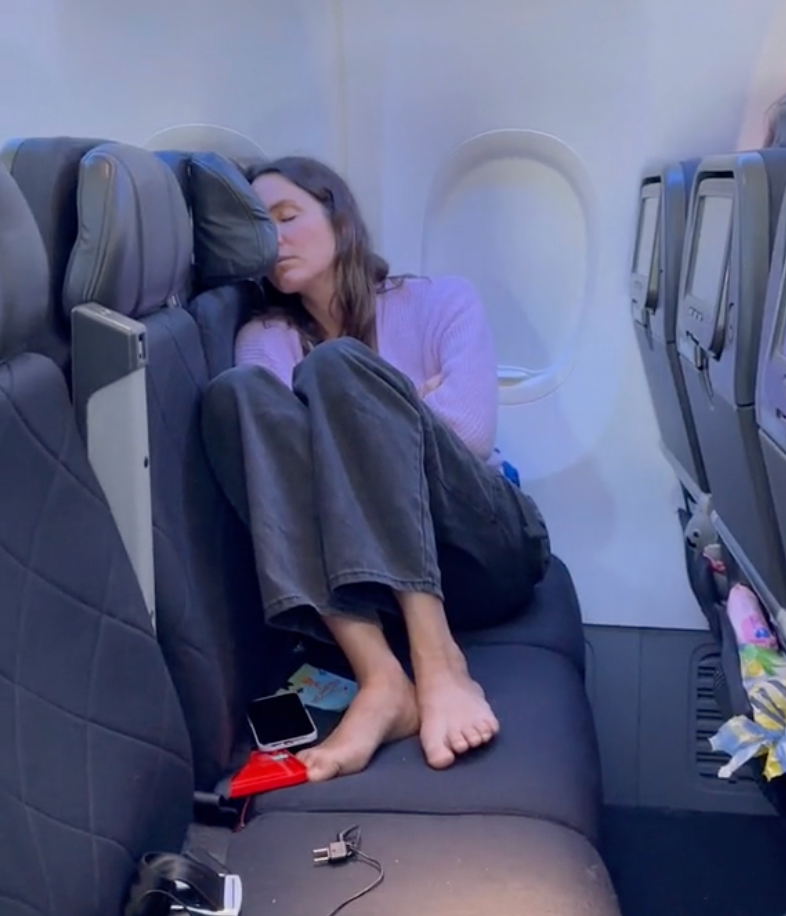
Screenshot from TikTok video by Matthew David Johnson (@matthewdavidjohnson): https://www.tiktok.com/@matthewdavidjohnson/video/7251525417922743553
Category: Travel Pillows
Author: Product Developer (Independent, No Sponsorships)
Written by a product developer who reviews travel gear with zero sponsorships.
Clear, technical breakdowns of materials, ergonomics, and real-world use.
Table of Contents
- Why Sleeping on Planes Is So Difficult
- The Hidden Problem: Airplane Seat Geometry
- Why Most Travel Pillows Fail
- The Three Ways People Actually Sleep on Planes
- Why Tall Travelers Struggle Even More
- When Travel Pillows Actually Help
- What Actually Keeps Your Head Stable on a Flight
- Final Verdict. Sleeping on a Plane Is a Stability Problem
- FAQ
Why Sleeping on Planes Is So Difficult
Why Are Airplane Seats Designed for Sitting, Not Sleeping?
Airplane seats are built for safety, space efficiency, and keeping hundreds of passengers upright during turbulence. Sleeping comfortably is not really part of the design brief. The seat back stays relatively vertical, the cushion is narrow, and the headrest sits at a fixed height meant for normal sitting posture.
That setup works perfectly well when you are reading, watching a movie, or scrolling through your phone. But the moment you try to sleep, the limitations become obvious. Your body naturally wants to recline and stabilize, yet the seat only tilts slightly and offers very little side support.
In other words, the seat keeps you in a position that works perfectly for sitting… and strangely badly for sleeping.
This mismatch between how the seat is built and how the body actually sleeps is the starting point of most sleep problems on flights.
Why Does Your Head Start Falling Forward or Sideways on a Plane?
The moment you begin to fall asleep, your head loses its active support. When you are awake, those muscles quietly hold your head upright without you even noticing. Once they relax, gravity takes over.
In a bed, the pillow and mattress catch that movement. In an airplane seat, there is usually nothing stopping it. The head slowly drops forward toward the chest or drifts sideways toward the shoulder. A few minutes later the position becomes uncomfortable, and your brain wakes you up again.
Anyone who has tried sleeping on a plane knows this moment. You close your eyes, drift off for a minute… and suddenly your head drops forward like it just remembered gravity exists.
Why Do Most People Wake Up Every 20–30 Minutes on Flights?
Because the head keeps moving.
Each time the neck relaxes and the head shifts, your body notices the instability. Even if the movement is small, it is enough to trigger a brief wake-up response. You adjust your posture, settle back in, and try again.
Then it happens again.
That repeating cycle is why airplane sleep often feels fragmented. You might technically fall asleep several times during a flight, but each stretch usually lasts only a short while before posture, gravity, and seat design interrupt the process again.
The Hidden Problem: Airplane Seat Geometry
How Does Seat Recline Angle Affect Your Neck While Sleeping?
Airplane seats recline only slightly, usually by a few degrees. That small tilt feels comfortable when you’re awake, but it creates a subtle problem once you try to sleep. Your upper body leans back just enough to relax, yet not enough to properly support the head.
In a bed, the head and torso lie on the same surface. The pillow catches the weight of the head as soon as the neck muscles relax. On a plane, that support simply isn’t there. The seat tilts backward a little, but your head is basically left hanging in space.
The result is a quiet tug-of-war between gravity and your neck muscles. As soon as those muscles start relaxing, the head begins to drift forward. A few minutes later your body corrects the position again without you even noticing.
If you’ve ever nodded off on a plane and suddenly jerked awake because your head dropped forward, you’ve already experienced this little design problem.
Why Does Headrest Height Matter for Neck Alignment?
Airplane headrests are built around the “average” passenger height. In theory, they should support the lower part of the head and upper neck while you sit upright.
In reality, the alignment is often slightly off. For some passengers the headrest lands closer to the upper shoulders. For others it presses against the back of the head but leaves the neck unsupported.
When you’re awake, you constantly make tiny posture adjustments that compensate for this. Once you start falling asleep, those adjustments stop. The neck relaxes, the head drifts, and suddenly the support that looked fine a few minutes ago no longer works.
That’s why many travelers wake up with their head tilted at a strange angle against the seat, wondering how they ended up there.
Why Do Narrow Airplane Seats Make Head Stability Worse?
Seat width plays a role too. Modern economy seats are relatively narrow, which limits how much the body can shift to stabilize itself.
When people sleep in beds or on couches, they naturally roll slightly to one side. That small rotation helps distribute body weight and gives the head something stable to lean against. Airplane seats don’t really allow that movement.
So passengers improvise. They lean toward the window, curl slightly into the seat, or tuck their chin toward their chest. It may look awkward from the aisle, but it’s the body trying to solve a stability problem inside a space that was designed primarily for sitting, not sleeping.
And once you notice it, you’ll see it on almost every overnight flight.
Why Most Travel Pillows Fail
Why Doesn’t Soft Foam Automatically Mean Better Support?
Most travel pillows focus on softness. When you first put one on, the foam feels comfortable and cushioned, which makes it seem like it should help you sleep.
But cushioning and real structural support are very different things.
Soft foam compresses under the weight of your head. At first the pillow feels cozy, but after a few minutes the material starts flattening and shifting. Once that happens, the pillow stops stabilizing the head and simply becomes another soft surface around the neck.
In a bed, that might still work because the mattress supports the rest of your body. On an airplane seat, the pillow is often the only structure keeping your head from drifting.
That’s why many travel pillows feel promising when you sit down, but noticeably less helpful an hour into the flight.
Why Does the Head Still Fall Forward During Sleep?
The most common sleep problem on planes is the forward head drop. As your body drifts deeper into sleep, the head slowly begins to tilt toward the chest.
A pillow can only prevent that if it provides some kind of forward resistance. Most traditional neck pillows don’t. They wrap around the back and sides of the neck but leave the front relatively open.
So when the head tilts forward, nothing really stops it.
Anyone who has used a travel pillow has probably experienced this moment. You drift off for a minute, then suddenly your chin hits your chest and you wake up again. It feels like the pillow failed, but in reality the design never addressed that movement in the first place.
Why Don’t U-Shaped Pillows Stop Sideways Head Drift?
U-shaped pillows are the classic travel pillow design, but they depend heavily on the passenger staying centered in the seat.
Sleep doesn’t usually work that way.
As soon as the body relaxes, the head naturally begins leaning to one side. If the pillow compresses or shifts slightly, the side support disappears and the head keeps moving.
At that point the pillow isn’t really stabilizing anything. It’s just moving along with the head.
That’s why many travelers wake up with the pillow twisted around their neck or pushed out of position. The pillow didn’t hold the head still. The head simply kept drifting until something else; the seat, the window, or sometimes the shoulder; finally stopped it.
The Three Ways People Actually Sleep on Planes
Why Do Some Passengers Sleep Leaning Forward on the Tray Table?
One of the most common airplane sleep positions is the forward lean. You’ll see it on almost every overnight flight: the tray table comes down, a jacket or pillow gets placed on top, and the passenger folds forward to rest their head.
At first glance it looks uncomfortable, but mechanically it solves a key problem. The head finally has something stable to rest on. Instead of fighting gravity, the body simply leans into it.
The downside is obvious after a while. The tray table is small, the angle is awkward, and unless you have something soft underneath your head, the surface becomes hard pretty quickly. When people wake up, there’s often that familiar moment of slowly straightening the neck again.
Still, plenty of travelers use this method because it solves the biggest problem of airplane sleep: giving the head somewhere stable to go.
Why Do Window Seats Make Side Sleeping Easier?
Passengers in window seats quietly gain one advantage the rest of the cabin doesn’t have. The aircraft wall becomes a support point. Travelers who sleep this way often do better with travel pillows for side sleepers on planes, which we explain in more detail in our guide.
Instead of trying to keep the head perfectly upright, the body leans slightly toward the window. A pillow, hoodie, or folded jacket can fill the gap between the head and the cabin wall. Suddenly the head has somewhere to rest.
It’s not elegant, but it works surprisingly well. Anyone who has flown overnight has probably noticed the same pattern: the window seat passenger sleeping reasonably peacefully, while the middle and aisle seats keep adjusting positions every few minutes.
The seat itself didn’t change. The passenger simply gained a second surface to lean on.
How Do Some Travelers Manage to Sleep Upright?
The third group tries to stay upright and stabilize the head instead of leaning somewhere.
This is where travel pillows come in. The idea is to limit how far the head can move once the neck muscles relax. Some designs try to block the chin from dropping forward, while others brace the head from the sides.
When it works, the passenger can remain relatively upright while sleeping. But the margin for error is small. If the pillow compresses or shifts even a little, the head starts drifting again.
That’s why upright sleeping tends to work best with designs that provide real structural support, not just soft cushioning around the neck.
Why Tall Travelers Struggle Even More
What Happens When Your Head Sits Above the Airplane Headrest?
Airplane seats are designed around an “average” passenger height. For many tall travelers, that means the headrest no longer lines up with the part of the body it’s supposed to support.
Instead of sitting behind the neck and lower head, the headrest ends up somewhere around the upper back or shoulders. The head itself sits above the support zone.
Once you notice this on flights, you start seeing it everywhere. Taller passengers constantly shift position, trying to find a spot where the head actually has something behind it.
When sleep finally starts and the neck muscles relax, the issue becomes obvious. Without proper support behind the head, gravity just takes over and the head slowly drops forward.
At that point the seat isn’t helping much anymore.
Why Does Neck Angle Change for Tall Passengers?
Height changes the geometry of the whole seating position.
Because the head sits higher than the seat designers intended, the neck often begins slightly angled forward even before sleep starts. It might be subtle at first, but once the muscles relax that small angle becomes the starting point for the familiar forward head drop.
That’s why many tall passengers struggle with upright sleeping positions. The seat simply wasn’t built around their proportions.
It also explains why certain travel pillow designs behave differently for taller travelers. Pillows that depend on the seat’s headrest alignment can work reasonably well for average-height passengers but become much less effective when the head sits above that support point.
For a deeper look at this problem, see our full guide to travel pillows for tall people and seat alignment issues.
When Travel Pillows Actually Help
At this point it might sound like travel pillows are mostly useless. That’s not really the case. The real issue is that many pillows try to solve the wrong movement. We explain the design problems behind this in more detail in our breakdown of why most travel pillows fail on planes.
Sleeping on a plane is mainly a stability problem. Once the neck muscles relax, the head starts moving — forward, sideways, or sometimes both. A pillow only helps if its design actually limits that movement.
Some designs try to brace the head from the side. Others attempt to stop the chin from dropping forward. A few rely on the airplane seat itself to create an anchor point that keeps the head from drifting.
The difference between these approaches becomes obvious once you’re actually sitting in an airplane seat. Certain pillows suddenly make sense, while others that felt comfortable in the airport or at home stop working once real sleep begins.
Understanding these design strategies helps explain why some pillows perform noticeably better during flights than others. The following examples show the main ways travel pillows attempt to stabilize the head.
Brace-Style Support (Trtl)
Brace-style designs approach the problem differently from traditional travel pillows. Instead of cushioning the head from all sides, they try to create a firm stopping point that prevents the head from drifting too far.
The Trtl travel pillow is a good example of this idea. Rather than acting like a soft pillow, it behaves more like a lightweight neck brace hidden inside a fabric wrap. An internal support frame sits against the jaw and cheek, creating a rigid surface the head can lean on.
Mechanically, this solves one of the biggest challenges of airplane sleep: sideways head drift. Once the head begins to tilt, the brace stops the movement before it turns into that familiar slow slide toward your shoulder.
The catch is that this design works only on one side. In practice, you usually have to decide which direction you want to lean before falling asleep. If you want to switch sides later, it often means unwrapping and repositioning the whole thing — which is not ideal in a cramped airplane seat.
Brace-style pillows also depend heavily on seat position. They tend to work best when the seat stays relatively upright. Once the seat reclines, the angle between the jaw and the brace changes, and the support becomes less predictable.
Even with those limitations, the design illustrates an important principle: stability on a plane often comes from structure, not softness.
Chin Support Designs (J-Pillow)
Chin-support designs focus on a different problem than brace-style pillows. Instead of stopping the head from drifting sideways, they try to prevent the forward head drop that wakes so many passengers up during flights.
The J-Pillow travel pillow tackles this by extending a padded arm under the chin while the curved upper section supports the side of the head. When the head begins to tilt forward during sleep, the chin meets that support instead of continuing toward the chest. In simple terms, the pillow gives the head somewhere to stop before gravity takes over. Together these contact points create a small three-point support system between the chin, jaw, and side of the head.
Once you see this design in use, the idea makes sense pretty quickly. The pillow isn’t trying to cushion the entire neck. It’s trying to block one very specific movement.
When the pillow lines up with the sleeper’s position, this targeted support can reduce the small corrections the neck muscles normally make during sleep. When the chin has a stable resting point, the body doesn’t need to constantly correct the head position.
Of course, the design isn’t perfect for every sleeping style. The pillow works best when the passenger leans consistently in one direction, usually toward a window or seat wall that provides a stable surface. Without that external support, the pillow relies mostly on cushioning rather than structural resistance.
Still, chin-support pillows highlight an important design lesson: sometimes improving sleep on a plane isn’t about adding more cushioning. It’s about stopping the one movement that keeps waking you up.
Seat-Dependent Stabilization (Cabeau Evolution S3)
Some travel pillows try to solve the stability problem by connecting the pillow directly to the airplane seat.
The Cabeau Evolution S3 travel pillow is built around that idea. Instead of relying only on cushioning around the neck, it uses elastic straps that attach to the seat’s headrest. Once secured, the pillow becomes partially anchored to the seat’s headrest, which helps prevent the pillow from sliding downward behind the neck. If you’re curious about airline rules around those, see our guide on seat-strap travel pillows and FAA rules.
The concept is simple: if the pillow can’t slide downward behind your neck, the head stays better centered during sleep.
In practice, this can work surprisingly well — especially for passengers who remain fairly upright during the flight. With the pillow held in position by the seat, the slow downward drift that usually happens during sleep becomes much less likely.
But the design depends heavily on the seat geometry. If the headrest sits in the right position behind the neck, the stabilization works nicely. If the seat reclines or the passenger sits higher than the headrest; something taller travelers run into often; the alignment changes and the straps lose part of their advantage.
So seat-anchored pillows can feel impressively stable when everything lines up. When the seat angle changes or the headrest sits too low, the whole system becomes less predictable.
It’s a clever idea, but one that works best when the airplane seat geometry and headrest position actually cooperate.
Lean Support Pillows (Travelrest)
Lean-support pillows take a different approach to the airplane sleep problem. Instead of trying to hold your head perfectly upright, they give it somewhere stable to lean.
The Travelrest Ultimate travel pillow is built around that idea. It runs diagonally across the body and creates a long support surface between your shoulder and head. When you lean into it, your upper body and head move together instead of drifting separately.
At first the design can look a little unusual, but once you see it in use the logic becomes clearer. People naturally lean slightly when they start falling asleep in a seat. The pillow simply extends that support surface so the head has something consistent to rest against.
Like most airplane sleep solutions, though, the effectiveness depends on the seating situation. Lean-support pillows usually work best when the passenger can maintain a fairly steady leaning position and consistent shoulder angle. If the body shifts frequently or the space around the seat is tight, the support angle can change and the stability drops.
Still, the design highlights an important idea. Sometimes the easiest way to stabilize your head on a plane is not forcing it to stay upright, but giving it a comfortable direction to lean.
What Actually Keeps Your Head Stable on a Flight
Once you start looking at airplane sleep from a mechanical point of view, the real problem becomes pretty obvious. The head is relatively heavy, the neck muscles eventually relax, and your head naturally begins drifting in one direction. When nothing interrupts that movement, the head slowly begins drifting forward or sideways.
While you’re awake, your body quietly keeps the head balanced without you noticing. Your body makes tiny adjustments that keep the head balanced over the spine. The moment sleep begins, those corrections fade away. The muscles relax, and gravity gradually wins the argument.
That’s why sleeping in a normal airplane seat often feels unstable. The seat supports your back, but it usually doesn’t provide enough contact points to stabilize the head.
Once you notice this on flights, you start seeing the same pattern everywhere. People lean toward the window, rest against the tray table, or wedge their head into the corner of the seat. All of these are attempts to give the head somewhere solid to rest.
Because real stability happens only when the head meets something that stops the movement early. Sometimes that support comes from the seat itself. Other times a travel pillow provides the barrier by bracing the chin, supporting the side of the head, or anchoring to the seat.
Once the head has somewhere reliable to rest, the body finally stops correcting the position every few minutes. The neck muscles can relax, and sleep becomes possible.
In the end, the goal isn’t softness or extra cushioning. It’s simply giving the head a stable place to go once gravity starts doing its work.
Final Verdict. Sleeping on a Plane Is a Stability Problem
After looking at how airplane seats and sleep positions actually work, the pattern becomes pretty clear. Sleeping on a plane isn’t mainly about comfort. It’s about stability.
The moment your neck muscles relax, the head slowly begins drifting forward or sideways. If nothing interrupts that movement, you wake up again a few minutes later. That familiar cycle — drift, wake up, adjust position, try again — is something almost every traveler has experienced.
This is why extra cushioning alone rarely solves the problem. A pillow can feel wonderfully comfortable when you first sit down, but if it doesn’t actually stabilize the head, the same drifting motion eventually returns.
The designs that work best usually focus on controlling that movement. Some brace the head from the side. Others stop the chin from dropping forward. A few even use the airplane seat itself as part of the support system.
Once you start looking at airplane sleep this way, many pillow designs suddenly make more sense.
In the end, the goal isn’t finding the softest pillow. It’s simply finding a way to stop the head from wandering once sleep begins.
FAQ
Can You Really Sleep on a Plane?
Yes, although it rarely feels like normal sleep. Airplane seats simply weren’t designed with sleeping in mind. The seat angle, limited space, and constant background noise all make deep sleep difficult.
Most travelers don’t sleep for hours at a time. Instead, they drift in and out of short sleep cycles. You close your eyes, relax for a while, wake up, adjust your position, and try again.
If the head finds a stable place to rest, those short stretches can still make a long flight feel much more manageable.
What Position Is Best for Sleeping on Flights?
The best position is usually the one that gives your head something stable to lean on. For some travelers that means resting against the window. Others lean forward onto the tray table or use a pillow to stabilize the head while sitting upright.
Once you start paying attention on flights, you’ll notice people improvising all kinds of variations of these positions.
The exact posture matters less than one simple rule: when your neck relaxes, something needs to stop the head from drifting too far.
Do Travel Pillows Actually Help on Long Flights?
They can, but only if the design controls the movement that wakes you up.
Some pillows brace the head from the side. Others try to stop the chin from dropping forward. A few even anchor to the airplane seat itself.
If a pillow only adds softness without limiting head movement, it may feel comfortable at first but becomes much less useful once real sleep begins.
Why Does My Head Keep Falling Forward on Planes?
Because your neck muscles relax when you start falling asleep. While you’re awake, those muscles quietly keep your head balanced.
Once sleep begins, gravity slowly pulls the head forward toward the chest. Without some kind of support, the movement continues until the position becomes uncomfortable enough to wake you up again.
Is the Window Seat Better for Sleeping?
For many travelers, yes. The aircraft wall creates an extra support surface that the aisle and middle seats don’t have.
Leaning slightly toward the window allows the head to rest against something stable. It’s not perfect, but on overnight flights you’ll often see window-seat passengers sleeping more comfortably than the rest of the row.
Once you notice it, it’s hard to unsee.