


Airplane seat neck pain is something many travelers notice once a flight settles into cruising altitude. After an hour or two, the discomfort slowly creeps in. Your shoulders feel stiff, your head keeps shifting position, and your neck starts to ache in that familiar way people complain about after long flights.
Most people blame it on “sleeping wrong.” But the bigger reason is usually the seat itself.
Airplane seats are designed for sitting upright, not for keeping your head stable for hours at a time. Once you look at the way seat angles, headrests, and limited shoulder space interact, the neck pain many passengers experience on flights starts to make a lot more sense.
Why airplane seats cause neck pain on flights
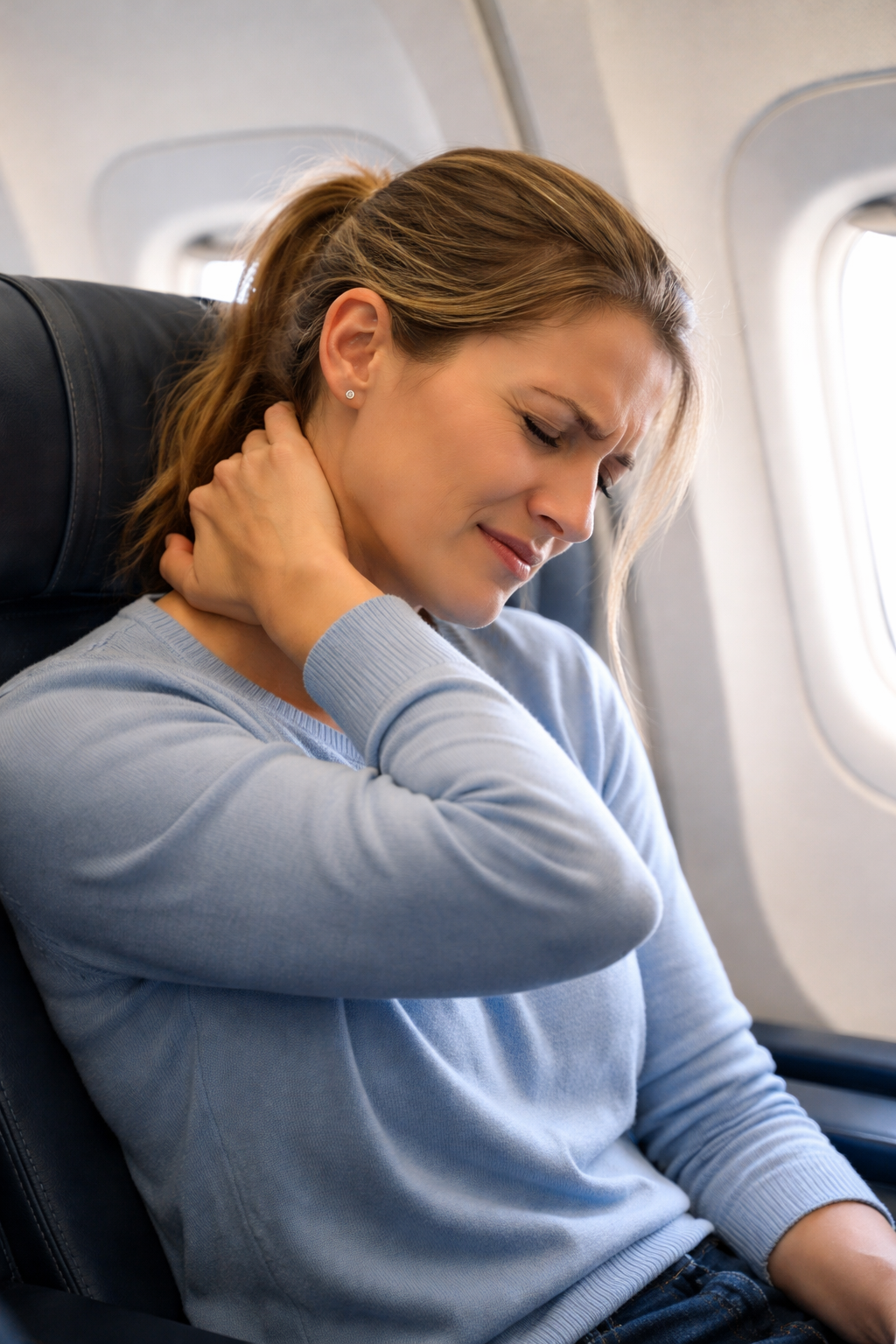
Airplane seats cause neck pain mainly because they push the head slightly forward and provide little support during long periods of sitting. When the head moves in front of the shoulders, the neck muscles must constantly hold its weight. Over time this steady tension leads to stiffness and soreness, especially on long flights.
Category: Travel Pillows
Author: Product Developer (Independent, No Sponsorships)
Written by a product developer who reviews travel gear with zero sponsorships.
Clear, technical breakdowns of materials, ergonomics, and real-world use.
Table of Contents
- Why Airplane Seats Gradually Cause Neck Pain
- Why Airplane Seats Push Your Head Forward
- The Real Problem: Airplane Seat Geometry
- Why Neck Pain Gets Worse When You Try to Sleep
- Why Most Travel Pillows Don’t Fix the Problem
- Why Some Travelers Feel More Neck Pain Than Others
- What Actually Helps Reduce Airplane Seat Neck Pain
- Final Takeaway / Neck Pain on Flights Is a Design Problem
Why Airplane Seats Gradually Cause Neck Pain
Neck pain on flights often shows up even when you haven’t slept at all. You’re just sitting there, maybe watching a movie or scrolling through something on your phone, and after a while your neck starts to feel strangely tired. You shift a little. Roll your shoulders. Sit up straighter. For a few minutes it helps. Then the discomfort quietly creeps back.
Most travelers assume it’s because they slept in a bad position.
But the bigger reason is usually the seat itself.
Airplane seats are designed for sitting upright, not for keeping your head comfortably supported for hours. In normal life your body constantly adjusts your posture without you noticing. Your shoulders move, your head tilts slightly, and your neck muscles get small breaks.
On a plane, that freedom disappears.
The seat back holds you in one position, the space around your shoulders is limited, and your head has very few stable places to rest. Over time your neck muscles end up doing quiet work just to keep your head balanced.
Three design factors usually drive this problem:
- the seat and headrest subtly pushing the head forward
- the angle created when the seat reclines
- the lack of stable support that keeps the head from drifting
Once you notice these pieces, airplane neck pain stops feeling like bad luck. It starts looking like a predictable side effect of how airplane seats are built.
Why Airplane Seats Push Your Head Forward
Why do airplane headrests push your head forward?
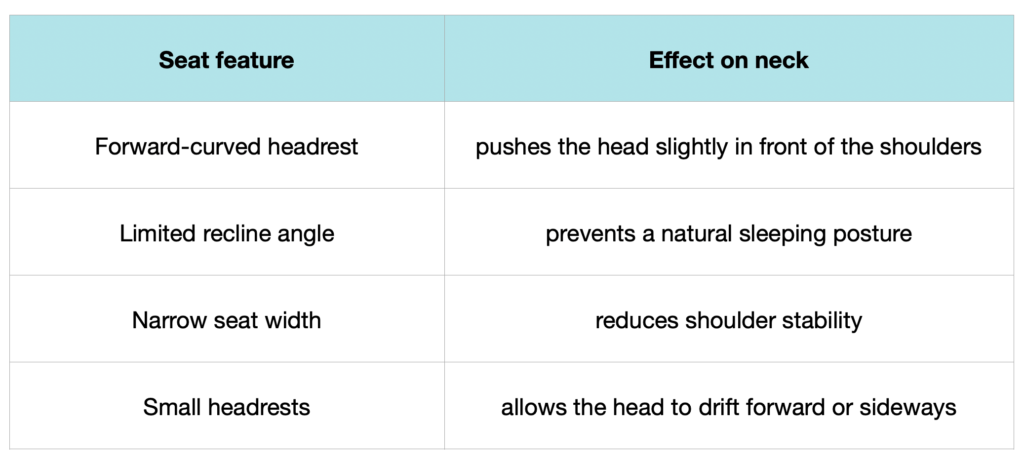
If you pay attention to how most airplane seats are shaped, the headrest rarely sits flat behind your upper back. It usually curves slightly forward. The idea is simple: keep passengers from falling backward and help stabilize the head when the seat is upright.
But that small curve changes where your head naturally sits.
Instead of resting comfortably above your shoulders, your head ends up a little farther forward. Not by much. Just enough that your posture stops feeling completely relaxed.
At first you barely notice it. The position feels normal for a few minutes. Then you shift your head slightly. Then again. Somewhere during the flight you realize you’ve been adjusting your neck over and over, trying to find a position that feels neutral again.
Most people assume they’re just sitting awkwardly. In reality, the seat is quietly nudging your head forward the whole time.
Why does this strain the neck muscles?
Your head isn’t light. It weighs roughly as much as a bowling ball. When it sits directly above the spine, your neck muscles don’t have to do much work. The skeleton carries most of the load.
But move the head forward even a little, and the physics change.
Now the neck muscles have to hold that weight in place. Not for a moment, but for the entire flight. They contract just enough to keep the head from slowly dropping farther forward.
The strange part is that you barely notice the effort while it’s happening.
It feels subtle at first, but after an hour your neck is doing quiet work the whole time.
A few hours later that quiet work starts to turn into stiffness, then soreness. By the time the plane begins its descent, many passengers are already rubbing the back of their neck without really knowing why.
The Real Problem: Airplane Seat Geometry
A lot of people assume neck pain on flights comes from sleeping in a strange position. But in many cases the problem starts earlier than that. You can be wide awake, sitting upright, and your neck still begins to feel tired halfway through the flight.
The real issue is the geometry of the seat itself.
Airplane seats are designed to keep passengers upright and contained in a small space. They’re not designed to support the way the body naturally relaxes over several hours. That mismatch becomes very noticeable somewhere between hour two and hour four of a flight.
Why seat recline changes neck pressure
Reclining the seat feels like it should help. And for a moment it does.
But when the seat tilts backward, your head doesn’t magically settle into a perfect resting position. Gravity still pulls it forward. The result is a small shift where your head ends up slightly in front of your spine again.
Your neck muscles quietly take over from there.
They contract just enough to keep your head balanced while the rest of your body leans back. You might not notice the effort immediately, but your neck certainly does. After an hour or two, it starts sending reminders.
Why the seat-back angle doesn’t match natural sleep posture
The other problem is the angle itself. Airplane seats never recline far enough to match a natural resting position.
In real sleep positions, the body is either lying down or leaning back far enough that the head can fully relax. On a plane you’re stuck somewhere in between. Too upright to sleep comfortably, but too reclined to sit naturally.
Your head ends up drifting, searching for something stable that usually isn’t there.
Why economy seats make stability worse
Economy cabins add another layer to the problem.
Seats are narrow, shoulder space is limited, and the headrests are relatively small. Your upper body has fewer ways to stabilize itself. Your shoulders can’t spread naturally, and your head often rests against a surface that supports only part of it.
So your neck ends up doing the job that the seat never quite finishes.
By the time the plane begins its descent, many passengers are already rubbing the back of their neck, wondering how sitting still managed to make their muscles so tired.
Several small design choices in airplane seats combine to create this neck strain:
Why Neck Pain Gets Worse When You Try to Sleep
Trying to sleep on a plane should make your neck feel better. Instead, it often makes the problem worse.
Most travelers know the pattern. You finally get comfortable enough to close your eyes. A few minutes later your head suddenly drops forward or tilts sideways, and you wake up again to fix your posture. Then it happens again. And again.
That cycle isn’t random. It’s what happens when your neck muscles finally try to relax.
What happens when your neck muscles relax during sleep?
When you’re awake, the muscles in your neck are quietly holding your head in place the entire time. You don’t notice it because the effort is small and constant.
But once you start falling asleep, those muscles loosen. Your body assumes it’s safe to relax because normally your head would be resting on something stable like a pillow or mattress.
On an airplane seat, that support usually doesn’t exist.
So the moment those muscles relax, gravity steps in.
Why the head begins to fall forward or sideways
Your head weighs several kilograms. If nothing holds it in place, it slowly begins to drift. Most often it falls forward toward your chest, but sideways collapse is just as common.
That’s the moment that wakes many people up.
Your neck muscles suddenly tighten again to catch the weight of your head before it drops too far. It feels like a small jerk or a quick snap back into position. After that you shift around, try another angle, and hope this one works better.
For a few minutes it does.
Then the whole thing repeats.
Why stabilization matters
This constant cycle; relax, drop, correct; is what slowly turns mild discomfort into real neck pain on long flights.
Your neck muscles never get a chance to fully rest. They keep switching between relaxing and suddenly catching the weight of your head.
That’s also why some travel pillows help while others barely change anything. The designs that actually work don’t just feel soft. They stabilize the head enough to stop that repeated falling motion. Once that motion stops, the neck muscles finally get the break they were hoping for.
Why Most Travel Pillows Don’t Fix the Problem
When neck pain starts creeping in during a flight, most travelers reach for the obvious solution: a travel pillow. It seems logical. Support the neck, solve the problem.
Sometimes it helps a little. But very often the discomfort returns anyway.
The reason is simple: most travel pillows are designed around comfort, not stability.
Soft foam feels nice when you first put it on. Your neck sinks slightly into the cushion and the seat suddenly feels less harsh. For a moment it seems like the problem is solved.
Then your muscles relax, your head drifts a little, and the pillow quietly compresses with it.
Instead of stopping the movement, it simply follows along.
That’s the part many travelers don’t notice at first. A pillow can feel comfortable while still allowing the head to slowly slide forward or tilt to the side. Once that movement begins, the neck muscles have to step back in to stabilize everything again.
So the cycle continues: relax, drift, correct, adjust.
A few hours later you’re awake again, shifting the pillow, trying another angle, wondering why the thing that was supposed to help doesn’t seem to be doing much.
The problem isn’t softness. It’s lack of stabilization.
For the neck to truly relax, the head needs something that actually prevents it from drifting once sleep begins. Pillows that focus only on cushioning rarely solve that part of the equation.
If you want to see why this happens in more detail, see why travel pillows fail on long flights.
Why Some Travelers Feel More Neck Pain Than Others
Not everyone feels neck pain on flights the same way. Some passengers land feeling mostly fine, while others start stretching their neck halfway through the movie.
A big factor is height.
Tall travelers often sit with their shoulders higher than the headrest was designed for. When that happens, the seat stops supporting the head altogether. Instead of resting against the headrest, your neck ends up doing the work of holding your head in place the entire time. After a few hours, that constant effort usually turns into the familiar stiffness people complain about after long flights.
Seat position can also change the experience.
Window seats sometimes give the neck a small advantage. You can lean slightly toward the side wall or window frame, which adds a bit of stability. It’s not exactly comfortable, but it can be enough to give the neck muscles a short break. Aisle seats usually remove that option, leaving your head with fewer places to settle.
Flight length plays a role too. On short flights, the neck muscles can tolerate the awkward posture for a while. On longer flights, that same position slowly becomes harder to maintain.
Passengers who are taller than average often notice this first. The relationship between headrest height and neck position becomes much more obvious once your head sits above the seat’s support zone. For a deeper look at that problem, see Best Travel Pillows for Tall People, and for seat-position differences, Best Travel Pillows for Window Seats.
What Actually Helps Reduce Airplane Seat Neck Pain
Once you start paying attention to how airplane seats affect your neck, the solution becomes a little clearer. It’s not really about making the seat softer. It’s about stopping your head from wandering around while you sit there for hours.
Your neck muscles only relax when your head is stable. As long as it keeps drifting forward or tilting sideways, those muscles quietly jump back in to correct the movement.
That’s the real source of the fatigue.
One thing that helps is creating stabilization points. If your head can lean against something solid; a window, the side of the seat, or even the headrest wings if the seat has them; the neck muscles don’t have to do all the balancing themselves.
Seat position matters more than people think too. Small adjustments can change how the weight of your head sits on your neck. Reclining slightly, shifting your shoulders, or leaning gently toward a stable surface can sometimes make the difference between constant tension and something that actually feels sustainable.
The same logic applies to travel pillows.
The designs that help the most aren’t always the softest ones. What matters more is whether the pillow limits how far your head can move once you relax. When your head stops drifting, your neck muscles finally get permission to stop working for a while.
And after a few hours in an airplane seat, that small break is exactly what your neck has been asking for.
Quick Takeaway
If neck pain is your main issue on flights:
- choose window seats for head support
- use structural travel pillows, not soft foam
- recline slightly to reduce forward head angle
Final Takeaway / Neck Pain on Flights Is a Design Problem
By the end of a long flight, you start seeing the same small scene all over the cabin. People rubbing the back of their neck. Rolling their shoulders. Tilting their head side to side like they’re trying to loosen something that slowly tightened over the last few hours.
Most people assume their neck hurts because they “slept wrong.”
In reality, the seat design gives the neck very little chance to stay stable.
Airplane seats are built for upright sitting, not for supporting the head once the body starts relaxing. As soon as the neck muscles loosen, gravity takes over. The head drifts forward. Or sideways. The muscles jump back in to catch it.
Then it happens again.
That small cycle repeats for hours: relax, drift, correct.
Travel pillows can help, but only when they actually counteract those seat mechanics and keep the head from moving too much. Otherwise the pillow just comes along for the ride.
And your neck keeps doing quiet work the entire flight.
By the time the plane lands, it’s ready to complain about it.