


You sit upright. Back straight. Trying not to end up twisted in a middle seat.
And somehow your head still gets pushed forward.
It’s not bad posture. It’s the seat.
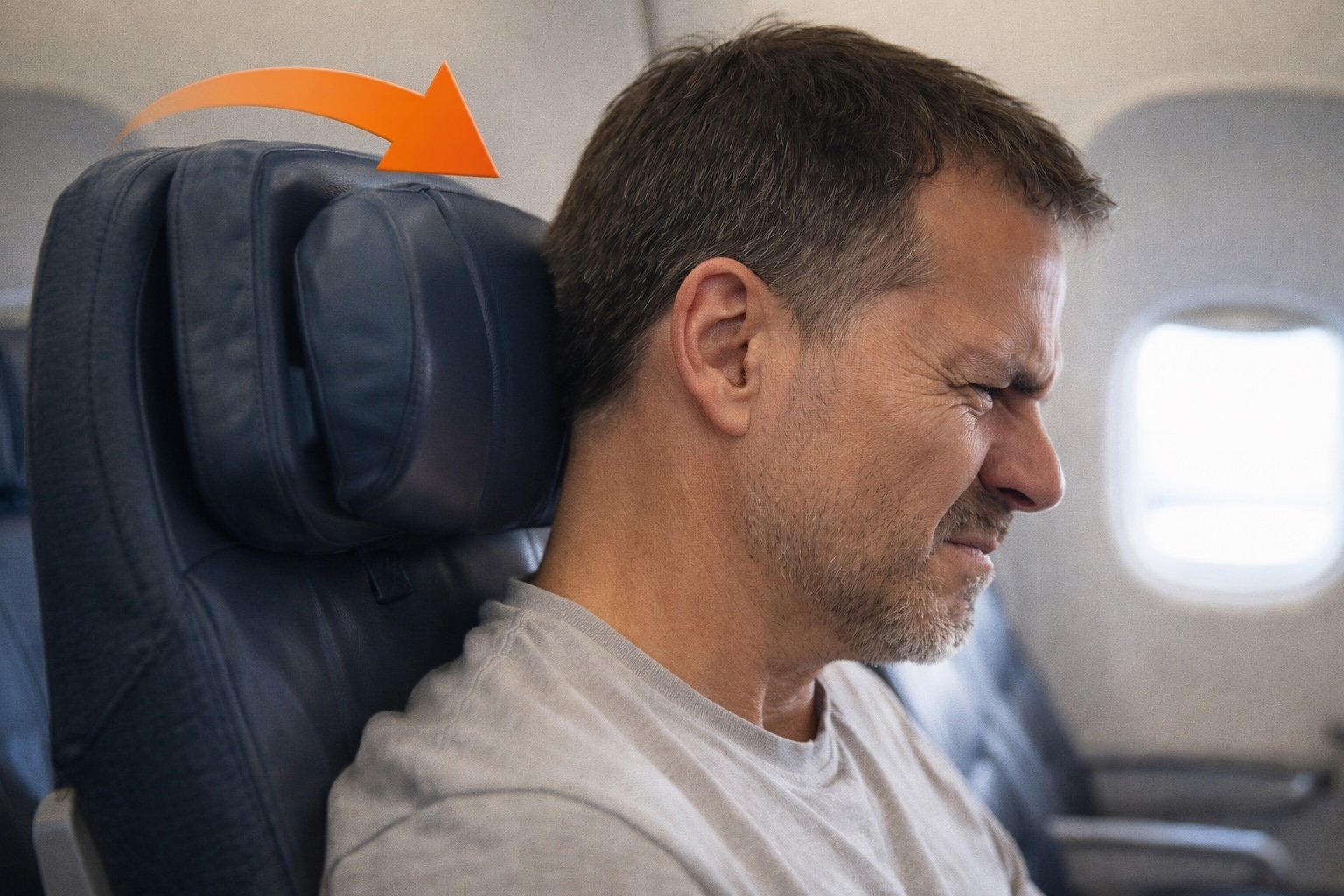
Most airplane seats quietly tilt your body in a way that leaves your head hanging without support. So your neck takes over. And after an hour or two, you feel it.
That’s what’s actually behind airplane seat neck pain. And why sitting “correctly” doesn’t fix it. It’s the same thing you notice when your head keeps falling forward on a plane. And no, sitting straighter won’t fix it.
Category: Travel Pillows
Author: Product Developer (Independent, No Sponsorships)
Written by a product developer who reviews travel gear with zero sponsorships.
Clear, technical breakdowns of materials, ergonomics, and real-world use.
Table of Contents
- You Sit Straight. Your Head Still Moves Forward
- What the Seat Is Actually Doing to Your Body
- Why Your Head Keeps Getting Pushed Forward
- Why This Turns Into Neck Pain
- Why Most “Fixes” Don’t Work
- What Actually Helps
You Sit Straight. Your Head Still Moves Forward
You sit down and try to do it properly.
Back against the seat. Head up. You correct yourself the moment you start to slump, because you already know how this usually ends.
For a short time, it holds.
Then your chin starts to drop.
Not enough to call it “bad posture.” Just enough that you feel it building. So you pull it back, reset your position, and try to stay there.
A few minutes later, same thing.
It’s not one clear movement. It’s a slow forward drift that keeps repeating. You adjust, it holds briefly, then it slips again. After a while, you’re not really resting, you’re just managing it.
That’s the part that doesn’t add up.
You’re aware of it. You’re actively correcting it. And it still keeps happening.
At some point it stops feeling like posture and starts feeling like something in the setup is off.
And it is.
What the Seat Is Actually Doing to Your Body
The problem starts with how the seat positions you before you even notice anything is wrong.
Airplane seats are slightly reclined, but not enough to support you. They sit in this awkward middle position where you’re not upright and not truly leaning back either.
Your body shifts just enough that your head is no longer sitting directly over your shoulders.
This is where it actually goes wrong.
But once that alignment shifts, your head is no longer stacked cleanly over your shoulders. It sits slightly in front of them.
That small offset is where the problem begins.
From that point on, your head isn’t fully supported by your skeleton anymore. It’s being held in place by your neck.
You don’t notice it while you’re awake. Your body compensates automatically. Small, constant corrections keep everything from drifting too far.
It feels like you’re just sitting there.
You’re not.
You’re maintaining a position that only works as long as you keep doing that. That’s not rest. That’s effort. This is exactly why most airplane headrests don’t solve the problem and why they make neck pain worse. They sit behind your head, so the forward position is still there, sometimes even worse.
Why Your Head Keeps Getting Pushed Forward
This is not about comfort. It’s about where your head sits relative to the seat.
The headrest is positioned behind you, often with a slight forward angle. In theory, that should support your head. In practice, it rarely lines up with where your head actually ends up.
Because of the seat angle and the way your spine settles, your head sits slightly forward of that support point. Not by much, but enough that it never fully rests against the headrest.
So instead of being supported, your head is effectively suspended in front of it.
That creates a gap between where your head is and where the support is.
As long as you are awake, your neck compensates for that gap. Small, continuous muscle activity keeps your head in place, and it feels like you are just sitting normally.
The moment that effort drops, the system stops working.
Your head already sits forward, so gravity simply continues that movement. There is nothing in front of you to interrupt it, and the headrest cannot catch it because it is behind the movement path.
So your head moves forward until your neck reacts and pulls it back.
That reaction is what you feel as strain, or the small correction that keeps waking you up.
The key point is simple:
The seat does not support your head. It places your head slightly in front of support, where it has to be held in place. That’s also why most travel pillow designs fail in real use. They don’t change this positioning.
Once you stop doing that, forward movement is unavoidable.
Why This Turns Into Neck Pain
Once your head sits slightly forward of your shoulders, the load shifts to your neck. The position still feels close enough to normal that you don’t question it at first, so your body compensates. Small, continuous muscle activity keeps your head from drifting further forward, and it feels like you’re just sitting there.
You’re not.
Your head isn’t resting in that position. It’s being held there.
That difference only shows up over time.
Because nothing in the setup actually supports that position, the same muscle groups stay active without a real break. Even when you try to relax, the load doesn’t disappear. Your head moves a little, your neck reacts, and you pull it back without thinking about it.
You’ve probably felt that moment where you “almost” fall asleep and then catch yourself. That’s the system correcting itself.
The problem is that this keeps repeating.
Each correction is small, but over an hour or two it adds up. The muscles get less precise, the forward drift becomes more noticeable, and the reactions become sharper. What started as a light hold turns into constant tension.
At the same time, you’re not moving enough to reset anything. The position stays the same, the load stays the same, and the same structures keep doing the work.
That’s why the stiffness doesn’t feel random.
It builds quietly, and by the time you notice it properly, it’s already there. This is also why economy seats tend to cause neck pain on longer flights.
Why Most “Fixes” Don’t Work
Most fixes feel right for about five minutes.
A standard U-shaped pillow is the obvious one. You put it on, it fills the space around your neck, and for a moment it actually feels like something is supporting you. Then your head drops forward again, and you realize nothing really changed.
The problem is still there. It just feels softer.
Soft cushions do the same thing. They improve comfort at the surface, but they don’t control movement. As soon as the material settles or compresses a bit, you’re back in the same position, just with more padding around it.
Then there’s the “just sit straight” advice.
You try it. You hold it. It works for a while.
But you’re not resting in that position, you’re maintaining it. The moment you stop actively holding yourself there, everything shifts forward again. That’s not a fix, it’s just delaying it.
All of these approaches miss the same point.
If your head is still free to move forward, the outcome doesn’t change. Then nothing has changed.
What Actually Helps
What actually helps is not more padding. It’s stopping the movement.
The issue isn’t that your neck needs something softer. It’s that your head has space to fall into. As long as that space is there, the result doesn’t change.
So the only thing that really works is reducing that gap.
If something is in front of your head, even lightly, it interrupts that forward drop early instead of forcing your neck to catch it later. The same goes for stable side support. Once your head has a place to settle into, it stops drifting as much.
You’ve probably noticed this without thinking about it. The moment your head finds something solid, even a window or your own hand, everything feels more stable.
That’s not comfort. That’s control.
It doesn’t need to be perfect. It just needs to limit how far your head can move.
Once that movement is reduced, your neck finally stops doing all the work. If you want something that actually works in this setup, your sleeping position matters more than most people think.