


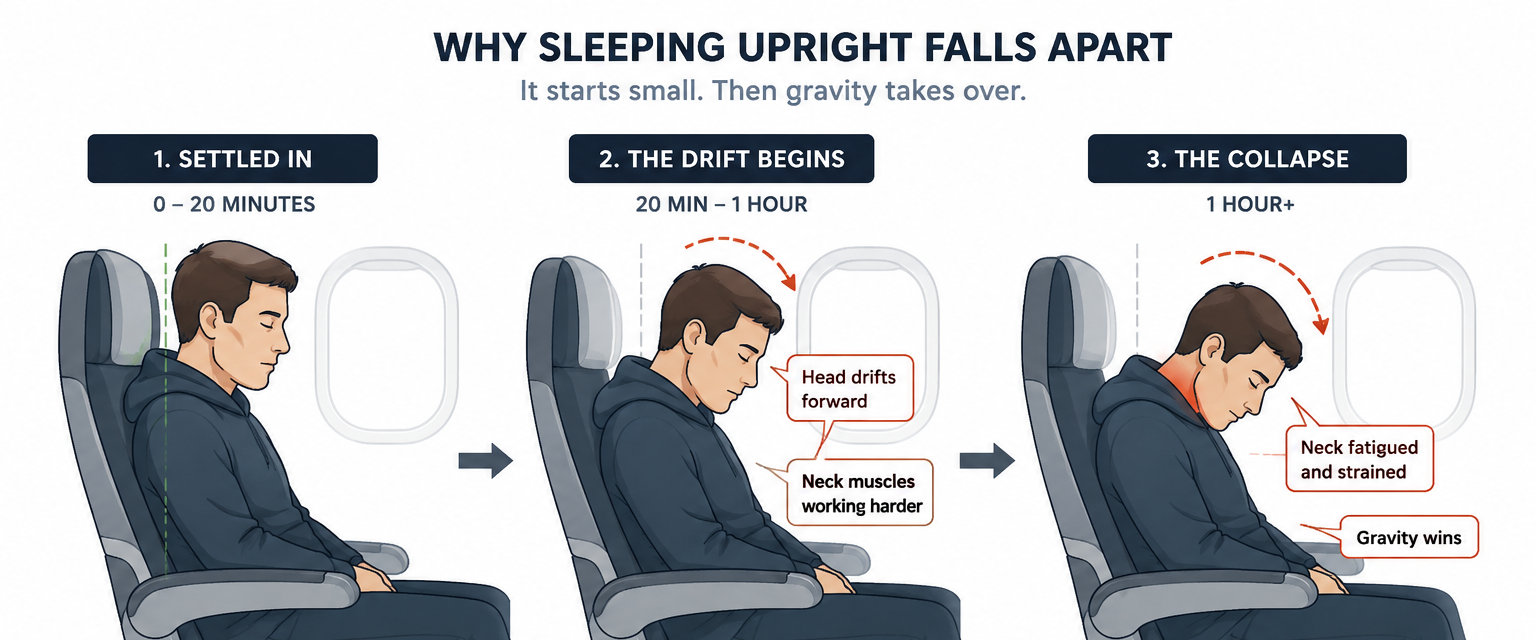
Sleeping upright on a plane usually feels possible for about the first 20 minutes. You lean back a little, adjust your neck, maybe pull your hoodie tighter and think, “this might actually work.” Then the slow collapse starts. Your head drifts forward, your neck tightens, and you keep waking yourself up trying to fix your position. It doesn’t fail all at once. That’s the frustrating part. It slowly falls apart while you’re still trying to convince yourself you’re comfortable.
Category: Travel Pillows
Author: Product Developer (Independent, No Sponsorships)
Written by a product developer who reviews travel gear with zero sponsorships.
Clear, technical breakdowns of materials, ergonomics, and real-world use.
Table of Contents
- Why Sleeping Upright Feels Possible at First
- Why Does Your Head Start Falling Forward on Planes?
- Why Does Sleeping Upright Fall Apart So Slowly?
- Why Do Airplane Seats Make Sleeping Upright Worse?
- Why Can Some People Sleep Upright Longer Than Others?
- What Actually Helps You Stay Asleep Longer on a Plane?
- Quick Reality Check
- Final Verdict
Why Sleeping Upright Feels Possible at First
Why does it feel manageable in the beginning?
At first, sleeping upright on a plane almost tricks you into thinking you’ve figured it out.
You lean back a little, adjust your neck, shift your neck around a few times, and eventually land on a position that feels… decent enough. Your body is still tense, still adjusting, and you haven’t been sitting there long enough for the discomfort to build up yet.
So for a while, it honestly feels possible.
Most people notice this during the first part of the flight. You’re not fully relaxed, but you’re holding yourself together well enough that the position still feels stable. At least for a while.
Then things slowly start slipping.
Your head drifts forward a little. You bring it back. A few minutes later, it happens again.
It doesn’t fall apart all at once. That’s the frustrating part. It happens gradually, while you’re still trying to convince yourself you’re comfortable.
Why Does Your Head Start Falling Forward on Planes?
It usually starts small
Your head normally doesn’t just drop forward out of nowhere.
At first, it’s just a tiny shift. Your chin lowers a little, your neck bends slightly more, and you barely notice it happening. You pull your head back up, settle in again, and think you fixed it.
Then it happens again a few minutes later.
Your neck is quietly doing all the work
That’s the part most people don’t realize.
When you’re sleeping upright, your neck muscles are basically trying to hold your head in place the whole time. Early in the flight, that works well enough. Your body is still tense, you’re adjusting constantly, and you haven’t relaxed fully yet.
Then the fatigue slowly kicks in.
It doesn’t happen immediately. It happens slowly.
There’s nowhere for your head to actually rest
And that’s where things get messy.
Your head naturally wants to fall forward when your muscles stop holding it up. On a plane, especially sitting upright, there usually isn’t anything stopping that movement.
No real anchor point. No stable support underneath it.
This is also why airplane seats push your head forward more than most people realize.
So the drift keeps coming back.
You notice this after about an hour. At that point, staying upright starts feeling less like resting and more like balancing.
Why Does Sleeping Upright Fall Apart So Slowly?
It slowly unravels
That’s the weird part about trying to sleep upright on a plane. It rarely fails immediately.
At first, you think you’re doing okay. Your head stays up long enough, your neck feels manageable, and every time you adjust your position it seems like you’ve solved it again.
Then the same drift keeps coming back.
Your head drifts forward a little. You pull it back up. A while later, you wake up again because your neck bent too far or your chin dropped toward your chest.
After a while, you realize you’ve been doing the same correction over and over again.
Your body keeps trying to correct it
Most people don’t fully realize how often they’re waking up to fix their position.
You notice this more on longer flights. After an hour or two, the corrections get more frequent and less effective. Your neck gets tired, your posture slips faster, and the comfortable position you thought you found earlier slowly disappears.
It doesn’t collapse all at once. It slowly falls apart while you’re still trying to make it work.
Why Do Airplane Seats Make Sleeping Upright Worse?
The position already starts slightly wrong
Most airplane seats don’t actually let your body relax backward the way people think they do.
A lot of people only realize this after a longer flight when the neck pain starts showing up.
You sit down, lean back, and it feels okay at first. But after a while, you notice your head keeps drifting forward even when your back is against the seat.
That’s the part people usually don’t expect.
Your upper body never fully settles
A lot of economy seats support your lower back more than your upper back and shoulders. So even when you recline a little, your upper body still feels like it’s hanging there instead of resting properly.
At least for a while.
That’s why people keep shifting around trying to “find the spot.” You lean left, lean right, pull your neck back, cross your arms differently, try again… and for a few minutes it feels better.
Then it slips again.
The seat slowly pushes you forward
You notice this more on longer flights.
As your muscles get tired, your shoulders round forward a little more, your head drifts out in front of your body, and staying upright starts feeling less like resting and more like balancing.
This usually gets worse in aisle seats where there’s nothing stabilizing you from the side.
And that’s where the whole thing starts falling apart faster.
Why Can Some People Sleep Upright Longer Than Others?
Some people really do seem better at it.
You’ve probably seen it on flights before. Someone leans back, crosses their arms, closes their eyes, and somehow stays asleep for two hours like they’re in their own bed. Meanwhile the person next to them is waking up every 15 minutes fixing their neck.
Part of it is the seat position.
Window seats usually help because people naturally lean into the wall or side panel without realizing it. That’s one reason window seats usually work better for sleeping on planes. Aisle seats tend to fall apart faster because there’s nothing keeping your body stable from the side once your muscles start relaxing.
And then there’s body tension.
Some people naturally hold their neck and shoulders tighter during the first part of the flight, so their head stays upright longer before the drift starts. Neck length and posture can affect it too.
But eventually, most people run into the same problem.
At some point, gravity usually wins.
What Actually Helps You Stay Asleep Longer on a Plane?
Soft doesn’t always mean stable
A lot of things feel comfortable during the first part of the flight.
That’s the trap.
You settle in, your neck feels supported enough, and for 20 or 30 minutes you think you finally found the position that’s going to work this time. Then your head starts drifting again and the whole thing slowly unravels. That’s usually where a lot of travel pillows stop helping.
You notice this more on longer flights. Comfort fades faster than expected once your neck starts getting tired.
Your head needs something that stays with you
That’s usually the difference between setups that last and setups that fall apart after an hour.
If the support moves every time you shift slightly, your head keeps losing its position. Then you wake up a little, pull your head back up, adjust again, and repeat the same cycle later.
And that’s where things get messy.
Less drifting usually means better sleep
It’s not really about locking your head in place.
It’s more about reducing how much movement keeps happening while your body is trying to relax. The less your head keeps wandering forward or sideways, the less often your neck has to “save” the position again.
In theory, anyway.
That’s usually what helps people stay asleep longer.
Side sleepers usually notice this differently because the head starts drifting sideways instead.
Quick Reality Check
Sleeping upright on a plane only feels natural for a little while.
That’s usually the illusion.
Your body spends the entire flight quietly trying to stop your head from falling forward while you’re also trying to relax enough to sleep. Those two things don’t work together very well. At least not for long.
For the first part of the flight, the constant little adjustments hide the problem well enough that you think you’re comfortable.
Then the corrections start happening closer together.
And eventually, resting slowly turns into balancing.
Final Verdict
Sleeping upright on a plane usually works just long enough to convince you it’s going to work.
That’s the frustrating part.
For the first part of the flight, your body keeps correcting the position well enough that you still feel relatively comfortable. Then the small adjustments start happening more often, your neck gets tired, and the whole thing slowly starts unraveling.
It rarely fails all at once. It usually falls apart little by little while you’re still trying to make the position work. That’s also why reclining your seat usually helps less than people expect.