


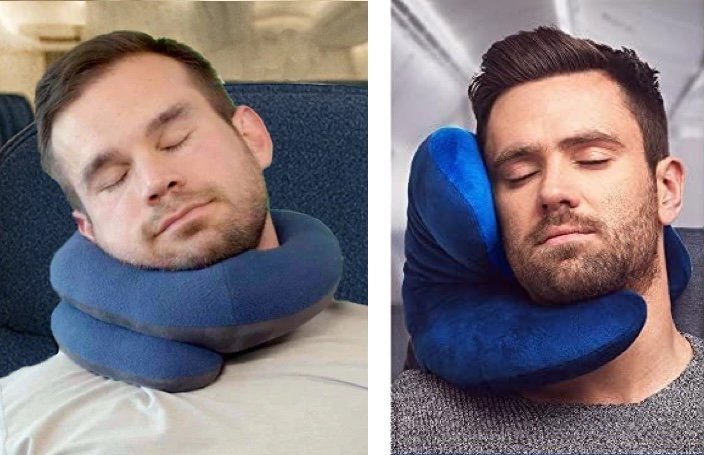
BCOZZY and J-Pillow approach neck support from two very different directions, even though both are often recommended for the same problem: head slumping on planes. One focuses on front chin stabilization, the other on shape-based side and under-chin support. This comparison breaks down how each design actually behaves in real airline seats, not how they’re marketed. Instead of ranking comfort or popularity, the focus here is on mechanics: how support is created, where it breaks down over time, and which sleeping positions each pillow realistically handles well.
Category: Travel Pillows
Author: Product Developer (Independent, No Sponsorships)
Written by a product developer who reviews travel gear with zero sponsorships.
Clear, technical breakdowns of materials, ergonomics, and real-world use.
Table of Contents
- Support Design: Overlapping Arm Support vs Shape-Based Support
- Neck Support & Stability
- Ergonomics in Real Airline Seats
- Comfort Over Time
- Ease of Use & Adjustability
- Who Each Pillow Is Actually For
- Final Verdict
- FAQ
Support Design: Overlapping Arm Support vs Shape-Based Support
BCOZZY and J-Pillow solve different problems, even though they’re often compared side by side. BCOZZY is a wrap-based design that builds support through overlap and positioning, while J-Pillow relies on a fixed shape that works in one dominant posture.
BCOZZY’s philosophy is flexibility. By wrapping fully around the neck, it allows users to stack material under the chin or shift support depending on seat and posture. There’s no rigid structure guiding movement. Support changes based on how it’s worn.
J-Pillow takes a more committed approach. Its asymmetrical shape assumes side leaning and uses geometry, not adjustment, to manage head position. When paired with a window or seat wall, the shape does the work. When that external support isn’t there, its limits show quickly.
The rest of this comparison looks at how these two philosophies behave under real travel conditions, where posture shifts, seats constrain movement, and time exposes weaknesses.
Neck Support & Stability
Neck support is where the design philosophies of BCOZZY and the J-Pillow diverge most clearly. Both aim to reduce neck strain, but they stabilize the head in fundamentally different ways. One manages load through overlapping, flexible support under the chin, while the other relies on fixed geometry and external bracing.
Does It Prevent Forward Head Drop in Upright Seats?
BCOZZY addresses forward head drop through its overlapping coil design, where layered front loops sit under the chin and distribute weight across a wider surface. This reduces chin collapse without locking the head into a rigid position. It works best when the sleeper remains mostly upright and does not slump aggressively forward.
The J-Pillow limits forward head drop indirectly. Its extended lower arm supports the chin, but this only works as intended when the pillow is paired with side support, typically a window or seat wall. Without that external surface, the chin support alone does not consistently stop forward collapse.
Which Design Controls Side Lean Better?
Side support is where the J-Pillow is strongest. Its J-shaped geometry braces the head laterally while the lower arm supports the chin, forming a stable three-point system when leaning against a window. In this posture, head movement is well controlled with minimal muscular effort, as detailed in my J-Pillow review of real-world window-seat performance.
BCOZZY provides side support through flexible contact rather than bracing. The overlapping coils adapt to the neck and jaw but do not lock the head against a surface. This makes side leaning more forgiving, but also less stable than a shape-based brace when external support is available.
What Happens When You Shift or Change Position?
BCOZZY tolerates movement better. Because support comes from layered, flexible coils rather than fixed geometry, small posture changes do not immediately break support. However, this also means it cannot enforce alignment once fatigue increases.
The J-Pillow is less forgiving. Its effectiveness depends on maintaining the intended lean direction. Changing sides or shifting posture requires waking up and repositioning the pillow to re-establish support.
Where Each Design Breaks Down First:
BCOZZY fails gradually as load increases and posture drifts, offering flexibility but limited resistance.
The J-Pillow fails abruptly when external support or directional alignment is lost.
Ergonomics in Real Airline Seats
BCOZZY and the J-Pillow interact with airline seats very differently because they assume different user behavior. One is built to work within the seat itself, the other assumes the seat provides an external surface. How upright the seat is, how much recline you get, and where you’re sitting matter more here than materials or softness.
Does It Hold Your Head in Fully Upright Economy Seats?
In fully upright economy seats, BCOZZY is the more predictable option. Its overlapping coil design supports the chin from the front and distributes load around the neck without needing a side surface. This allows the head to stay relatively centered, even when the seat offers minimal recline. It doesn’t lock posture, but it reduces muscular effort better than shape-dependent designs in this scenario.
The J-Pillow struggles here. Without a window or side wall, its geometry loses leverage. The under-chin arm alone is not enough to stabilize the head in a purely upright, unsupported seat, and forward slump becomes more likely.
What Changes When the Seat Is Slightly Reclined?
With some recline, both designs improve, but for different reasons. BCOZZY benefits because gravity is no longer pulling the head straight down, making its flexible support feel more effective and less strained.
The J-Pillow becomes usable if recline is paired with a consistent side lean. Recline reduces forward load, but the design still depends on lateral bracing to work as intended.
Does Window vs Aisle Seating Change Stability?
Window seating strongly favors the J-Pillow. The window completes its support system, allowing the head to rest against a stable surface with minimal effort. In this setup, ergonomics feel natural and low-maintenance.
BCOZZY is more seat-agnostic. It works similarly in window, aisle, or middle seats, but never gains the same stability boost a window provides to the J-Pillow.
Comfort Over Time
Comfort over time is where BCOZZY and the J-Pillow separate most clearly, because they age differently as fatigue, heat, and micro-movement accumulate.
BCOZZY’s overlapping coil design spreads load around the front and sides of the neck rather than concentrating it at a single contact point. Early comfort feels modest rather than plush, but pressure builds slowly and predictably. Because support is shared across multiple contact zones, discomfort tends to show up as general fatigue rather than sharp pressure. Over long flights, comfort depends on how well the chin support stays aligned. If posture drifts, the pillow still supports, but the benefit diminishes gradually rather than failing suddenly.
The J-Pillow feels more comfortable at the beginning when used exactly as intended. The plush fill and broad contact area against the cheek and jaw create low pressure points during window-leaning sleep. Over time, however, the polyester fill compresses and the pillow can slowly settle. As that happens, users often need to subtly reposition it to maintain support. Comfort fades through softening rather than pain, which makes the decline easy to miss until fatigue returns.
Heat retention is moderate for both. BCOZZY’s wrap design traps some warmth around the neck, while the J-Pillow’s plush fabric can feel warm during prolonged contact.
The quiet reality is this: BCOZZY trades early plushness for steadier long-term comfort, while the J-Pillow feels better early but asks more of you as the hours pass.
Ease of Use & Adjustability
Ease of use comes down to how much effort a pillow demands once you’re tired, half-asleep, and stuck in a narrow seat. BCOZZY and the J-Pillow take opposite approaches here.
BCOZZY is built around active adjustment. Its overlapping coil design wraps fully around the neck and allows the front sections to be repositioned, tightened, or loosened depending on posture. This makes it adaptable across upright, forward, and light side-leaning positions. The trade-off is interaction cost. Getting it right takes a moment, and maintaining support often means small readjustments as posture changes. For travelers who don’t mind minor tweaking, this flexibility is a strength. For hands-off sleepers, it can feel fussy.
The J-Pillow is the opposite. There is almost no adjustment at all. You place it, lean into it, and it either works or it doesn’t. When posture and seat conditions line up, especially at a window, usability feels effortless. There are no straps, toggles, or tension points to manage. The downside appears when you move. Changing lean direction or posture requires waking up, rotating the pillow, and reseating it correctly. There is no incremental adjustment, only full repositioning.
Packability and handling also differ. BCOZZY compresses into a familiar U-shape and packs predictably. The J-Pillow’s asymmetrical form is bulkier and less cooperative in tight bags.
In short, BCOZZY rewards engagement and adjustment. The J-Pillow rewards commitment to one posture and minimal movement.
Who Each Pillow Is Actually For
BCOZZY is best suited for travelers who don’t sleep in a single fixed position. If you tend to nod forward, sit upright for long stretches, or shift slightly as you doze, its overlapping coil design provides adaptable under-chin support without forcing you into one posture. It works particularly well for economy-seat travelers who lack a window to lean on and want something that functions reasonably across multiple positions. BCOZZY favors people who are willing to make small adjustments to maintain comfort and who value versatility over hands-free support.
The J-Pillow is for travelers who know exactly how they sleep. If you reliably lean toward a window and stay oriented in one direction, its fixed J-shaped geometry offers stable, low-effort support that feels natural once in position. It’s especially well-suited to window-seat sleepers who want under-chin support without straps, tightening, or ongoing adjustment. The trade-off is flexibility. If you change sides, sit fully upright, or lack a solid surface to lean against, its effectiveness drops quickly.
In practical terms, this comparison comes down to predictability versus adaptability. BCOZZY serves travelers who need one pillow to function across imperfect conditions. The J-Pillow rewards travelers whose seating position and sleeping posture remain consistent.
Decision rule:
• If you sit upright, lack a window, or shift positions → choose BCOZZY
• If you reliably lean on a window and stay on one side → choose J-Pillow
• If you move frequently and rarely get stable side support → avoid both
Final Verdict
BCOZZY and J-Pillow solve neck support in fundamentally different ways, but their real-world performance makes the better choice clear for most travelers.
BCOZZY is the more reliable option in typical economy conditions. Its overlapping coil design manages forward head drop without depending on external support, and it tolerates small posture changes as fatigue builds. For travelers who sit upright, lack a window, or shift slightly during sleep, it delivers more consistent results over long flights.
The J-Pillow is highly effective in a narrow set of conditions. When paired with a window and used in a stable side-leaning posture, its fixed geometry provides excellent low-effort support. Outside of that setup, its performance drops quickly and predictably.
If you want one pillow that works in most seats and most positions, BCOZZY is the safer choice. If you always book window seats and sleep in one direction, the J-Pillow can feel better. For everyone else, BCOZZY is the more dependable long-term tool.
FAQ
Which travel pillow is better for preventing forward head drop?
BCOZZY is more reliable for preventing forward head drop in unsupported seats because its overlapping coil design distributes chin load across both sides. This reduces collapse even when sitting fully upright. The J-Pillow can limit chin drop only when paired with a window or side wall, where external bracing completes its support system.
Is BCOZZY or J-Pillow better for neck support on planes?
For most economy travelers, BCOZZY provides more consistent neck support because it does not rely on external surfaces and tolerates small posture changes. The J-Pillow offers stronger support only in stable side-leaning setups. Outside of that posture, its effectiveness drops quickly.
Is the J-Pillow only good for window seats?
Largely, yes. The J-Pillow is designed to use the window or seat wall as part of its support structure. In aisle or middle seats, where that surface is missing, the pillow loses stability and becomes less effective at controlling head movement.
Can BCOZZY work in upright economy seats?
Yes. BCOZZY performs well in upright economy seating because its chin-support system does not depend on side bracing. It supports the jaw and front of the neck while allowing limited movement, which reduces fatigue during long periods of upright sitting.
Which pillow is better for restless sleepers?
BCOZZY is better suited to restless sleepers because its flexible structure maintains partial support during small posture changes. The J-Pillow requires consistent orientation and loses effectiveness when users shift position.
Do either of these pillows work for long-haul flights?
Both can work on long-haul flights, but BCOZZY is more predictable over time because it degrades gradually as posture drifts. The J-Pillow can feel excellent for hours in ideal conditions but often requires repositioning as fill compresses and alignment changes.
Can one travel pillow replace all others?
No. Travel pillows are posture-dependent tools. BCOZZY and J-Pillow solve different mechanical problems and are optimized for different seating conditions. The best results come from choosing the design that matches how you most often sleep on planes.