


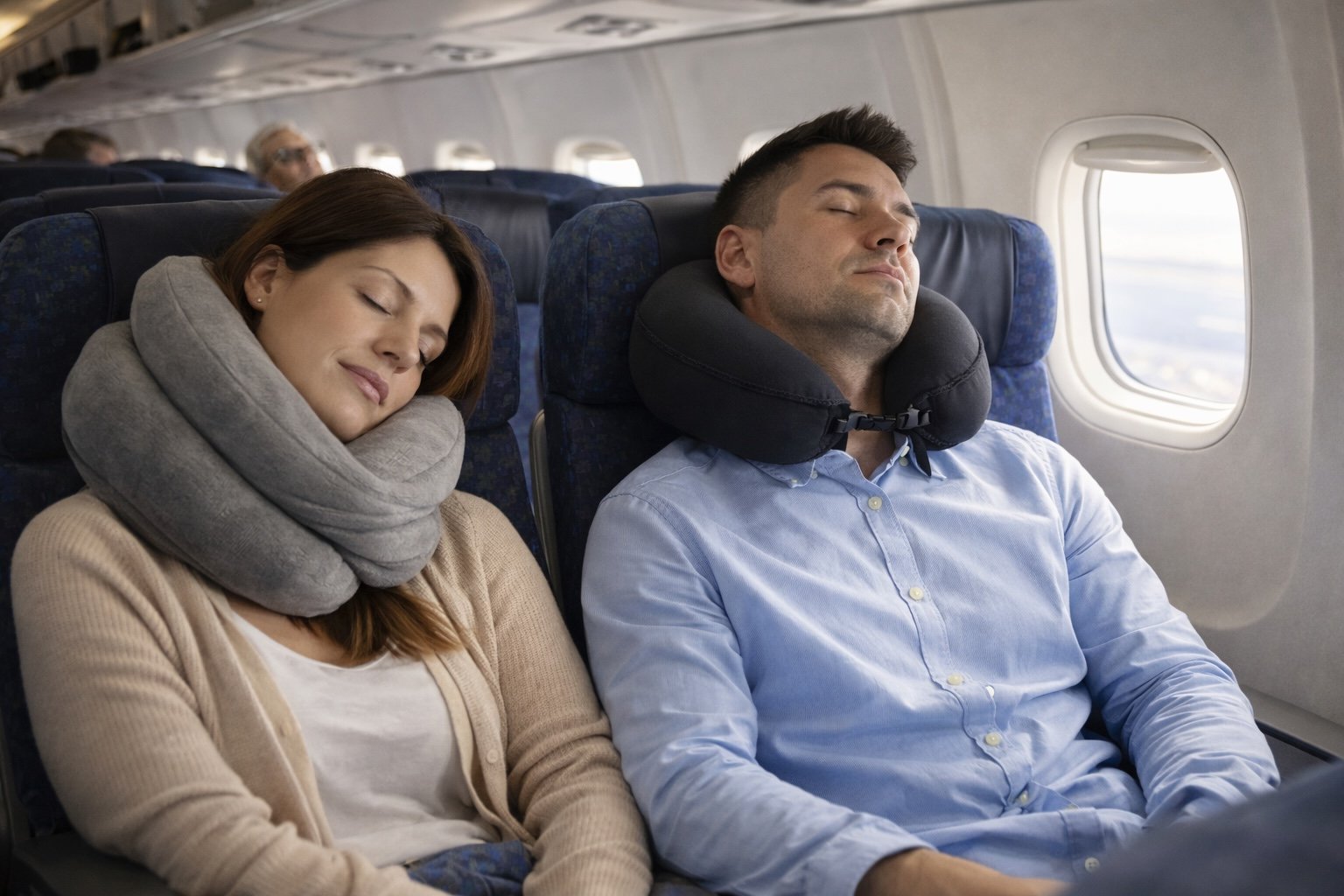
Finding the best travel pillow for window and aisle seats is harder than it looks. Many passengers assume any neck pillow will work in both window and aisle seats, only to wake up with neck pain, poor head support, and stiff shoulders. In reality, seat position changes how pillows perform. This guide compares the best travel pillows for window vs aisle seats, using real-world fit testing to show which designs stabilize your head, which collapse, and which actually work for long flights in economy cabins. If airline policies affect which designs you can even use, my breakdown of seat-strap travel pillow rules explains the limits in detail.
Category: Travel Pillows
Author: Product Developer (Independent, No Sponsorships)
Written by a product developer who reviews travel gear with zero sponsorships.
Clear, technical breakdowns of materials, ergonomics, and real-world use.
Table of Contents
- Why Window and Aisle Seats Create Different Sleep Problems
- What Makes a Pillow Work in a Window Seat
- What Makes a Pillow Work in an Aisle Seat
- Best Travel Pillow Types for Window Seats
- Best Travel Pillow Types for Aisle Seats
- How Body Type and Sleep Style Affect Seat-Based Fit
- Common Mistakes When Matching Pillows to Seats
- Who Each Seat–Pillow Combination Is Actually For
- Decision Guide: Window vs Aisle Pillow Matching
- Conclusion: Match the Pillow to the Seat, Not the Hype
- FAQ
Why Window and Aisle Seats Create Different Sleep Problems
How lateral support changes neck stability
Window and aisle seats create two very different support environments for your head and neck. In a window seat, the cabin wall provides a fixed lateral surface that limits sideward movement. When your head leans, it meets resistance quickly, which reduces uncontrolled neck flexion. This external boundary effectively supplements weak pillow structures, allowing even soft designs to maintain partial alignment.
In aisle seats, that lateral boundary is missing. The only available support comes from the seatback and whatever pillow you are using. Without a rigid side surface, the head drifts outward under its own weight, increasing rotational strain on the cervical spine. Most U-shaped and loop pillows are not designed to counter this lateral torque for extended periods.
Why aisle seats increase forward head drop
Aisle seats also promote forward head drop more frequently. Passengers tend to sit more upright to avoid contact with passing traffic, carts, and neighboring arms. This posture shifts the head’s center of gravity forward. Without chin support or a rigid brace, neck muscles must compensate continuously, leading to early fatigue and progressive head collapse during sleep.
Over time, this creates a predictable pattern: sideways instability dominates in window seats, while forward collapse dominates in aisle seats.
What Makes a Pillow Work in a Window Seat
Why wall support favors flexible designs
Window seats give travel pillows something rare in economy class: a stable external support surface. When your head leans, it meets the cabin wall quickly, limiting excessive rotation. This reduces the amount of structural work the pillow itself must perform. As a result, flexible designs such as loop pillows, scarf wraps, and soft U-shapes often perform better here than they would in open seating.
These designs can compress against the wall and adapt to small changes in posture without losing contact. Instead of fighting gravity alone, they work in combination with the aircraft structure. This shared load is why softer pillows feel more supportive in window seats than they do elsewhere.
This is why many window-seat sleepers think they finally ‘found the right pillow’ until they switch to an aisle seat and everything falls apart.
How side-lean sleepers benefit from soft wraps
Side-lean sleepers benefit most from this environment. When the head rests partially on the wall, soft wrap-style pillows can fill the gap between neck and shoulder without forcing the jaw upward. The fabric conforms to facial contours, reducing pressure points around the ear and cheek.
This makes loop and scarf-style pillows especially effective for travelers who naturally tilt sideways rather than forward. They stabilize rotation without locking the neck into a rigid position.
When rigid collars fail at windows
Rigid memory foam collars and brace-style designs often struggle in window seats. Their fixed geometry prevents them from adapting to angled contact with the wall. Instead of compressing, they push the head inward, creating uneven loading on the jaw and upper cervical spine. Over time, this leads to discomfort and frequent repositioning, which negates their structural advantages.
What Makes a Pillow Work in an Aisle Seat
Why self-support matters without side contact
Aisle seats remove the most important stabilizing element available in window seating: lateral contact. With no wall to lean against, the head is suspended entirely by the seatback and the pillow. This shifts the load from shared support to full self-support. Any design that relies on external bracing immediately loses effectiveness.
In this environment, the pillow must generate its own resistance to rotation and forward flexion. If it cannot maintain shape under load, it becomes decorative padding rather than structural support, which is when most people realize their neck is doing all the work again.
How chin support prevents forward collapse
Forward head drop is the dominant failure mode in aisle seats. As neck muscles fatigue, the head rotates downward and inward. Pillows that include defined anterior support, such as brace-style designs or reinforced U-shapes, counter this movement by creating a physical boundary under the chin and jawline.
This boundary reduces cervical flexion and slows progressive slumping. It does not eliminate movement, but it extends the time before collapse occurs. For upright sleepers and light recliners, this function is more valuable than side cushioning.
Why soft pillows drift in aisle seats
Soft loop and wrap-style pillows perform poorly in aisle seating, which is why they usually slide away within the first hour. Without lateral contact, they migrate downward and outward with each posture shift. Over time, they slide off the neck, concentrate pressure on one area, or bunch against the shoulder. This instability explains why designs that feel comfortable at windows often feel ineffective in aisle rows.
Best Travel Pillow Types for Window Seats
Infinity-style loop pillows
Infinity-style loop pillows perform best in window seats because their flexibility complements structural wall support. When leaned against the cabin wall, the loop can be folded and tensioned into a semi-rigid brace. This creates distributed side support without forcing a fixed head position.
The key advantage here is adaptability. Travelers can reposition the loop as seat angle, window contour, or fatigue level changes. For side-lean sleepers who shift frequently, this prevents localized pressure buildup. However, these designs rely heavily on the presence of a wall. Without it, their stability drops sharply, which is why their performance is seat-dependent. I break down how this works in practice in my full Infinity Pillow review.
J-shaped pillows
J-shaped pillows are designed to lock onto one side of the head and neck. In window seats, this geometry aligns well with lateral leaning. One arm of the “J” stabilizes the chin and jaw, while the longer side rests against the window, creating a controlled support triangle.
This structure benefits sleepers who prefer consistent positioning rather than constant adjustment. It reduces drift and limits rotational movement. The trade-off is reduced flexibility. If the seat angle or window height does not match the pillow’s geometry, pressure points can develop over time, usually right where your jaw meets the pillow at 2 a.m.
Soft wrap designs
Soft wrap pillows emphasize comfort and compression over structure. In window seats, they function best as cushioning layers between the head and cabin wall. They reduce vibration and surface hardness rather than actively controlling posture.
These designs suit travelers who already sleep well when leaning sideways and mainly want padding. They are less effective for users seeking active stabilization, which is why many buyers end up replacing them after one trip.
Best Travel Pillow Types for Aisle Seats
Memory foam collars
Memory foam collars perform best in aisle seats when they provide sufficient vertical and anterior support. Their primary advantage is shape retention under continuous load. Unlike fiberfill or fabric wraps, dense foam resists long-term compression and maintains boundary structure around the neck.
When properly fitted, these collars limit forward flexion and reduce progressive slumping. This makes them suitable for upright sleepers and passengers who cannot rely on lateral surfaces. However, performance depends heavily on neck length and jaw height. Poor alignment leads to uneven pressure distribution and early discomfort, especially around the ears and mandible.
Brace-style pillows (Trtl-type)
Brace-style pillows are specifically engineered for unsupported seating. Instead of surrounding the neck, they anchor against the shoulder and jaw, creating an internal scaffold. This structure counteracts both lateral drift and forward collapse without requiring external contact.
In aisle seats, this design provides the highest stability per unit of material. It is particularly effective for travelers who remain relatively still and prioritize posture control over softness. The trade-off is reduced adaptability. Brace systems limit natural movement and may feel restrictive during long periods of wakefulness. I break down how this brace-style support system works in real airline seating in my Trtl review.
Structured hybrids
Structured hybrid pillows combine foam cores with adjustable wraps or straps. Their goal is to balance stability with adaptability. In aisle seats, they offer moderate chin support while allowing limited repositioning.
These designs work best for travelers who alternate between upright and semi-reclined postures. They are more forgiving than rigid braces but more stable than pure soft wraps. Performance varies widely by brand and geometry, which is why two ‘similar’ hybrids can feel completely different in the same seat.
How Body Type and Sleep Style Affect Seat-Based Fit
Tall vs short travelers
Neck length and shoulder width strongly influence how a pillow performs in different seats. Taller travelers with longer necks tend to benefit more from structured collars and braces in aisle seats, where vertical support is critical. Shorter travelers often experience jaw and ear pressure with rigid designs and may achieve better comfort with flexible wraps in window seats.
Seat pitch also interacts with height. Longer torsos shift the head forward in upright seating, increasing reliance on chin support systems.
Restless vs still sleepers
Sleep behavior matters as much as anatomy. Restless sleepers who reposition frequently benefit from adaptable designs that tolerate movement, especially in window seats. Loop and wrap-style pillows recover more easily after shifts. Still sleepers, by contrast, gain more value from rigid support systems that maintain alignment over time.
Side vs forward sleepers
Side sleepers typically perform better in window seats using soft or semi-flexible designs that fill lateral gaps. Forward sleepers rely more on anterior support and perform better in aisle seats with collars or braces. Mismatching sleep style and pillow structure is one of the most common causes of perceived “bad pillow” experiences.
Common Mistakes When Matching Pillows to Seats
Buying for comfort instead of stability
Many travelers choose pillows based on how soft they feel in-store or at home. While initial comfort matters, it does not predict in-flight performance. Soft materials that feel pleasant during short trials often compress quickly and fail to control head movement in real seats. This leads to progressive slumping, frequent readjustment, and early fatigue.
Stability determines whether a pillow maintains alignment over time. Ignoring this factor is the most common reason passengers abandon otherwise well-reviewed products after one overnight flight.
Ignoring seat pitch and headrest shape
Seat pitch and headrest geometry vary widely between airlines and aircraft types. Shallow recline angles and forward-curved headrests increase reliance on chin and vertical support. Passengers who ignore these constraints often select pillows that cannot function within their seating environment.
Matching pillow geometry to seat structure is essential for consistent performance.
Who Each Seat–Pillow Combination Is Actually For
Window seat travelers
Window seat travelers benefit most from flexible designs that cooperate with lateral support. Infinity-style loops, soft wraps, and J-shaped pillows work best for side-lean sleepers who regularly use the cabin wall for stabilization. These combinations suit passengers who shift occasionally and prioritize pressure distribution over rigid posture control.
If you consistently sleep by leaning sideways and value adaptability, flexible pillows in window seats offer the best balance between comfort and stability. Rigid collars are better suited only for travelers who remain upright and rarely contact the wall.
Aisle seat travelers
Aisle seat travelers require self-supporting systems that function without external bracing. Memory foam collars, brace-style designs, and structured hybrids perform best for upright sleepers and minimal movers. These combinations reduce forward collapse and maintain alignment in open seating.
If you fly aisle frequently and struggle with head drop, prioritize internal support systems over soft cushioning. Flexible wraps rarely provide sufficient control in this environment.
Decision Guide: Window vs Aisle Pillow Matching
Use this if you want to avoid buying another pillow you’ll abandon after one trip:
If you usually sleep by leaning against the cabin wall and change position occasionally → choose a flexible loop, wrap, or J-shaped pillow.
If you stay mostly upright in window seats and rarely shift → choose a structured collar with moderate rigidity.
If you fly aisle seats on long or overnight routes and struggle with forward head drop → choose a memory foam collar or brace-style pillow.
If you move frequently, rotate between side and forward positions, and dislike restrictive designs → avoid rigid braces and choose adaptable wraps.
If you have a short neck or experience jaw pressure with firm collars → avoid thick memory foam designs and prioritize softer compression materials.
If you want one pillow for both window and aisle seats → choose a structured hybrid with adjustable tension rather than a single-purpose design.
If you’re choosing between flexible loops and rigid braces, I compared the Infinity Pillow and Trtl directly here.
Conclusion: Match the Pillow to the Seat, Not the Hype
Most travel pillows fail not because they are poorly made, but because they are used in the wrong seating context. Window and aisle seats create different stability demands, and no single design performs equally well in both. Flexible wraps succeed when external support is available, which is why they feel great at the window and often disappointing in the aisle. Structured collars succeed when it is not. Understanding this distinction is more important than brand reputation or online ratings.
This is why so many frequent flyers own three unused pillows at home and still wake up sore.
Before buying another pillow, identify how and where you actually sleep. Matching design to seat position will improve comfort more reliably than chasing the latest “best” product.
FAQ
Which is the best travel pillow for a window seat?
For window seats, flexible designs like loop pillows, soft wraps, and J-shaped pillows work best. They use the cabin wall as secondary support, which reduces side strain and improves long-term stability for side-lean sleepers.
Why do aisle seats cause more neck pain on flights?
Aisle seats lack lateral support, so your head relies entirely on the pillow and seatback. As muscles fatigue, forward head drop becomes more likely, increasing neck and shoulder strain over time.
Which travel pillow works without leaning on the window?
Brace-style pillows and firm memory foam collars perform best without external support. They provide internal structure that limits forward collapse in upright seating.
What is the best travel pillow for overnight aisle flights?
For long-haul aisle seating, prioritize pillows with chin and jaw support. Brace-style designs and dense foam collars maintain alignment longer than soft wraps during overnight fatigue.
What works best for side sleepers in window seats?
Side sleepers in window seats benefit most from soft wraps and loop pillows. These fill lateral gaps without forcing the jaw upward or creating pressure points.
Can one travel pillow work well in both window and aisle seats?
Some structured hybrid pillows adapt reasonably well to both positions. However, no design performs equally in both environments. If you frequently switch seats, adjustable hybrids are the safest compromise.