


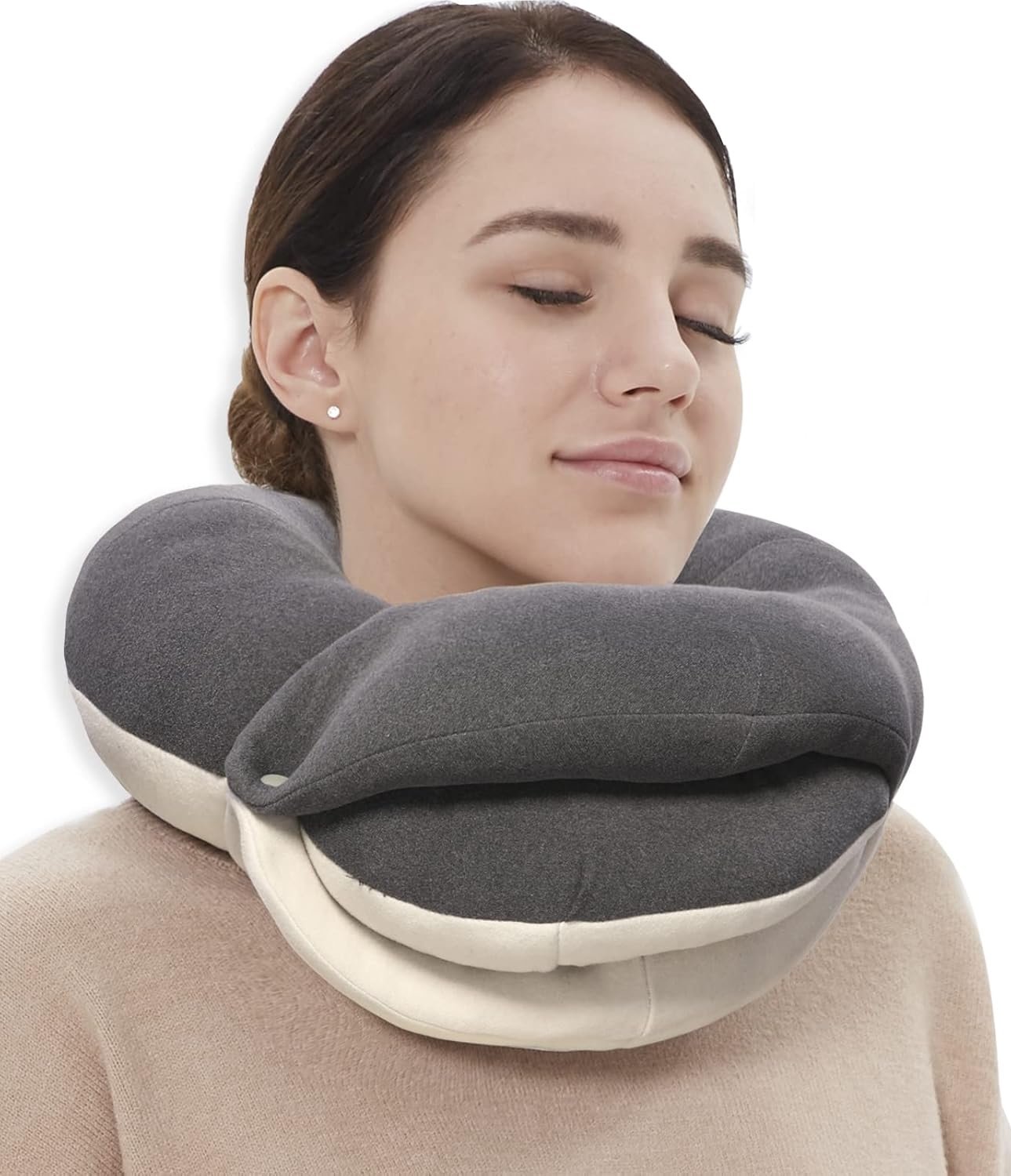
The BUYUE travel neck pillow uses a distinctive Q-shape design intended to provide 360-degree support for the head, neck, and chin, rather than relying on side cushioning alone. This geometry is meant to limit forward head drop and reduce the “bobblehead” effect that shows up on long flights. The pillow also claims skin-friendly, breathable materials designed to improve comfort over time, but long-haul performance depends on more than surface feel. Heat retention, material compression, and how the structure interacts with aircraft seat geometry all determine whether support holds after hours of use. In this review, the focus is not first-minute comfort, but whether the BUYUE’s shape and materials maintain alignment and thermal comfort throughout a real flight.
Below is the full breakdown.
Category: Travel Pillows
Author: Product Developer (Independent, No Sponsorships)
Written by a product developer who reviews travel gear with zero sponsorships.
Clear, technical breakdowns of materials, ergonomics, and real-world use.
Table of Contents
- Design Overview
- My Take (from a product developer)
- Real-World Limitations
- What Travelers Are Saying
- Final Scores
- Verdict
- FAQ
Design Overview
This pillow is designed to actively control head position through adjustable layer tension. Instead of simply cradling the neck, its Q-shaped, multi-layer structure lets you reconfigure how support is applied by threading and locking the layers together. In one setup, the layers create a firm chin shelf that resists forward head drop. In another, they wrap and stack to stabilize the head from multiple angles. The key difference is that support isn’t coming from softness or bulk. It comes from how the layers interact and tighten around your neck, allowing you to fine-tune stability as your posture changes.
Key design elements:
- Q-shaped structure designed to support head, neck, and chin simultaneously
- asymmetric construction with two distinct ends
- single-layer end for threading and tension adjustment
- dual-layer end with snap button for locking the structure in place
- adjustable support created by overlapping layers, not foam thickness
- structure-based chin support to reduce forward head drop
- skin-friendly, breathable fabric surface
- fully machine-washable construction
- compact carry pouch for travel
My Take (from a product developer) on the BUYUE Travel Pillow
From a product-developer perspective, the BUYUE Travel Pillow is built around structure rather than softness. It isn’t a normal U-shaped pillow that simply “fills space” around your neck. Its support comes from a mechanical wrap-and-lock structure rather than passive cushioning.
This kind of wrap-style, front-supported design only makes sense once you factor in seat type and neck length, which is why I break those mechanics down in detail in my guide on how to choose the right travel pillow by seat type and neck length.
Design & Structure
Two different ends (on purpose): one end is a single layer, the other end is a two-layer end that can be snapped together with a button. That asymmetry is the whole design.
Support is created by overlap, not bulk: you slide the single-layer end through or between the two-layer end, then tighten. The pillow becomes a closed loop with tension, which is what helps reduce the bobblehead drop.
Two usage modes:
Thread-through mode: pull the loose end through while the two layers stay connected, then snug it so your chin has somewhere to land.
Clamp-and-lock mode: open the two-layer end, insert the single-layer end between them, snap shut, then pull the inner layer to adjust tightness.
What this design is trying to solve: classic U-pillows fail because there’s no front structure. BUYUE tries to create a front “platform” for the chin using the layered overlap.
Trade-off: this pillow is more “configured” than worn. If you don’t tighten it correctly, it behaves like a soft collar and the support benefit disappears.
Materials
BUYUE describes the filling as “three-dimensional PP cotton,” which isn’t cotton at all. It’s a synthetic polypropylene fiber, commonly used in pillows and cushions because it’s lightweight, springy, and easy to wash. The term sounds premium, but it’s essentially marketing language for a standard synthetic fill.
This type of fiber doesn’t provide structure on its own. It compresses easily under load and relies on the pillow’s shape and wrapping system to create support. That’s why the BUYUE’s performance depends far more on its asymmetric Q-shape design than on the firmness of the filling itself.
A practical upside is hygiene. Because there’s no foam core, the entire pillow can be machine-washed, which is something many memory-foam travel pillows can’t offer. The fabric cover is soft and skin-friendly, and most users report it feels breathable at first, though heat can still build up during long, uninterrupted use.
Overall, the materials are chosen for comfort, washability, and flexibility, not for long-term structural resistance. Support comes from how the pillow is wrapped and locked, not from the fill pushing back.
Durability
The BUYUE pillow is not a one-trip disposable, but it’s also not built for years of heavy abuse. The synthetic fiber fill holds up reasonably well with regular use and doesn’t break down suddenly, but it will lose loft gradually with repeated compression and washing.
Because there’s no rigid foam core or internal frame, there’s nothing to crack or deform. The layered wrap design and button closure tolerate frequent adjusting without obvious stress points. Fabric wear and softening of the fill are the main long-term changes.
In practical terms: it survives many trips, washes fully, and degrades slowly rather than failing abruptly. Support becomes softer over time, which is expected for this type of construction.
Ergonomics
The BUYUE’s ergonomics are built around active head control rather than passive neck cushioning. Instead of relying on foam resistance, it uses an adjustable wrap-and-thread locking structure that secures the pillow under the chin, preventing forward head drop during upright sleep. When tension is set correctly, the head stays supported with minimal muscular effort. Set too loose, support fades; overtightened, pressure under the chin or around the neck becomes noticeable.
This same structure can also work for side sleepers. By rotating the pillow so the thicker, three-layer section sits against the cheek, the pillow creates a wider lateral brace that helps prevent the head from tipping sideways. In this position, support comes from surface area and compression rather than chin tension, making it more suitable for leaning sleep against the seat or window side.
However, this is not a passive transition. Because the pillow’s support is position-specific, switching between forward and side support requires briefly waking to rotate and re-tension it. It works best when you commit to one sleeping posture at a time rather than shifting unconsciously during sleep.
Real-World Limitations
Here’s where the BUYUE starts showing its real boundaries:
• Setup is not intuitive at first
The wrap-and-thread system requires a short learning curve. Getting the tension right takes deliberate adjustment. This is not a grab-and-sleep design.
• Support depends heavily on correct tension
If the layers aren’t tightened enough, the pillow behaves like a soft collar and the chin support collapses. Too much tension, and pressure under the chin or around the neck becomes uncomfortable.
• Position changes require waking up
Switching from forward support to side-leaning support isn’t automatic. You need to rotate and re-tension the pillow, which breaks sleep if you move positions often.
• Bulkier than it looks once adjusted
While soft and compressible, the layered structure creates more volume around the neck than minimal designs.
• Heat buildup over long sessions
Even with breathable fabric, extended contact around the neck and chin can trap warmth during long flights, especially when tension is set high.
• Not ideal for very restless sleepers
People who toss, turn, or change posture unconsciously often report losing the benefit of the design. The pillow works best when you stay relatively still.
• Button and stitching are functional, not premium
Long-term users note that while the button closure holds up, it doesn’t feel high-end. It works, but it’s clearly built for function rather than luxury finishing.
These aren’t deal-breakers for a budget pillow, but they explain why comfort varies so much between travelers and why the Amazon 4.3★ rating doesn’t tell the full story.
What Travelers Are Saying (Amazon, YouTube, Reddit)
What Do Users Like About the Buyue Travel Pillow?
- Forward head control is noticeably better than standard U-shaped pillows
When adjusted correctly, the wrap-and-thread system reduces chin drop more effectively than soft foam collars. - Adjustment range is wider than it looks
Travelers who take time to configure it report that small changes in threading depth or tension significantly affect support. - Works best for upright economy seats
The design aligns well with minimal recline, where forward head bobbing is the main issue. - Lighter and less bulky than foam-heavy pillows
Despite the layered structure, it packs flatter than dense memory-foam options and doesn’t feel rigid in a bag. - Fully washable construction is appreciated
Being able to wash the entire pillow, not just a cover, is frequently cited as a practical advantage. - Chin support feels more “secure” than drawstring designs
Compared to front-cinch U-pillows, the layered overlap provides a firmer, more controlled front brace.
What Complaints Appear Most Often in Reviews?
- Setup is not intuitive at first
The wrap-and-thread system isn’t obvious on first use. Without understanding how the layers interact, the pillow behaves like a loose collar and provides little benefit. - Support depends heavily on correct tensioning
If the threading is too loose, chin support collapses. If overtightened, pressure builds under the jaw or around the neck, which can become distracting over time. - Not a passive, “move-as-you-sleep” pillow
Support is position-specific. Switching from forward-facing to side-leaning sleep requires waking up to rotate and re-adjust the pillow. - Less forgiving than soft foam designs
Because support comes from structure rather than cushioning, incorrect setup is more noticeable than with plush U-shaped pillows that mask poor fit. - Limited adaptability for restless sleepers
People who shift positions frequently or change posture unconsciously tend to lose the benefit of the locked structure. - Perceived as restrictive by some body types
Necks with unusual proportions or strong sensitivity around the jaw may find the mechanical hold intrusive rather than supportive. - Does not solve heat entirely
While more breathable than memory foam, long, uninterrupted use can still lead to warmth buildup around the neck and chin.
Final Scores
Scores reflect engineering performance, not just comfort.
How Good Is the Support and Stability?
Support & Stability: 7.5/10
The wrap-and-thread locking structure provides noticeably better forward head control than standard U-shaped pillows when adjusted correctly. Support is structural rather than cushioned, which makes it effective for upright sleeping but sensitive to setup.
How Comfortable Are the Materials?
Material & Comfort: 6/10
The surface fabric is a basic microfiber-style polyester that feels soft but clearly isn’t premium in stitching or finish. Inside, the synthetic PP fiber is lightweight holding comfort initially but offering little structural resistance on its own. Support comes from the wrap-and-thread design, not the material. Heat can build during long, uninterrupted use.
Is It Easy to Use in Tight Seats?
Ease of Use: 6.5/10
Once understood, adjustment is straightforward and flexible. However, the pillow requires intentional setup and re-tensioning, making it less intuitive than slip-on foam or drawstring designs.
How Portable Is It for Travel?
Packability: 7/10
The absence of a rigid foam core allows the pillow to compress flatter than many memory-foam options. It fits easily into its pouch, though it doesn’t disappear into a bag.
Does It Stay Comfortable on Long Flights?
Long-Haul Performance: 6.5/10
For upright economy seating, the BUYUE holds alignment longer than soft U-shaped pillows. Its performance depends on maintaining a single posture; frequent position changes reduce effectiveness.
Verdict
The BUYUE Travel Pillow is not a soft, passive comfort pillow. It’s a structure-driven design that tries to solve a very specific problem: forward head drop during upright sleep. When adjusted correctly, its wrap-and-thread locking system does a noticeably better job of stabilizing the chin than most traditional U-shaped pillows, especially on economy seats with limited recline.
That said, this is not a plug-and-play pillow. Comfort and effectiveness depend heavily on setup, tension, and posture choice. It rewards travelers who are willing to configure it properly and commit to a single sleeping position. If you expect something that adapts automatically as you move, this will feel restrictive.
For travelers who struggle with head bobbing and want mechanical support rather than plush cushioning, BUYUE offers a genuinely different approach. For those who prioritize softness, ease, or unconscious movement during sleep, it may feel overengineered.
Bottom line:
A niche but purposeful travel pillow. When used as intended, it provides better upright head control than most budget U-pillows. It’s not for everyone, but for the right traveler, it solves a real problem that soft pillows don’t.
FAQ
Does the BUYUE travel pillow actually stop forward head drop on planes?
Yes, when tightened correctly. The layered wrap creates a firm chin brace that limits forward head drop better than soft U-shaped pillows.
How long does it take to adjust the BUYUE pillow correctly?
A few minutes the first time. Once you understand the threading and tension, setup becomes quicker.
How long does it take to adjust the BUYUE pillow correctly?
A few minutes the first time. Once you understand the threading and tension, setup becomes quicker.
Is the BUYUE better for upright economy seats or reclining seats?
Upright economy seats. That’s where forward head bobbing is most common and where the design works best.
Can you sleep comfortably with the BUYUE without tightening it fully?
Only to a point. Light tightening improves comfort, but real support requires enough tension to hold the chin in place.
How is BUYUE different from a normal U-shaped travel pillow?
Instead of passively cushioning the neck, BUYUE uses layered overlap and tension to mechanically control head position.
Can BUYUE be used for side sleeping on a plane?
Yes, but only deliberately. You need to rotate the pillow so the thicker layered section supports the cheek, then re-adjust tension.
Does BUYUE work if you move a lot while sleeping?
Not well. The support is position-specific. It works best if you commit to one posture at a time.
Is the filling memory foam?
No. It uses synthetic polypropylene fiber, which is lightweight and washable but relies on the structure for support rather than material firmness.
Does BUYUE get warm during long flights?
It can. The microfiber-style fabric feels breathable at first, but heat buildup is still possible during extended use.
Is BUYUE pillow easy to pack?
It compresses and fits into its pouch, but it takes some effort. It’s flatter than many foam pillows, not effortless to pack.
How durable is BUYUE’s locking system and button?
The snap and layered construction handle repeated adjustments well. Long-term wear shows up more in the fill softening than in hardware failure.
Who is BUYUE pillow best suited for?
Travelers who struggle with forward head bobbing on upright seats and are willing to adjust and configure their pillow intentionally.
Does the BUYUE require adjustment to work properly?
Yes. The pillow’s support depends on how the layers are threaded and tightened. Until it’s adjusted, it behaves like a soft collar. Once configured correctly, it provides much stronger head control than a standard U-shaped pillow.