


Cabeau Evolution Earth vs Evolution S3: Neck Support Compared is a side-by-side breakdown of how these two popular travel pillows perform in real airline seats. Both use memory foam, but they rely on different support strategies, foam structure, and strap systems to control head movement during flights. In this comparison, I focus on neck stability, comfort over time, posture control, and how each design behaves in upright and slightly reclined economy seats. Rather than listing features, this review looks at what actually happens during long and short flights, including where support holds, where it collapses, and which model works better for different sleeping positions and seat layouts.
Category: Travel Pillows
Author: Product Developer (Independent, No Sponsorships)
Written by a product developer who reviews travel gear with zero sponsorships.
Clear, technical breakdowns of materials, ergonomics, and real-world use.
Table of Contents
- Support Design: Comfort-First U-shape vs Strap-Stabilized Support
- Neck Support & Stability
- Ergonomics in Real Airline Seats
- Comfort Over Time
- Ease of Use & Adjustability
- Who Each Pillow Is Actually For
- Final Verdict
- FAQ
Support Design: Comfort-First U-Shape vs Seat-Stabilized Support
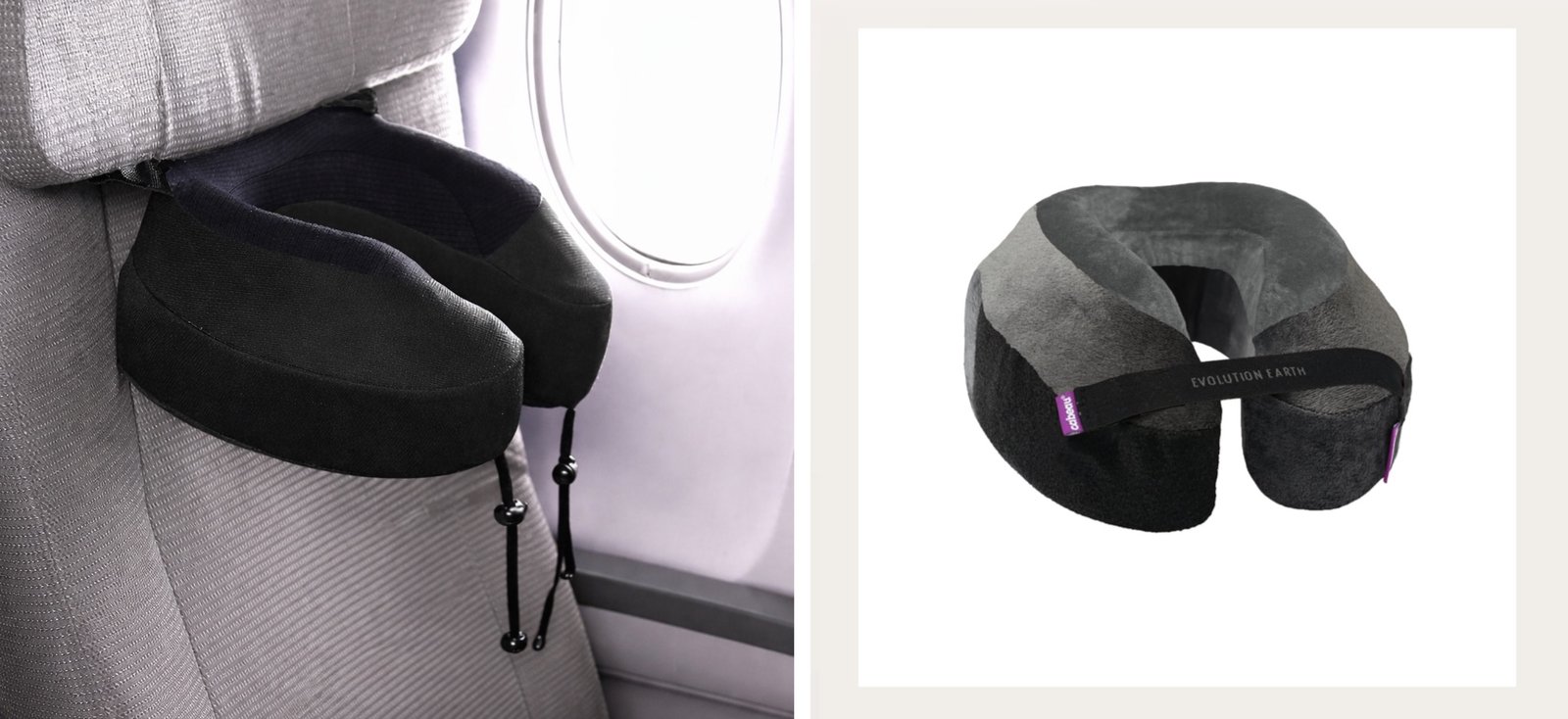
The Evolution Earth follows a comfort-first take on the classic U-shape. Its support strategy is internal: contoured memory foam, raised sidewalls, a thin flat back, and an elastic chin strap intended to interrupt forward head drop. Nothing anchors the pillow beyond the neck itself. As a result, alignment depends heavily on neck length, head position, and precise strap placement. When those variables line up, the pillow feels balanced. When they do not, support drifts upward and pressure concentrates at the jaw and ears.
The Evolution S3 keeps the same core geometry but changes where stability comes from. Instead of relying only on foam and fit, it introduces seat-mounted straps and a front tension system to control movement. The load path partially shifts from the neck to the aircraft seat. This can reduce sliding in seats with defined headrests, but it also introduces seat dependence and leaves a persistent gap under the chin. Both designs trade universal consistency for conditional stability through different mechanisms.
Neck Support & Stability
Both the Evolution Earth and Evolution S3 try to solve the same problem: keeping the head aligned in an upright airline seat without creating new pressure points. They approach this through different restraint strategies, but both remain sensitive to anatomy, seat geometry, and small changes in posture over time.
Does It Prevent Forward Head Drop in Upright Seats?
The Evolution Earth manages forward head drop internally. Raised sidewalls provide lateral resistance, while the elastic chin strap is intended to catch the jaw before the head collapses forward. In practice, this only works when the strap sits precisely under the chin. For many neck lengths, especially average or shorter, the strap rides too high and fails to intercept forward motion, leaving the head to tip until the jaw meets the foam edge.
The Evolution S3 addresses forward drop by anchoring the pillow to the seat. The headrest straps reduce overall drift, but the front tension system deliberately maintains a gap between the arms. That gap removes any true under-chin landing zone. Forward support improves when the seat is reclined, but in upright economy seating the design relies more on seat angle than structural bracing.
Which Design Controls Side Lean Better?
Both pillows use tall, raised sidewalls to stabilize the jaw and cheeks. When neck height matches the geometry, lateral support feels controlled and predictable. When it does not, those same sidewalls become pressure points. Shorter or average necks often experience the foam pressing into the ears or folding them inward, especially when the pillow is tightened to increase stability. The S3’s seat straps limit side-to-side sliding, but they do not change the interaction between the sidewalls and the ear.
What Happens When You Shift or Change Position?
Movement exposes the differences quickly. On the Evolution Earth, shifting posture often causes the pillow to ride upward, concentrating pressure higher on the jaw and ears unless the chin strap is readjusted. On the Evolution S3, small posture changes alter strap tension. On seats without a defined headrest, the straps tend to migrate downward, slowly lowering the support zone and reducing stability without the user noticing immediately.
Where Each Design Breaks Down First
Both designs fail gradually, not catastrophically. Support erodes through misalignment: strap position, sidewall height, and back-panel compression drift out of sync with the neck over time. When that happens, comfort drops sharply, even though the pillow still appears properly positioned.
Ergonomics in Real Airline Seats
Airline seating exposes differences that don’t show up in static fit tests. Seat pitch, recline angle, and lateral constraints all change how these pillows behave once your head starts to relax and posture drifts.
In real use, seat-mounted restraint systems are not consistently permitted. Whether they can be used depends on airline rules, seat construction, and crew judgment, especially during taxi, takeoff, and landing phases. That inconsistency feeds directly into how predictable the ergonomics are in practice. For a deeper explanation of policy differences and FAA context, see my detailed breakdown of seat-strap travel pillows and airline regulations.
Does It Hold Your Head in Fully Upright Economy Seats?
In upright economy seating, both pillows are constrained less by their own geometry than by the seat itself. Limited recline and a near-vertical backrest increase forward load and reduce the margin for error in head positioning. Small changes in posture are amplified, and any misalignment becomes noticeable faster than in reclined seats.
The Evolution Earth depends on maintaining its position against the neck in this posture. When alignment holds, support feels acceptable for short periods. As posture shifts, the pillow tends to migrate upward, concentrating contact higher on the jaw and ears and requiring readjustment to restore balance.
The Evolution S3 gains relative stability when the seat provides a defined headrest and allows the straps to stay at a fixed height. In that case, overall drift is reduced compared to a free-floating U-shape. In seats without a usable headrest, the benefit largely disappears, and performance becomes similar to the Earth, with stability determined more by seat angle than pillow structure.
What Changes When the Seat Is Slightly Reclined?
With a mild recline, both designs improve. The Evolution Earth benefits from reduced forward load, allowing the sidewalls to do more of the work. Pressure shifts from the chin to the cheeks, which can still be uncomfortable for shorter necks.
The Evolution S3 performs more consistently when reclined. The seat straps limit drift, and the recline angle compensates for the missing under-chin support. Stability increases, but ear and jaw pressure from the raised sidewalls remains unchanged.
Does Window vs Aisle Seating Change Stability?
Window seats help both pillows by providing an external surface to lean against, reducing reliance on internal geometry. Aisle seats expose weaknesses faster. Any movement, seat contact, or adjustment tends to shift alignment, requiring readjustment to maintain support.
Comfort Over Time
Comfort with both the Evolution Earth and Evolution S3 changes noticeably as flight time increases, and the shift is mechanical rather than subjective. Both rely on mid-density memory foam that feels supportive at first contact and then gradually softens as heat builds. Early impressions are usually positive. Long-term consistency is where differences emerge.
With the Evolution Earth, the main change over time is positional drift. As the foam warms, the pillow is more likely to migrate upward or settle unevenly, especially during small posture adjustments. The thin back panel continues to prevent forward head push, but it also becomes the most load-sensitive area, concentrating pressure at a narrow contact zone behind the neck. Once alignment slips, restoring a neutral position requires frequent readjustment.
The Evolution S3 maintains its position longer when the seat straps can be used as intended. Reduced lateral movement delays the onset of discomfort caused by shifting. However, that stability does not translate into improved forward support over time. Because neither design provides consistent under-chin support in upright seats, alignment drift becomes more noticeable as foam softens. Comfort increasingly depends on seat recline rather than pillow structure.
In both cases, failure is gradual. Nothing collapses suddenly, but once the head settles into a suboptimal position, comfort degrades steadily and is harder to recover with each passing hour.
Ease of Use & Adjustability
Both pillows look straightforward until you try to keep them dialed in during an actual flight. The issue is not whether adjustment exists, but how forgiving that adjustment is once you are seated and your posture starts to change.
With the Evolution Earth, setup is quick and intuitive. You put it on, adjust the chin strap, and you are done. The problem appears after that first setup. Adjustment is less about range and more about tolerance. Small anatomical mismatches require frequent corrections, which is difficult to maintain in a cramped seat. Minor shifts in posture often undo the initial fit, and correcting them usually means pulling at the strap or repositioning the pillow while seated, which quickly becomes intrusive.
The Evolution S3 introduces more adjustment points, but that does not automatically improve ease of use. The seat straps, front tension system, and pillow position all interact. When everything aligns, the pillow stays centered longer. When it does not, the adjustments start working against each other. Small changes in seat position or posture can alter strap tension and support height, requiring repeated fine-tuning.
In both cases, adjustability is continuous rather than set-and-forget. The designs assume a level of ongoing interaction that is hard to sustain on longer flights, especially when space, movement, and attention are limited.
Who Each Pillow Is Actually For
Choose the Evolution Earth if your neck length naturally matches its geometry and the chin strap sits securely under your jaw without riding upward. If the sidewalls rest below your ears and the strap intercepts forward drop reliably, it can provide stable support for short to moderate flights without relying on the seat. This option suits travelers who prefer a traditional U-shape and fly on mixed aircraft where seat attachments may be restricted.
Choose the Evolution S3 if you have a longer neck, frequently fly on aircraft with defined headrests, and are comfortable using seat-mounted straps when permitted. When properly anchored, it reduces lateral drift and maintains position longer than a free-floating pillow. It is best suited to travelers who fly repeatable routes on similar aircraft and value positional stability over universal compatibility.
If your neck length is average or short, you change posture frequently, or you fly across mixed fleets with inconsistent seat designs, neither model is likely to deliver reliable long-term comfort. In those cases, both designs become adjustment-heavy and sensitive to small misalignments rather than forgiving.
Final Verdict
Between the two, the Evolution S3 is the better choice when seat attachment is available and usable. In cabins with defined headrests and permissive crew policies, it holds position longer, drifts less over time, and delivers more consistent stability than the Evolution Earth. On paper, the S3 looks more secure, but that advantage only exists when the cabin cooperates.
The Evolution Earth is the better option only if you cannot rely on seat-mounted straps and your anatomy happens to match its geometry. When the chin strap sits correctly and sidewalls align with your jaw, it performs acceptably without depending on the seat. Outside that narrow fit window, stability deteriorates quickly.
If you regularly fly on modern aircraft with usable headrests and want the highest chance of maintaining alignment over multi-hour flights, choose the Evolution S3.
If you fly on mixed fleets, cannot depend on strap usage, and prefer a simpler setup, choose the Evolution Earth.
If neither condition applies, neither pillow is a reliable long-term solution, and you are likely to experience ongoing adjustment and declining comfort.
FAQ
The questions below are answered on the assumption that seat-strap pillows are allowed and usable on the aircraft. In real flights, acceptance can vary by airline, seat design, and crew discretion, etc. The answers here focus on how the designs behave when the strap system can actually be used.
Is either pillow a good choice for forward sleepers in upright economy seats?
No. Neither pillow consistently supports forward sleepers in upright economy seating. Both designs work better when some recline is available, and performance drops quickly when the seat remains close to vertical.
Does the Evolution S3 always work better because it attaches to the seat?
Not always. The added stabilization only helps when the aircraft seat has a usable headrest and attachment is permitted. In cabins where this is not possible, the advantage largely disappears.
Are these pillows suitable if I fly on many different aircraft types?
They are better suited to repeatable seating scenarios. Mixed fleets, older cabins, or inconsistent seat designs reduce predictability and make performance harder to rely on.
Which pillow is more forgiving if my neck length is average or shorter?
Neither is particularly forgiving. Both designs assume a specific anatomical range. If your proportions fall outside that range, comfort and stability become inconsistent rather than slightly reduced.
Do these pillows work for long-haul flights?
They can, but only under the right conditions. Comfort tends to hold when posture, seat angle, and fit remain stable. Once alignment shifts, comfort is harder to recover over longer durations.
Are they easy to use without frequent adjustment?
No. Both require ongoing attention. Small posture changes often mean small corrections, which becomes tiring over time, especially in tight seating.
Which one is the safer overall choice?
Neither is universally safe. Both are conditional designs that perform well only when body proportions, seat geometry, and flight conditions align. If any one of those factors is off, performance degrades quickly rather than gradually.