


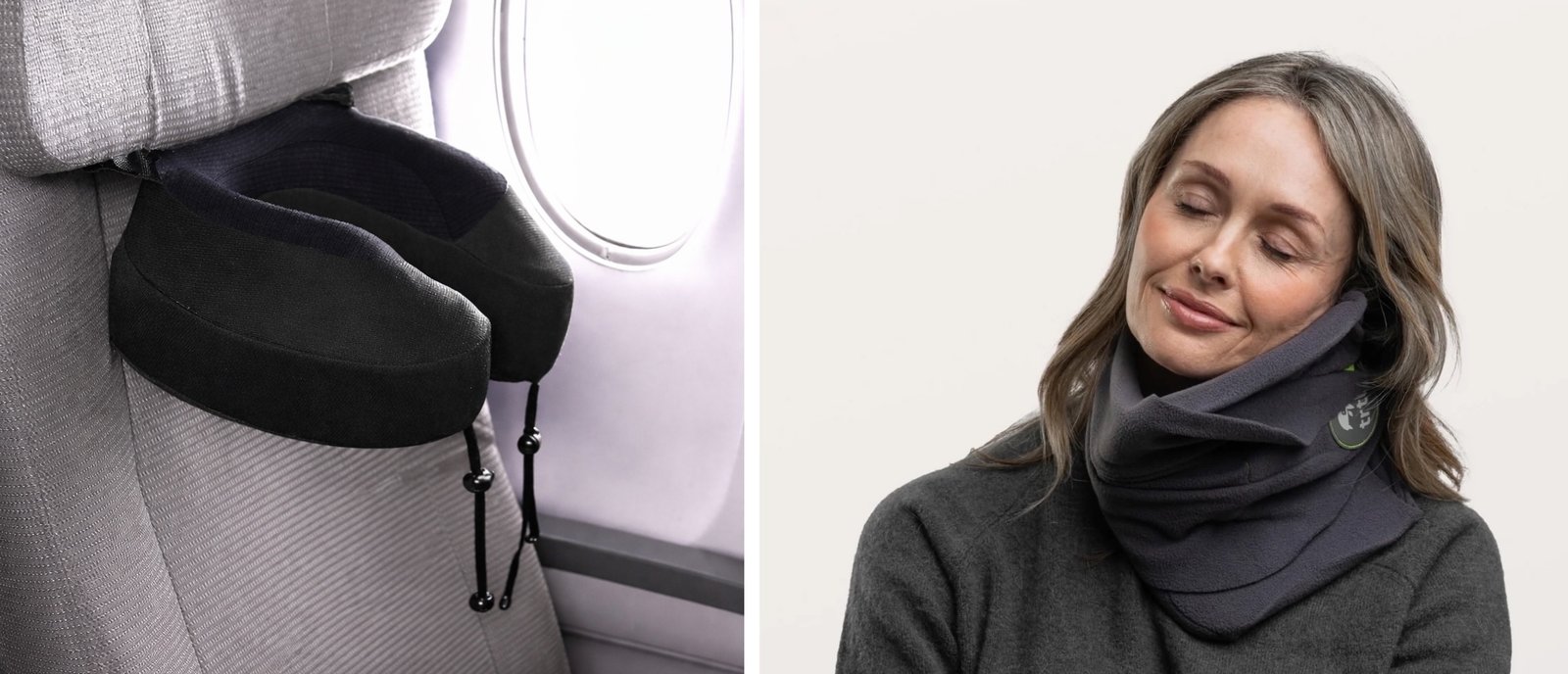
Cabeau Evolution S3 vs Trtl Pillow compares two fundamentally different approaches to neck support on planes. The Cabeau Evolution S3 uses a memory foam cradle with a seat-strap system designed to anchor the pillow to the headrest and limit movement. The Trtl Pillow relies on a rigid internal brace wrapped in fleece to mechanically stop head drop without attaching to the seat. Both target upright airline seating, but they behave very differently once recline, movement, and real cabin constraints are introduced.
Category: Travel Pillows
Author: Product Developer (Independent, No Sponsorships)
Written by a product developer who reviews travel gear with zero sponsorships.
Clear, technical breakdowns of materials, ergonomics, and real-world use.
Table of Contents
- Support Design: Cabeau Evolution S3 vs Trtl Pillow
- Neck Support & Stability
- Ergonomics in Real Airline Seats
- Comfort Over Time
- Ease of Use & Adjustability
- Who Each Pillow Is Actually For
- Final Verdict
- FAQ
Support Design: Cabeau Evolution S3 vs Trtl Pillow
The Cabeau Evolution S3 and the Trtl Pillow are built on different assumptions about how neck support should work on planes. Cabeau treats head movement as a containment problem. The S3 uses a memory foam cradle with raised sidewalls and a seat-strap system intended to anchor the pillow to the headrest and limit drift. Stability comes from distributing pressure around the neck and tying the pillow’s position to the seat.
Trtl approaches the problem as mechanical restraint. Its internal plastic brace is designed to intercept head drop directly and transfer load into the shoulder. The fleece wrap exists to hold the brace in place, not to create cushioning or shape, and the system operates independently of the seat.
In practice, the S3 prioritizes distributed comfort and seat-dependent stability, while Trtl prioritizes fixed geometry and predictability. One relies on foam and anchoring. The other relies on structure and posture. Those choices define both performance and failure modes.
Neck Support & Stability
Neck support differences between the Cabeau Evolution S3 and the Trtl Pillow only become clear once the pillow is under sustained load. Upright seating, partial recline, and small movements expose where each design resists motion and where it gives way. This section breaks that down by forward collapse, lateral stability, and movement tolerance.
Does It Prevent Forward Head Drop in Upright Seats?
The Evolution S3 is designed to address forward head drop through a combination of memory foam geometry and a seat-strap system. The raised sidewalls and front tension cinch are meant to keep the head centered, while the straps anchor the pillow to the headrest. In practice, this only works consistently when the seat is reclined. The front cinch maintains a gap under the chin, which means there is no true forward brace in upright positions. As a result, the head can still fall forward until it meets the seat angle rather than the pillow.
Trtl approaches forward drop indirectly. Its rigid internal brace intercepts head movement once the head begins to lean laterally. When the seat is close to upright, this prevents the cascading forward slump common with soft pillows. As recline increases, that interception point shifts, and forward support weakens quickly.
Which Design Controls Side Lean Better?
Side stability is where Trtl has a clear mechanical advantage. The internal brace transfers load directly into the shoulder, maintaining a fixed lean angle with minimal deformation. As long as alignment is correct, support remains consistent over time.
The S3 relies on foam and straps for lateral control. When the straps are secured to a proper headrest, they can reduce side drift. Without that anchor, side support depends entirely on foam compression, which degrades as the material warms and softens.
What Happens When You Shift or Change Position?
Movement breaks both systems, but differently. With Trtl, any posture change breaks alignment. Switching sides or adjusting lean requires unwrapping and resetting the brace. Support is stable, but only while you stay still.
With the S3, movement redistributes foam and loosens strap tension. Support fades gradually rather than failing immediately, but frequent adjustments are needed to rebuild shape and height.
Where Each Design Breaks Down First:
Trtl fails abruptly when posture or seat angle changes beyond its designed range. The S3 fails progressively as foam compresses and anchoring becomes unreliable. One fails by geometry. The other fails by material fatigue and dependency on the seat.
Ergonomics in Real Airline Seats
Airline seats expose how dependent each pillow is on seat geometry rather than intent. Seatback angle, headrest shape, and lateral space determine whether support holds or degrades. This matters more when a design interacts with the seat itself. The Cabeau Evolution S3 uses a rear seat-strap system that relies on headrest compatibility, while the Trtl uses a fixed brace with no seat attachment.
In practice, seat-strap systems are not universally accepted. Their use can depend on airline policy, aircraft seat design, and crew discretion, particularly during taxi, takeoff, and landing. That variability directly affects real-world ergonomics. If you want to understand how airlines and the FAA actually handle seat-strap pillows in real flights, I break it down in this full seat-strap rules analysis.
Does It Hold Your Head in Fully Upright Economy Seats?
In fully upright economy seats, Trtl operates closer to its design target. The fixed brace intercepts lateral head movement early and does not depend on foam compression or seat features. Support remains predictable as long as posture stays stable.
The Evolution S3 is less reliable here. The front tension system leaves a gap under the chin, offering limited resistance to forward head drop. Without recline, the memory foam alone cannot prevent collapse, and the seat straps contribute little unless the headrest geometry aligns well and their use is permitted.
What Changes When the Seat Is Slightly Reclined?
With slight recline, the balance shifts. The S3 benefits from the changed angle, allowing the foam sidewalls and straps to stabilize the head more effectively. Trtl loses efficiency as recline increases, since the brace no longer intercepts the dominant movement path.
Does Window vs Aisle Seating Change Stability?
Seat position affects Trtl more. Window seats reinforce its side-lean posture, improving stability. In aisle seats, outward drift increases reliance on the brace alone. The S3 is less seat-position dependent, but only when the seat and rules allow strap use.
Neither design is universally ergonomic. Trtl favors fixed geometry and stillness. The S3 favors seat-assisted stability, when the seat allows it.
Comfort Over Time
Comfort over time exposes the trade-off between distributed cushioning and fixed mechanical support. Early impressions are misleading. What matters is how each pillow behaves after body heat, muscle relaxation, and repeated micro-movements set in.
The Cabeau Evolution S3 feels more comfortable at the start. The microfiber face panel and memory foam sidewalls spread pressure across the cheeks and jaw, avoiding sharp contact points. Over time, that comfort becomes inconsistent. As the foam warms, it softens and loses height, especially at the thin back panel. The raised sides can begin pressing into the ears for shorter or average necks, and the front gap under the chin remains unsupported. Comfort shifts from supportive to merely padded, requiring frequent strap or position adjustments.
Trtl feels less forgiving initially. The fleece masks the internal brace, but you are always aware of the structure beneath. Pressure is concentrated along the jaw and side of the neck rather than distributed. The difference is stability. That pressure profile stays largely unchanged over time. There is no foam collapse and little drift, but static load becomes noticeable on longer flights, especially for users sensitive to jaw or facial pressure.
Neither design adapts passively. The S3 trades long-term consistency for early softness. Trtl trades softness for predictability. On extended flights, both interrupt rest, just for different reasons.
Ease of Use & Adjustability
Ease of use differs less in how quickly each pillow goes on and more in how much attention it demands once you are tired. Both are usable in economy seats, but they fail in different ways during real flights.
The Trtl Pillow has a deliberate setup. The wrap needs horizontal tension and accurate placement of the internal brace along the jaw before fastening the Velcro. In tight rows, this takes a moment of space and intent. Once secured, the system is stable. There are no fine adjustments to manage and nothing to retune gradually. The cost of that simplicity is commitment. If alignment is off or you want to change sides, the only option is to unwrap and start again.
The Cabeau Evolution S3 is easier to put on initially. You position the pillow, adjust the front cinch, and optionally secure the seat straps. Adjustability is continuous. You can tighten, loosen, or re-center the pillow without removing it. In practice, this flexibility becomes maintenance. Foam compression, strap slippage, and seat geometry require repeated corrections to keep support consistent.
Trtl asks for one correct setup and then leaves you alone. The S3 offers more adjustment options but demands ongoing attention. Which feels easier depends on whether you prefer a single committed setup or repeated small interventions.
Who Each Pillow Is Actually For
Trtl is the better choice if you prioritize structural stability over cushioning and tend to sleep in one fixed posture. It works best for upright economy seating, window-seat leaning, and travelers who remain still once settled. If you prefer predictable mechanical support that does not depend on seat design, Trtl is the more reliable option. It suits short to medium flights, minimalist packing, and users who accept jaw contact in exchange for consistent lateral control. If you frequently change positions, recline deeply, or expect the pillow to adapt dynamically, Trtl will feel restrictive.
Cabeau Evolution S3 is the better choice if you value distributed comfort and usually fly in seats that allow recline and strap use. It performs best for longer necks, partial recline, and aircraft with compatible headrests. If you tend to slump forward rather than lean sideways and prefer softer contact around the face and neck, the S3 is the more comfortable starting point. However, if you mostly fly upright, encounter strap restrictions, or want support that works independently of seat geometry, the S3 becomes unreliable and is the weaker choice.
Final Verdict
If you mostly fly in upright economy seats, prefer stable window-seat leaning, and want support that works without relying on airline seat design, choose Trtl. Its internal brace delivers more consistent neck control across aircraft types, even though it feels firmer and limits movement.
If you usually have access to recline, compatible headrests, and allowed strap use, and you prioritize softer contact over rigid structure, choose the Cabeau Evolution S3. Under the right conditions, it offers better initial comfort, but its performance depends heavily on seat geometry and ongoing adjustment.
In practical terms, Trtl is the safer default for unpredictable flights and frequent travelers. The S3 only makes sense if your seating conditions regularly match its design assumptions. If they do not, its advantages disappear quickly.
If you regularly switch sides, sleep diagonally, or rely on adaptive cushioning, neither design is a good fit.
FAQ
The questions below are answered on the assumption that seat-strap pillows are allowed and usable on the aircraft. In real flights, acceptance can vary by airline, seat design, and crew discretion, etc. The answers here focus on how the designs behave when the strap system can actually be used.
Is Cabeau Evolution S3 or Trtl better for neck support on planes?
They solve neck support differently. The Evolution S3 uses memory foam and a seat-strap system to stabilize the head through cushioning and anchoring. Trtl uses a rigid internal brace to mechanically stop head movement without attaching to the seat.
Does the Cabeau Evolution S3 seat-strap system actually help?
It can help when the seat has a proper headrest and the straps can stay in position. In those cases, it reduces sliding and lateral drift. Without a usable headrest, the benefit largely disappears.
Which pillow works better in upright economy seats?
Trtl is more reliable in fully upright seats because it does not rely on recline or seat attachment. The Evolution S3 performs better once slight recline is available, where the foam and straps can work together.
Is Trtl uncomfortable compared to memory foam pillows?
Trtl feels firmer and more noticeable because of the internal brace. Comfort comes from stability rather than softness. Users expecting plush cushioning often prefer memory foam, even if support degrades over time.
Which is better for long flights?
Neither is ideal for uninterrupted long-haul sleep. Trtl maintains structure but can create pressure fatigue. The Evolution S3 feels softer initially but loses support as foam compresses and adjustments increase.
Can you move or change positions easily with either pillow?
Movement breaks both systems. Trtl requires full repositioning if you switch sides. The Evolution S3 allows incremental adjustments, but frequent movement accelerates foam collapse and strap slippage.
Who should avoid both designs?
Restless sleepers, frequent side-switchers, and travelers who rely on adaptive cushioning rather than fixed support may struggle with both. These designs reward specific postures, not constant movement.