


Finding a comfortable travel pillow on planes is harder than most travelers expect, even after trying multiple designs. Many products promise better neck support and pain-free sleep, yet still fail in real economy seats. The problem is rarely the pillow alone. Airline seat design, limited recline, upright posture, and individual sleep position all shape whether a travel pillow works or collapses after an hour. If you’re unsure which pillow designs are even permitted in-flight, this breakdown of airline seat-strap rules explains the limits in detail.
This guide explains why so many travelers struggle to stay comfortable on long flights, how common pillow designs fall short, and what actually improves sleep quality when space and posture are restricted.
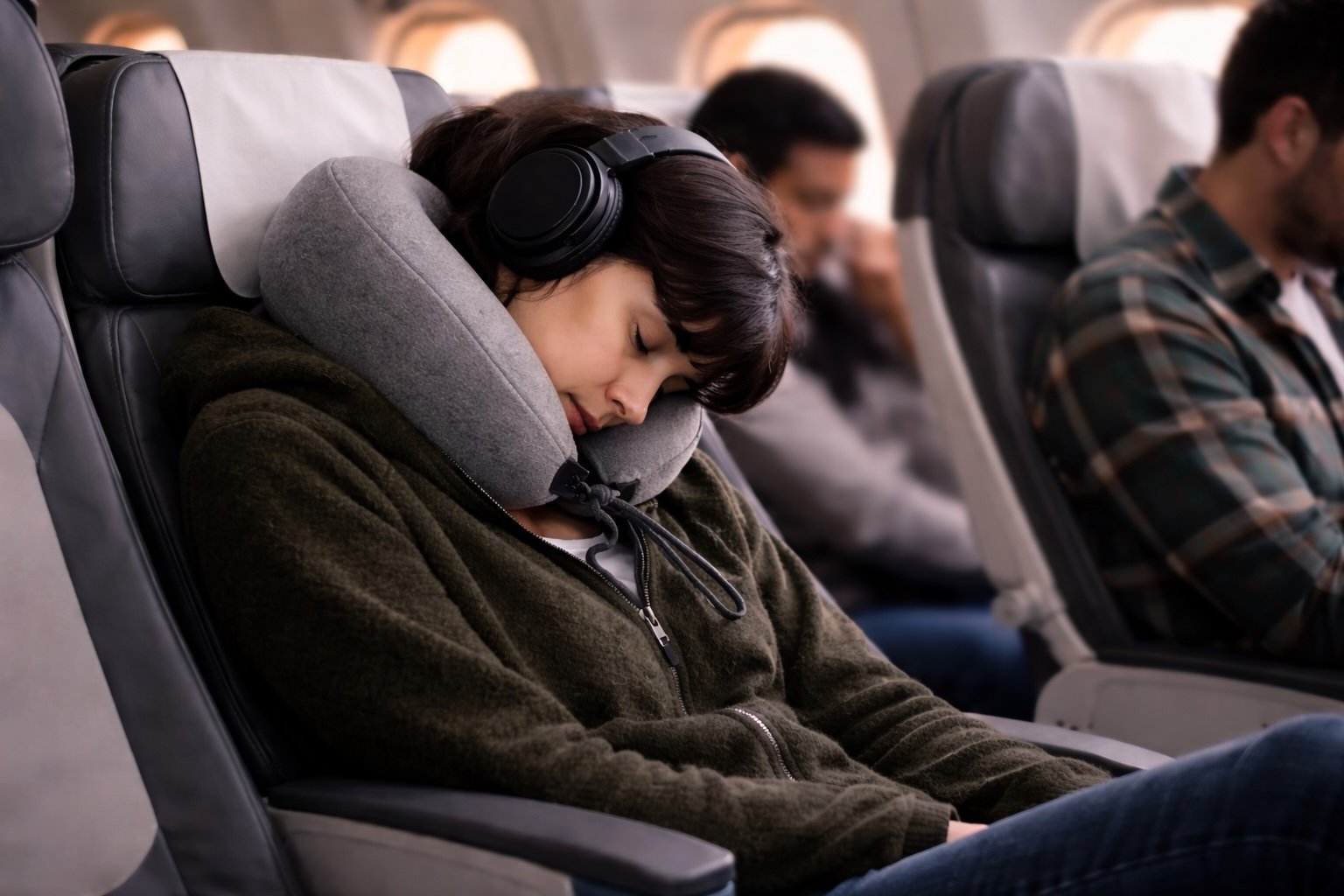
Category: Travel Pillows
Author: Product Developer (Independent, No Sponsorships)
Written by a product developer who reviews travel gear with zero sponsorships.
Clear, technical breakdowns of materials, ergonomics, and real-world use.
Table of Contents
- Why Most People Buy the Wrong Travel Pillow
- Why Airline Seats Cause Neck Pain (Not Pillows)
- Common Travel Pillow Design Flaws Explained
- Why Comfort Does Not Equal Neck Support on Planes
- Different Sleeping Positions and Why Pillows Fail
- What Actually Works for Sleeping on Planes
- Conclusion: How to Choose a Pillow That Fits Your Seat
- FAQ
Why Most People Buy the Wrong Travel Pillow
Most travelers don’t choose a travel pillow based on how it performs in real airline seats. They choose it based on ratings, photos, and short-term comfort impressions. That decision process favors products that feel good immediately but fail once posture, fatigue, and limited space enter the equation. As a result, many buyers end up cycling through multiple pillows without solving the underlying problem.
Many of these patterns appear repeatedly in large travel forums, where users describe buying multiple pillows without finding consistent relief.
Why do travel pillow reviews feel misleading?
Most travel pillow reviews are written after brief testing sessions, not multi-hour flights. Reviewers often evaluate softness, first-contact comfort, and portability, while ignoring long-term stability and posture control. Many tests are done on sofas, office chairs, or recliners, where seat geometry is forgiving. In those environments, almost any pillow feels supportive. In upright economy seats, the same designs behave very differently. Most reviews rarely account for seat position. A pillow that works well in a window seat may fail completely in an aisle seat, yet both experiences are averaged into a single rating.
Why Store Displays Don’t Reflect Real Airplane Use
Retail displays encourage quick, upright trials that last seconds, not hours. Shoppers test pillows while standing or sitting briefly on flat benches with full back support. These conditions eliminate forward head drop, side instability, and fatigue-related posture collapse.
Without those stress factors, structural weaknesses remain hidden. The pillow feels comfortable in-store, but loses effectiveness once used in narrow, semi-reclined airline seats for extended periods.
That gap between testing conditions and real use drives most disappointing purchases.
Why Airline Seats Cause Neck Pain (Not Pillows)
Neck pain on airplanes is primarily a structural problem, not a product failure. Most economy seats are designed to maximize cabin density, not sleeping ergonomics. Limited recline, short seat pans, and forward-positioned headrests place the spine in a compromised posture from the start. Travel pillows can only modify that posture slightly. They cannot correct the underlying geometry.
How Seat Geometry Affects Neck Alignment
Airline seats position the pelvis slightly forward and tilt the upper back away from vertical support. This shifts the head’s center of mass in front of the spine, increasing cervical load. Headrests are typically placed too far back to provide meaningful contact in upright posture, forcing the neck to bridge the gap.
Seat width also matters. Narrow armrests restrict lateral movement, preventing natural repositioning. Without a stable side surface, the head must be supported almost entirely by neck muscles or external aids. Over time, this creates cumulative strain regardless of pillow type.
Why Upright Seating Increases Muscle Fatigue
In upright economy seats, the neck rarely reaches a true resting position. Instead, stabilizing muscles remain partially engaged to prevent forward collapse and rotational drift. This low-level contraction persists for hours, accelerating fatigue and stiffness.
As fatigue increases, posture deteriorates. The head drifts forward, shoulders slump, and cervical flexion increases. Pillows may soften contact points, but they cannot eliminate continuous muscular compensation. The longer the flight, the more dominant this fatigue mechanism becomes.
Understanding this constraint explains why comfort often fails despite multiple pillow purchases.
Common Travel Pillow Design Flaws Explained
Most travel pillows fail not because of poor materials, but because their designs do not match the mechanical demands of upright sleeping. Supporting a suspended head in a narrow seat requires controlled load transfer, stable contact surfaces, and resistance to gradual deformation. Many popular designs prioritize softness and portability instead, creating predictable performance limitations.
Why Soft Pillows Collapse Under Load
Soft fiberfill and low-density foam feel comfortable on first contact, but they compress quickly under sustained head weight. As compression increases, vertical support and lateral resistance decline. The pillow gradually flattens, forcing the neck to compensate through muscle engagement.
This collapse is rarely noticeable during short tests. It becomes obvious only after one to two hours of continuous use, when loft reduction reaches a functional threshold. At that point, comfort may remain acceptable, but structural support has already deteriorated. This collapse pattern is especially common in U-shaped and chin-support designs.
Why Straps and Wraps Rarely Stabilize the Neck
Strap-based and wrap-style pillows attempt to create stability through tension rather than structure. In theory, anchoring the pillow to the seat or body should limit movement. In practice, tension fluctuates with posture changes, breathing, and fabric stretch.
This behavior is clear in structured wrap designs like the Trtl, which rely heavily on sustained tension for support.
As tension relaxes, alignment drifts. Retightening restores support temporarily, but requires frequent adjustment. This makes long-term stability dependent on user intervention rather than design integrity.
Why “Memory Foam” Is Often Misused
Many travel pillows labeled as memory foam use low-density, fast-recovery variants optimized for weight reduction. These materials conform quickly but lack sufficient rebound force to maintain shape under dynamic loads.
True high-density memory foam is heavy and slow to recover, making it impractical for travel products. As a result, most “memory foam” pillows trade structural resilience for portability, limiting their effectiveness in prolonged upright seating.
These design compromises explain why many pillows feel promising initially but underperform in flight.
Why Comfort Does Not Equal Neck Support on Planes
Comfort and support are often confused in travel pillow marketing, but they solve different problems. Comfort describes how a pillow feels against the skin and facial structures. Support describes how well it controls head position over time. On airplanes, these two qualities rarely align.
Soft fabrics, plush fillings, and wide cushioning surfaces reduce pressure points and irritation. This creates immediate relief and positive first impressions. However, these materials deform easily under sustained load. As they compress, the head gradually loses positional stability, even though surface comfort remains high.
In upright economy seating, effective neck support requires resistance to rotation, forward collapse, and gradual drift. A pillow can feel pleasant while failing to provide any meaningful mechanical control. Many travelers interpret this mismatch as “bad posture” or “restless sleep,” when it is actually a structural limitation.
This gap explains why users often report that a pillow feels good at first but becomes ineffective after an hour. Comfort delays discomfort. Support prevents misalignment. Without both, long-term rest remains unreliable, regardless of softness or price.
Different Sleeping Positions and Why Pillows Fail
Travel pillow performance depends heavily on how a person naturally tries to sleep in confined seating. Most designs are optimized for one dominant posture, while real travelers shift between several. This mismatch explains why a pillow that works briefly can fail over longer flights.
Upright sleepers are the most difficult to support. With limited recline, the head tends to fall forward and rotate unpredictably. Pillows that lack under-chin resistance or rigid lateral surfaces struggle to control this movement, leading to progressive neck flexion and muscle fatigue.
Side sleepers rely on external contact, usually a window or seat wall, to stabilize their head. When this support is available, structured pillows can perform well. Without it, side-lean posture collapses quickly, forcing constant repositioning.
Frequent movers alternate between upright, semi-reclined, and curled positions as discomfort builds. Each shift disrupts pillow placement and resets support. Designs that require precise alignment lose effectiveness fastest in this group.
Forward-lean sleepers often rest against tray tables or folded arms. While this reduces backward tilt, it increases cervical flexion and upper-back strain. Most travel pillows are not designed to function in this posture.
Pillows fail when their intended support model conflicts with a traveler’s dominant sleep pattern. Matching design to position matters more than brand or material. A direct comparison of loop-based and wrap-based designs shows how these failures play out in real use.
What Actually Works for Sleeping on Planes
Improving sleep on airplanes requires working within structural limits rather than trying to override them. The most reliable gains come from combining seat choice, posture management, and selective use of support tools.
Window seats provide the strongest foundation for rest. The cabin wall offers consistent lateral resistance, reducing the load placed on neck muscles. When paired with a structured pillow or compact cushion, this setup creates the closest approximation to external bracing available in economy class.
Moderate recline, when available, reduces forward head drift and lowers muscular demand. Small posture adjustments, such as supporting the upper back with a folded jacket or lumbar cushion, can improve spinal alignment and indirectly reduce neck strain.
Pillows work best when treated as stabilizers rather than primary supports. Their role is to refine positioning, not replace seat structure. Lightweight neck braces, compact lumbar pads, and adjustable footrests can also contribute by improving overall body alignment.
Travelers who focus on controlling their seating environment and posture consistently achieve better sleep than those who rely on a single product. Effective rest is built from coordinated adjustments, not isolated purchases.
Conclusion: How to Choose a Pillow That Fits Your Seat
Choosing a travel pillow is ultimately about matching design to seating conditions and sleep behavior. Window-seat sleepers benefit most from structured, side-support designs. Travelers who move frequently need flexible options that adapt to changing posture. Upright aisle seating limits the effectiveness of most pillows, regardless of brand or material.
Before buying, consider where you usually sit, how much you recline, and how often you change position. When those factors align with a pillow’s support model, comfort becomes predictable. When they don’t, repeated disappointment follows.
FAQ
Do travel pillows actually help prevent neck pain on planes?
Travel pillows can reduce neck strain when matched to the right seat position and sleeping posture. They work best in window seats or semi-reclined positions where external support is available. In fully upright aisle seats, most pillows provide limited long-term relief.
Why do most travel pillows feel comfortable at first but fail later?
Most pillows use soft materials that compress under sustained head weight. As loft decreases, structural support weakens. Comfort remains, but alignment control declines, leading to fatigue over time.
Is memory foam better than fiberfill for travel pillows?
High-density memory foam can provide better shape retention, but most travel versions use lightweight, low-density foam. These prioritize portability over support, making real-world performance similar to fiberfill in long flights.
Which seat is best for using a travel pillow?
Window seats provide the most reliable environment for pillow effectiveness. The cabin wall adds lateral stability, reducing reliance on neck muscles. Aisle and middle seats limit structural support.
Can any pillow work for upright sleeping in economy class?
No pillow consistently supports upright sleeping without external bracing. Some designs reduce discomfort, but none eliminate muscle engagement in fully upright seats.
How should I choose a travel pillow for long flights?
Choose based on seat preference and sleep behavior. Stable window sleepers benefit from structured pillows. Frequent movers benefit from flexible designs. Avoid selecting based on softness alone.