


The flowzoom inflatable travel pillow takes a different approach from foam-based neck pillows by using an inflatable air-chamber design instead of fixed padding. Rather than relying on material thickness for support, it uses adjustable air pressure to change firmness, shape, and neck contact depending on how much it’s inflated. This makes the pillow lightweight, highly packable, and easy to customize, but it also shifts the responsibility for comfort and stability onto setup and inflation accuracy. How well it works depends less on softness and more on how precisely you adjust it for your posture and seat position. Below is a detailed breakdown of how this inflatable design performs in real travel conditions.
Below is the full breakdown.
Category: Travel Pillows
Author: Product Developer (Independent, No Sponsorships)
Written by a product developer who reviews travel gear with zero sponsorships.
Clear, technical breakdowns of materials, ergonomics, and real-world use.
Table of Contents
- Design Overview
- My Take (from a product developer)
- Design-Level Constraints (Independent of User Preference)
- What Travelers Are Saying
- Final Scores
- Verdict
- FAQ
Design Overview
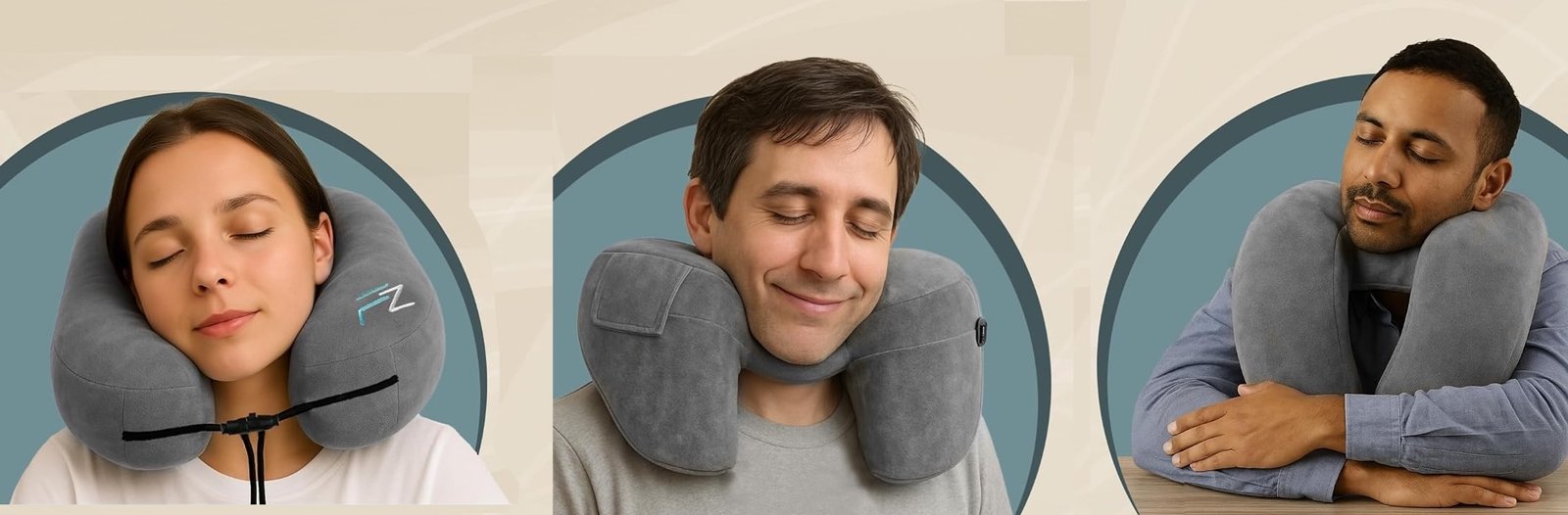
The Flowzoom Travel Pillow is an inflatable design that replaces foam structure with adjustable air pressure. Instead of relying on fixed padding, support is created by how much air you add and where the pillow presses against the neck, jaw, and sides of the head. The shape is meant to distribute contact around the neck while keeping the back relatively flat to avoid pushing the head forward.
Because it’s inflatable, firmness, height, and support change depending on inflation level. This makes the pillow highly adjustable, but also means stability depends on setup rather than built-in structure.
Key design elements:
- Inflatable air-chamber construction instead of foam
- Ergonomic, multi-contact shape for neck and jaw support
- Flat rear profile to reduce forward head push
- Adjustable firmness via air pressure
- Push-button valve for inflation and deflation
- Soft fabric exterior over the inflatable chambers for skin contact
- Washable fabric construction for basic hygiene
- Optional hood attachment for light and visual shielding
- Packs down very small when fully deflated
- Lightweight design focused on portability
My Take (from a product developer) on the Flowzoom Inflatable Travel Pillow
Design & Structure
The Flowzoom is an inflatable H-shaped travel pillow, not a padded foam one. Its structure uses two vertical air columns positioned on the left and right sides of the neck. These columns rise higher toward the back to support the head and taper lower toward the front to avoid forcing the chin upward. The two columns are connected by a short horizontal bridge at the back. The front remains open and can be lightly tightened with a drawstring, but there is no structural bridge in front providing true chin support.
The H-shape allows the pillow to provide lateral and chin support without pushing the head forward when leaning against a seat. Because the rear section is slim, it avoids the common issue where thick-backed pillows force the neck into flexion.
Structurally, the pillow works in two genuinely practical configurations, despite marketing claims of “five positions”:
- Reclined / side-support configuration Used like a traditional U-shape, the tall side columns support the jaw and sides of the head, while the higher rear section stabilizes the back of the skull. This works best in slightly reclined seats, where forward chin support isn’t critical. The curved top edges naturally cradle the jawline without forcing chin lift.
- Forward chin-support configuration Rotating the pillow places the taller columns at the front, creating a raised surface under the chin. This can prevent forward head drop, but only if the pillow height matches the user’s neck length. When the fit is off, chin support becomes inconsistent rather than corrective.
Flowzoom advertises 360° support, but in practice this comes from rotational flexibility, not continuous structural support. The pillow does not self-adjust as you move. Stability depends on inflation level, neck length, and staying in position.
The integrated drawstring and stopper system helps fine-tune front tension but does not create a rigid closure. One of the two main configurations can be used with or without the hood. The hood improves light blocking and containment but does not materially change head or neck support.
In short, the Flowzoom’s design prioritizes positional flexibility and compactness over enforced posture. It avoids the forward-push problem of bulky U-pillows, but its effectiveness depends heavily on fit and deliberate setup rather than automatic alignment.
Materials
The Flowzoom uses an inflatable PVC air bladder as its core structure. A soft polyester fabric layer is permanently integrated around the inflatable chambers, meaning it’s not a removable cover but a built-in exterior surface for skin contact. This fabric improves comfort compared to bare PVC and allows the entire pillow to be machine washable. The materials are chosen for light weight and packability rather than a premium or padded feel.
Durability
The Flowzoom’s durability is governed by its inflatable PVC bladder rather than foam fatigue. Because there’s no compression-based core, it avoids the gradual collapse seen in memory-foam pillows. Repeated inflation and deflation are generally well tolerated under normal travel use.
Long-term wear risk comes from puncture, seam stress, and fabric abrasion, not loss of support. The permanently attached polyester surface offers basic protection but will soften and show cosmetic wear over time, especially around the valve and drawstring.
Overall, it’s durable enough for regular trips if handled carefully, but it’s not designed for rough packing or long-term abuse.
Ergonomics
The Flowzoom’s ergonomics are built around lateral and rear head containment, not chin bracing. The two vertical air columns sit on either side of the neck, rising higher at the back to stabilize the head while remaining lower at the front to avoid forcing the chin upward.
In practice, this creates two genuinely useful configurations. In a reclined seat, the pillow works best as a side-and-rear support system, where the taller back portions prevent the head from rolling or drifting backward. When rotated forward, one column can provide partial chin support, but this only works well if neck length and inflation level align closely.
The front drawstring adjusts fit but does not create structural chin support. As a result, the Flowzoom is most effective for reclined or side-leaning sleep, not strict upright head-forward control.
Design-Level Constraints (Independent of User Preference)
Beyond design, there are practical considerations that show up only during use.
• No structural front load path
The H-shaped layout leaves the front of the neck largely unsupported from a structural standpoint. Without a rigid or semi-rigid front element, resistance to forward head rotation depends on air pressure and drawstring tension rather than geometry.
• Column height is fixed relative to anatomy
The vertical air columns cannot adapt to variations in neck length or jaw position. If the column height doesn’t align with the user’s cervical geometry, the pillow cannot redirect load effectively, regardless of inflation level.
• Air chambers provide limited compliance under sustained load
Inflatable structures distribute pressure evenly but lack progressive resistance. Over time, this results in a firmer, less adaptive feel compared to compressible foam that can absorb micro-movements.
• Internal air migration affects stability
Because support relies on shared air volume, shifts in posture cause pressure redistribution inside the columns. This reduces positional consistency and introduces the need for periodic re-adjustment.
• Performance depends on seat recline geometry
The design assumes partial recline to offset forward head torque. In fully upright seating, the pillow has limited mechanical leverage to counter sustained nodding forces.
• Surface material prioritizes practicality over tactile refinement
The integrated fabric layer improves comfort and usability but is optimized for durability and washability rather than long-duration skin contact or premium feel.
What Travelers Are Saying (Amazon, YouTube, Reddit)
Positive patterns:
- Back section doesn’t push the head forward
The thin rear connector avoids the common problem of inflatable U-pillows forcing the head into a forward tilt against the seat. - Side stability is better than classic inflatable pillows
The taller rear portions of the air columns give the head something to lean into, reducing side roll when resting against a seat or window. - Adjustable firmness helps dial in comfort
Being able to control inflation lets users fine-tune support instead of being stuck with a single foam density. - Packs extremely small when deflated
When fully deflated, the pillow takes up far less space than foam alternatives, which makes it easy to carry or clip externally. - Works well for reclined sleeping positions
The shape aligns naturally with slightly reclined seats, where rear and lateral support matter more than front chin bracing. - Lightweight and easy to reposition
Because it’s inflatable, rotating or adjusting the pillow during use requires little effort compared to bulky foam designs.
Negative patterns:
- Limited forward chin support
With no structural bridge at the front, the pillow does little to stop forward head drop unless the drawstring is tightened aggressively, which many find uncomfortable. - Fit depends heavily on neck length
When the column height doesn’t match the user’s neck, the support feels either too low to matter or awkwardly positioned. - Inflatable surface lacks “forgiveness”
Even with partial inflation, the air chambers feel firmer and less adaptive than foam once pressure builds during longer sessions. - Air pressure shifts with movement
Changing position redistributes air inside the columns, which can reduce stability and require re-adjustment. - Less effective for fully upright sleeping
In economy seats with minimal recline, the design struggles to keep the head from nodding forward for extended periods. - Fabric surface feels basic
The integrated fabric layer improves comfort over bare plastic but still feels utilitarian rather than premium during long contact.
Final Scores
Scores reflect engineering performance, not just comfort.
Support & Stability: 6/10
The H-shaped air columns provide decent lateral and rear support, but the lack of a structural front element limits forward head control, especially in upright seats.
Material & Comfort: 6/10
The integrated fabric surface improves skin contact over bare inflatable designs, but the air-filled structure remains firmer and less adaptive than foam during extended use.
Ease of Use: 7/10
Inflation is quick and adjustments are straightforward, though finding the right pressure and configuration still requires trial and error rather than instinctive setup.
Packability: 8.5/10
Deflates flat, weighs very little, and takes up minimal space. This is one of the pillow’s strongest technical advantages.
Long-Haul Performance: 6/10
Works acceptably when seat recline and neck geometry align, but stability drops over time as air shifts and posture changes during long flights.
Verdict
The Flowzoom prioritizes portability over structural support. Its inflatable H-shaped design works when your posture and seat angle cooperate, but it can’t fully control forward head drop on long, upright flights. This is a space-saving solution, not a sleep-enforcing one.
Best for:
Travelers who want a very compact pillow for short to medium flights, light sleepers who recline slightly or lean sideways, and anyone minimizing carry-on space.
Not ideal for:
Fully upright economy seating, long-haul sleep, frequent position changes, or users who need firm chin support without tightening.
Bottom line:
Excellent packability, limited long-haul stability. Choose it for convenience, not for serious overnight support.
FAQ
Does inflation level meaningfully change performance?
Yes. Under-inflation reduces stability, over-inflation increases pressure points. There’s a narrow “sweet spot,” which requires manual tuning.
Does the Flowzoom Inflatable travel pillow actually prevent forward head drop?
Only partially. Without a structural front bridge, forward head control depends on how tightly the drawstring is pulled and whether your neck length matches the column height.
Is the H-shape doing real work or just marketing?
It’s doing real work for side and rear support. The tall rear portions of the side columns help stabilize the head without pushing it forward, which is the design’s main strength.
Why does the Flowzoom feel less stable than foam pillows on long flights?
Inflatable air chambers redistribute pressure as you move. That makes the support lighter and less consistent over time compared to dense foam.
Is the Flowzoom better for upright or reclined seating?
It performs better with some recline or side-leaning. In fully upright economy seats, forward nodding becomes harder to control.
Can the Flowzoom replace a structured neck pillow for overnight flights?
No. It’s designed for portability first. Long-duration, hands-off support is not its strong point.
Does neck length affect how well it works?
Significantly. If the column height doesn’t align with your jaw and head position, support feels either too low or awkwardly placed.
Is the integrated fabric layer enough for long-term comfort?
It improves skin contact over bare plastic, but it’s utilitarian. Comfort is acceptable, not premium, especially during extended use.