


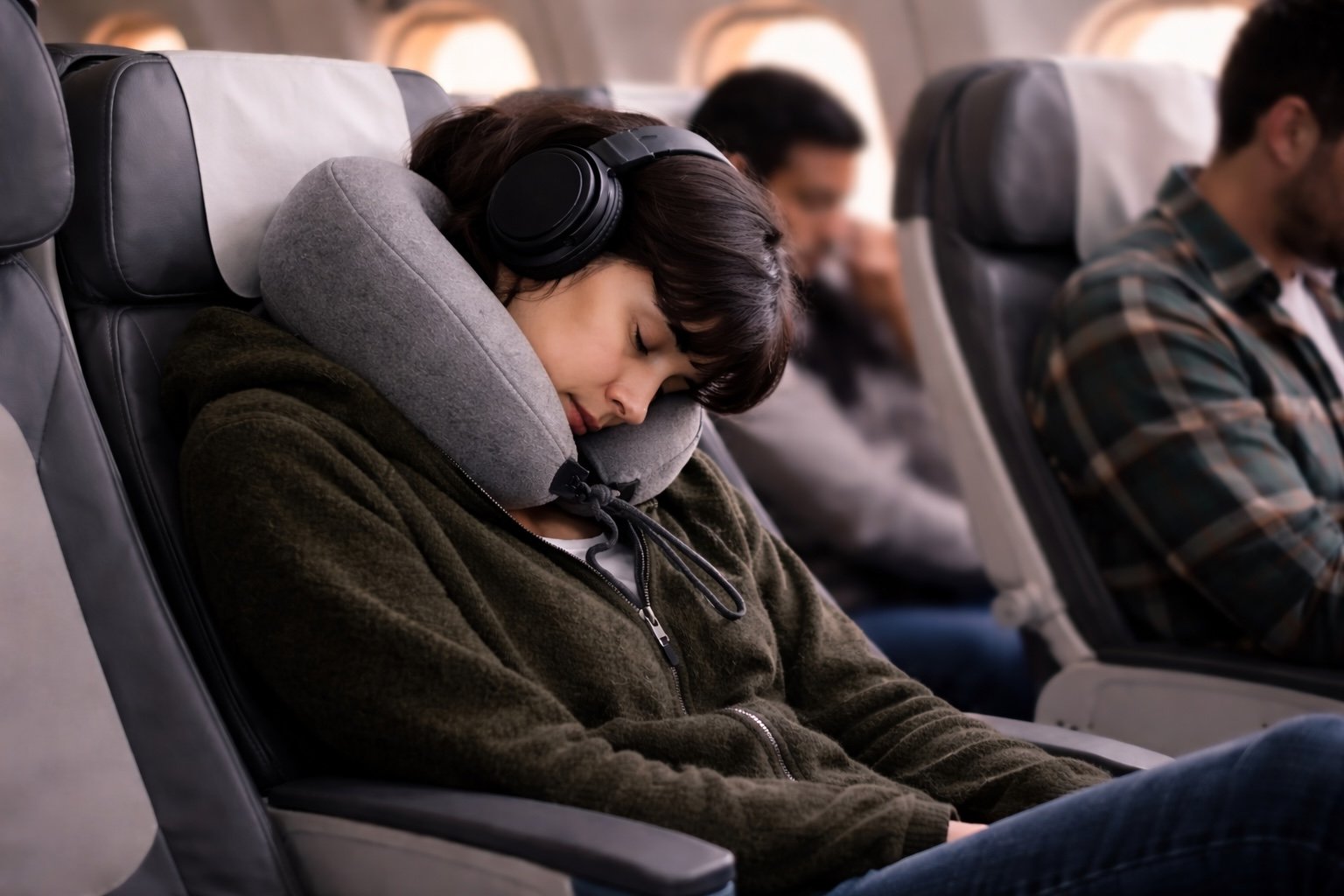
When your head falls forward while you try to sleep on a plane, it feels almost impossible to control. You pull it back up, adjust your position, maybe even tense your neck for a while. Then it happens again. It’s not just annoying, it’s exhausting. Most people assume they just need a better pillow, but the real reason this keeps happening has more to do with how your body and the seat interact than anything you wrap around your neck. If you’ve noticed this getting worse on long flights, it’s usually not random. It’s how airplane seats are built in the first place.
Category: Travel Pillows
Author: Product Developer (Independent, No Sponsorships)
Written by a product developer who reviews travel gear with zero sponsorships.
Clear, technical breakdowns of materials, ergonomics, and real-world use.
Table of Contents
- Why Your Head Falls Forward on a Plane
- What’s Actually Causing It (Seat + Body Mechanics)
- Why You Can’t “Fix It” Just by Adjusting
- Why Most Travel Pillows Don’t Solve It
- What Actually Helps (Without Overpromising)
- Quick Summary
Why Your Head Falls Forward on a Plane
Airplane seats look like they should be comfortable enough. They’re not. Not if you’re trying to sleep.
You sit down, lean back, and for a moment it feels manageable. Then your head starts to drift forward. Slowly at first. Just enough that you notice it when it’s already uncomfortable.
So you pull it back up. Adjust your shoulders. Try again.
A few minutes later, same thing…
It’s not one big movement. It’s this quiet, repeated slip. You never really settle into sleep because your body keeps stepping in to correct it. Your head drops, your neck reacts, and you wake up just enough to fix it. Then it starts again.
After a while, it becomes more frustrating than painful. You’re tired, but you can’t stay still long enough to rest properly.
And the strange part is, it feels like something you should be able to control. You’re aware of it happening, but you can’t hold that position once your body starts to relax.
Why does it keep happening over and over?
Because the moment you stop actively holding your head up, there’s nothing else doing that job. Your head drops, your neck catches it, and that small correction is enough to wake you. Then you relax again, and the cycle repeats.
Why is it worse on a plane than anywhere else?
Because there’s nowhere for your head to go. The seat doesn’t support it in front, the headrest sits behind you, and you’re stuck in between. On a bed or even a couch, your head can fall into something. On a plane, it just falls forward. It’s the same reason airplane headrests often make neck pain worse instead of better.
What’s Actually Causing It (Seat + Body Mechanics)
It feels like your body is betraying you, but it’s really just the setup working against you.
The seat looks supportive enough when you first sit down. You lean back, shift a bit, and think, this might work. But the moment you stop actively holding yourself upright, everything starts to drift.
Your upper body isn’t fully supported. It’s slightly forward. Not enough to notice when you’re awake, but enough that your head isn’t really resting on anything. It’s just… there. Balanced. You notice this even more depending on where you sit. Window vs aisle changes how your head can stabilize.
That’s the part nobody tells you. You’re not resting your head. You’re holding it up the entire time without realizing it. That’s the trick. It only feels like rest.
Why do airplane seats push your head forward?
They don’t shove you forward in an obvious way. It’s more subtle than that.
Your hips stay fixed, your lower back gets some support, but your upper body ends up a bit ahead of where it should be. The headrest sits behind you, not under you, so your head never actually leans into it.
So instead of being supported, your head is slightly in front of your body, like it’s waiting for something to catch it.
Nothing does.
Why can’t your neck hold that position?
Because it was never supposed to do that job for hours.
When you’re awake, your neck muscles are constantly making tiny corrections. You don’t notice it, but they’re working the whole time to keep your head steady.
Then you start to fall asleep.
That quiet effort stops. The muscles loosen, just like they should. And the second they do, there’s nothing left holding your head where it was.
So it drops.
Why does gravity always win?
Because there’s nothing competing with it anymore.
Your head has weight. It’s already sitting a bit forward. Once your muscles let go, gravity just takes the easiest path, straight down and forward.
There’s no surface to catch it. No structure to slow it down. It just keeps going until your neck suddenly has to react.
That reaction is what wakes you up. Not fully, just enough to pull your head back and try again.
And somehow, you keep expecting a different result the next time.
If nothing stops your head from falling forward, nothing else you do matters.
Why You Can’t “Fix It” Just by Adjusting
At some point you start thinking it’s your fault.
Maybe you just haven’t found the right position yet. So you keep trying. Lean back a bit more. Sit up straighter. Turn your head slightly. Pull your shoulders in. For a moment, it feels like you’ve figured it out.
Then a few minutes later, your head drops again. Same outcome. Every time.
That’s the part that gets frustrating. Not the first time, but the fifth, the tenth. You keep resetting yourself like something is going to click and suddenly hold.
It never does. You’re not fixing it. You’re just delaying it. Most people never fix this. They just get used to being tired on flights. That’s why most “best travel pillow” lists don’t actually solve the real problem.
Why doesn’t holding your head up actually last?
Because you’re quietly holding it there the whole time.
It doesn’t feel like effort, but your neck is doing just enough work to keep your head in place. The second you start to relax, that support fades. Not dramatically, just enough for things to slip.
And once it slips, it’s over.
You can sit there slightly tense and delay it, but that’s not rest. That’s just waiting for your muscles to give up.
Why does it keep happening every few minutes?
Because every time you start to fall asleep, you lose control again.
You adjust, get comfortable enough, and drift off. Your body relaxes like it’s supposed to. Your head drops. Your neck catches it. You wake up just enough to fix it.
Then you do the same thing again.
It turns into this loop where you’re never fully asleep, just constantly interrupted. Not enough to wake you properly, but enough that you don’t actually rest either.
And after a while, you stop trying to fix it and just sit there, tired, waiting for the flight to end.
Why Most Travel Pillows Don’t Solve It
You buy a travel pillow thinking this is finally going to fix it.
You put it on, adjust it, lean back. For a few minutes, it actually feels promising. Softer, more comfortable, like something is finally supporting your neck.
Then your head drops forward again. So nothing actually changed.
The pillow didn’t fail later. It just never solved it.
That’s the moment you realize the pillow isn’t solving the thing you thought it would.
Most of them aren’t built for that movement at all. They’re built to feel good, not to stop movement. You can see this clearly when you compare different pillow designs side by side.
Why is there always a gap under your chin?
Because most pillows are designed around your neck, not under your head.
They sit on the sides, sometimes behind you, and give you that cushioned feeling like something is holding you in place. But the front, the exact spot where your head falls into, is left open.
So when your head tips forward, there’s nothing there to stop it.
You can feel the gap. Even with the pillow on, your chin still drops into empty space. And once it starts moving, it keeps going.
Some designs try to fix this with chin support, but that comes with trade-offs.
Why do soft pillows stop helping after a while?
Because they slowly give up.
At the beginning, they feel full enough to support something. But after a bit of pressure, the material starts to flatten. Not dramatically, just enough that the support fades. Comfort fades. Support disappears.
You don’t notice it right away. You just find yourself adjusting again. Pulling it tighter. Shifting it around. Trying to get back to that first “this might work” feeling.
It never quite comes back.
That’s why people end up blaming themselves. Like they’re using it wrong or just haven’t found the right position yet.
But the problem isn’t you. It’s that most pillows are built to feel comfortable for a moment, not to actually stop your head from moving in the first place.
What Actually Helps (Without Overpromising)
Most of the advice sounds reasonable until you try it half-asleep in a cramped seat.
Lean back more. Use a better pillow. Adjust your position.
You do all of that, and your head still drops forward.
What actually helps is less about comfort and more about stopping movement. If your head can still fall forward, nothing has changed.
If something actually limits that movement, even a little, everything gets easier.
That’s the difference. This is where more structured designs start to behave differently.
A small recline helps a little. Not because it’s comfortable, but because it slightly reduces how far forward your head wants to go. It buys you some time, nothing more.
Positioning matters too, but only in a practical way. If you’re by the window and can rest your head against something solid, it’s immediately better. Not perfect, just more stable.
But if you’re upright with nothing in front of you, you’re back to the same problem.
This is why people “sleep” on flights and still wake up exhausted. And most people assume that’s just normal.
What actually makes a real difference?
Something that stops your head from falling forward in the first place.
Once that movement is limited, everything changes. You’re not constantly correcting yourself, and your neck isn’t catching your head every few minutes.
It’s less about comfort and more about control.
What only sounds helpful but usually isn’t?
Anything that just feels soft.
Soft support feels good for a few minutes, but it doesn’t hold anything in place. After a while, it compresses, shifts, and you’re back to adjusting again.
Which is the whole problem.
Quick Summary
Most of the usual fixes don’t really fix anything. You adjust, you try a different angle, maybe add a pillow, and it still ends the same way.
Your head keeps falling forward because there’s nothing actually holding it in place once you relax. You’re fine while you’re awake, but the moment you drift off, it drops, your neck reacts, and you wake up just enough to start over.
That’s the loop.
Most pillows don’t stop it. They just make the first few minutes feel better.
The only thing that really changes it is stopping that forward movement. If your head can’t fall, you finally get a bit of rest. If it can, you’re back to adjusting every few minutes.