


Choosing the right travel pillow by seat type and neck length isn’t about brand hype or star ratings. It’s about how your body, your seat, and the pillow’s design interact over hours of real travel. It’s about how your body, your seat, and the pillow’s design interact over hours of real travel. Neck length, sleeping position, seat type, and pillow geometry matter far more than most people realize. This guide breaks down how to choose the right travel pillow based on seat type and neck length, using real-world behavior and design logic, not marketing claims.
Category: Travel Pillows
Author: Product Developer (Independent, No Sponsorships)
Written by a product developer who reviews travel gear with zero sponsorships.
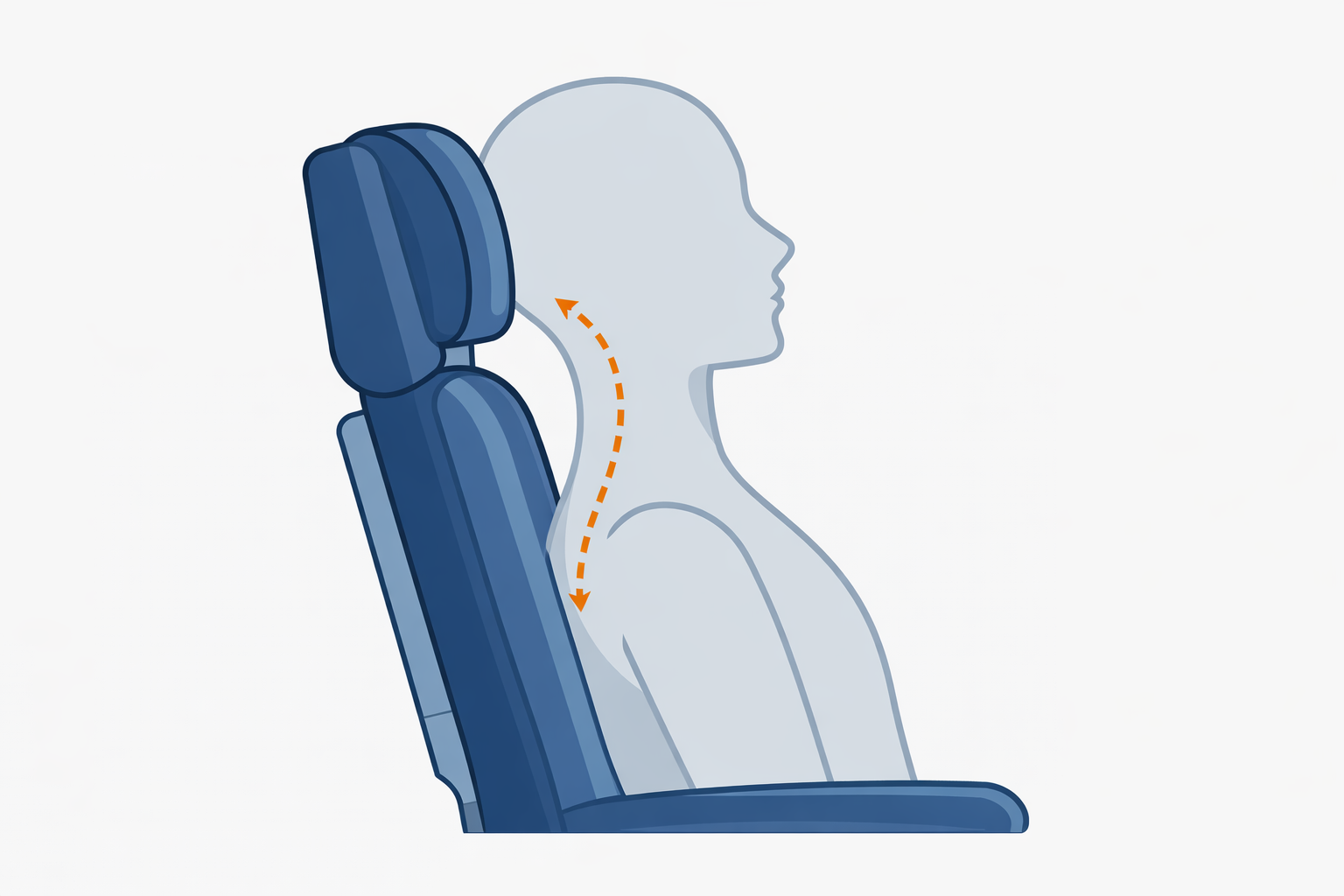
Table of Contents
- Why Most Travel Pillows Fail
- Start With Your Seat Type
- Start With Your Neck Length
- U-Shaped vs Wrap vs Seat-Strap Pillows
- What Works for Forward Sleepers
- What Works for Side-Leaning Sleepers
- When Seat-Strap Pillows Cause Problems
- Materials That Help (and Hurt) Support
- How to Match a Pillow to Long-Haul Flights
- Common Buying Mistakes
- Final Recommendation Framework
Why Most Travel Pillows Fail
Most travel pillows don’t fail because they’re cheap or poorly made.
They fail because they’re designed around simplified assumptions that don’t hold up in real airplane seats.
The biggest mistake is treating the neck as a fixed shape. In reality, neck length, shoulder width, and head weight vary dramatically between people. A pillow that feels supportive for one traveler can push the jaw forward, fold an ear, or force the head into an unnatural angle for another. Most designs ignore this variability and rely on a single geometry to “fit everyone.”
The second failure point is seat interaction. Airplane seats are not neutral surfaces. Seatbacks recline at different angles, headrests vary wildly, and some offer no usable support at all. Many pillows assume a stable seatback or headrest, but once that assumption breaks, the pillow either rides up, collapses, or shifts out of position within minutes.
Time is the third overlooked factor. A pillow that feels fine for ten minutes can become unbearable after an hour. Foam warms and softens. Fabrics stretch. Gravity slowly pulls the head forward. Most pillows are tested for comfort, not for fatigue over time, which is where real discomfort starts.
Finally, many travel pillows are optimized for marketing, not behavior. Tall sidewalls, thick padding, or clever straps look supportive in photos but often create pressure points, restrict movement, or require constant adjustment in a cramped seat.
In short, most travel pillows fail not because the idea is wrong, but because the design doesn’t account for human variability, seat geometry, and long-duration use. Until those factors are addressed together, even well-made pillows will continue to disappoint..
Start With Your Seat Type (Choosing a Travel Pillow)
Before neck length, sleeping position, or pillow shape, the most important variable is the seat itself. Travel pillows don’t exist in isolation. They either work with the seat or fight against it.
Most airline seats fall into three broad categories:
Seats with a defined headrest (often with wings).
These are common on long-haul aircraft and some newer short-haul planes. A headrest can provide lateral stability, but it also limits where a pillow can sit. Thick pillows or tall sidewalls often collide with the headrest wings, forcing the pillow upward and pushing into the jaw or ears. In these seats, slimmer profiles or designs that rely on the seat for side support tend to behave more predictably.
Seats with a flat seatback and no real headrest.
This is where many travel pillows struggle. Without a structure to brace against, U-shaped pillows often ride up the neck, inflatable pillows collapse downward, and wrap designs depend entirely on tension around the neck. In these seats, the pillow must provide its own vertical stability. If it can’t, you’ll spend the flight readjusting.
Seats with limited recline or upright posture (short-haul, economy).
When the seat stays mostly upright, forward head fall becomes the dominant problem. Pillows that rely on backward support do very little here. The design must actively manage forward rotation of the head, either through geometry, wrap tension, or controlled chin support. Comfort alone isn’t enough.
The key point is this: a travel pillow that works in one seat type can fail completely in another. Reviews that ignore seat context are incomplete by default.
Before choosing a pillow, you should know what kind of seat you’ll actually be using most often. That single factor narrows the field more effectively than brand names, materials, or star ratings.
Once the seat type is clear, then it makes sense to talk about neck length, sleeping position, and pillow shape.
Start With Your Neck Length
Neck length is one of the most underestimated factors in travel pillow comfort, yet it explains a large percentage of negative reviews. Most travel pillows are built around an assumed neck height that simply doesn’t match many travelers.
A pillow’s side height, chin support position, and back thickness are all fixed design decisions. If your neck is shorter than the design expects, raised side panels press into the ears or jaw instead of supporting the neck. Chin supports sit too high and end up pushing into the cheeks rather than preventing forward head fall. If your neck is longer, the opposite happens: the pillow may feel undersized, leaving gaps where support is needed.
This mismatch is why some people describe a pillow as “perfect” while others find the same model unbearable. It’s not about softness or quality. It’s about geometry relative to the body.
Most U-shaped pillows are designed around an average neck length and rely on shoulder contact to stay in place. On shorter necks, they tend to ride up. On longer necks, they often don’t reach high enough to stabilize the head. Wrap-style designs handle neck length slightly better because tension can be adjusted, but they still assume a specific vertical alignment between jaw and collarbone.
Seat-strap designs attempt to bypass neck length entirely by anchoring to the seat. This can help in some cases, but it introduces new variables and restrictions that aren’t always compatible with airline seating or personal comfort.
The takeaway is simple: a travel pillow that doesn’t match your neck length will never work consistently, no matter how well it’s made. Before comparing features or materials, it’s worth understanding where your neck sits relative to the pillow’s support surfaces.
U-Shaped vs Wrap vs Seat-Strap Pillows
Most travel pillows fall into three structural categories. Each tries to solve the same problem, head stability during seated sleep, but they approach it in very different ways. Understanding the mechanical trade-offs matters more than brand or material.
Classic U-shaped pillows rely on sidewall height and shoulder contact to stabilize the head. When the geometry matches your neck length, they can work well. When it doesn’t, they ride up, push into the ears or jaw, or collapse inward under load.
Their biggest limitation is that they assume the seat will provide rear support. In upright economy seats with shallow headrests, that assumption often breaks, especially over longer flights as foam softens.
I break this down in detail in my Napfun travel pillow review and BCOZZY travel pillow review, where both comfort and long-term support limitations become clear.
Wrap-style pillows try to control motion through tension rather than shape. When positioned correctly, they can reduce forward head fall more effectively than U-shapes, especially in upright seats.
The trade-off is pressure concentration. If the tension point doesn’t align with your jaw or collarbone geometry, discomfort builds quickly. Fit is highly dependent on neck length and correct tightening, which varies between users.
This trade-off is explained clearly in my Trtl travel pillow review, where tension placement plays a central role in comfort.
Seat-strap pillows anchor support to the seat rather than the body. When everything lines up, this can feel stable at first. In real cabins, however, seat geometry, airline rules, and movement during sleep introduce new failure points. Small shifts in posture can change strap tension, and compatibility depends heavily on the headrest and seat design.
I break this down in detail in my Cabeau Evolution S3 travel pillow review, including where the strap system helps and where it creates new problems.
The key takeaway is this: no pillow type is universally better. Each design solves one problem by creating another. Choosing between them should depend on your seat environment, neck geometry, and tolerance for pressure or restriction, not on marketing claims.
What Works for Forward Sleepers
Forward sleepers are the group most often disappointed by travel pillows, because gravity is working directly against them. As neck muscles relax, the head naturally drops forward. Any pillow that doesn’t actively resist that motion will fail, no matter how soft or expensive it is.
For forward sleepers, rear support alone is not enough. A pillow can feel comfortable at first but still allow gradual forward collapse as foam warms and compresses. This is why many classic U-shaped pillows feel fine for the first few minutes and then become useless once sleep sets in.
Designs that work better for forward sleepers share one trait: they introduce controlled resistance in front of the neck or jaw, not just on the sides. Wrap-style pillows can help here by creating a tension path that limits forward rotation. When properly positioned, they reduce chin drop without relying on seatback contact. The drawback is precision. If the wrap sits too high or tight, pressure shifts to the jaw or throat. If it sits too low, support disappears.
Seat-anchored systems also target forward sleep by preventing the head from moving independently of the seat. When the headrest geometry is compatible, this can feel stable. But the system’s success depends on strap height, seat shape, and whether movement during sleep changes tension. Forward sleepers who move even slightly can lose alignment quickly.
What rarely works for forward sleepers are thick rear panels or oversized padding. These often push the head forward rather than stopping it from falling. Extra bulk does not equal better support.
The practical takeaway is this: forward sleepers need directional control, not cushioning. Any pillow that doesn’t actively manage forward head rotation will eventually fail, regardless of how comfortable it feels at first.
What Works for Side-Leaning Sleepers
Side-leaning sleepers face a different problem than forward sleepers. Instead of gravity pulling the head straight down, the issue is lateral collapse. The head tips to one side, compressing the neck and creating uneven pressure through the jaw, ear, and shoulder.
For side-leaning sleepers, sidewall height and firmness matter more than front support. A pillow must create enough vertical distance between the shoulder and the head to keep the neck aligned. If the side panels are too soft, they compress within minutes. If they’re too tall or stiff, they push directly into the ear or cheekbone, causing pain rather than support.
This is where many U-shaped pillows partially succeed. When the side height matches the sleeper’s neck length and shoulder width, they can provide stable lateral support. The problem is consistency. As foam warms and softens, that side support often collapses unevenly, causing the head to drift lower over time.
Wrap-style pillows can work for side-leaning sleepers if the wrap provides asymmetric tension. When the design allows one side to be reinforced more than the other, it can stabilize a leaning head better than a symmetrical U-shape. However, many wrap designs distribute tension evenly, which doesn’t fully address lateral imbalance.
Seat-strap pillows are less predictable for side leaners. Because the anchor point is behind the head, lateral movement can introduce twisting forces that pull the pillow out of position. Small shifts in posture often lead to pressure spikes or loss of support.
The key requirement for side-leaning sleepers is controlled side height that resists compression over time. Comfort matters, but geometry matters more. A pillow that looks tall enough on day one may still fail once hours of sustained pressure expose its structural limits.
When Seat-Strap Pillows Cause Problems
Seat-strap pillows are designed to solve one clear issue: forward head fall. By anchoring the pillow to the seat, they reduce reliance on neck muscles and shoulder contact. When everything lines up, this can feel stable. The problems start when real cabin conditions don’t match the assumptions behind the design.
The first issue is seat compatibility. Not all headrests are shaped or positioned in a way that allows straps to sit correctly. Some are too low, too narrow, or angled in a way that causes the straps to slide or pull unevenly. When this happens, the pillow either loses tension or creates pressure in the wrong place.
The second issue is movement during sleep. Most people shift position, even slightly. With a seat-strap system, small movements can change strap tension dramatically. What feels supportive at first can quickly become restrictive, pulling on the jaw, cheeks, or neck as the head rotates.
Airline rules introduce another variable. Once a pillow attaches to the seat structure, it becomes more visible to cabin crew. Even if the design feels harmless, anything fastened to the seat can draw attention during critical phases of flight. This can lead to requests to remove it, interrupting rest or forcing the pillow to be used without its defining feature, as seen in the incident on an Alaska red-eye flight and the FAA guidance behind it.
Finally, seat-strap designs reduce adaptability. If the seat recline angle changes or the headrest shifts, the entire support system changes with it. Unlike body-worn pillows, there’s no easy way to compensate.
Seat-strap pillows don’t fail because the idea is bad. They fail because they depend on too many external factors the traveler cannot control.
Materials That Help (and Hurt) Support
Material choice plays a larger role in travel pillow performance than most people realize. Comfort is easy to market, but support depends on how materials behave under sustained load, not how they feel at first touch.
Memory foam is the most common core material, and for good reason. When the density is high enough, it provides gradual resistance and adapts to neck contours. The problem is that many pillows use low-density foam to feel soft out of the box. As body heat builds, that foam relaxes and collapses, turning initial comfort into poor long-term support.
Inflatable pillows offer adjustability, which sounds ideal in theory. In practice, they often struggle with stability. Slight air loss or uneven inflation can cause sudden changes in height or firmness. They also lack lateral resistance, which makes them unreliable for side-leaning sleepers.
Fabric and shell materials affect support indirectly. Stretchy covers allow foam to deform more easily, accelerating collapse. Firmer fabrics help maintain shape but can create pressure points if not paired with proper padding. Breathable materials improve comfort but don’t compensate for weak structure underneath.
Straps and elastic components are another weak point. Elastic stretches over time. Once it does, any support that depended on tension becomes inconsistent.
The takeaway is simple: materials don’t create support on their own. Geometry comes first. Materials either preserve that geometry over time or allow it to break down. Softness feels good initially, but durability and resistance are what determine whether a pillow works beyond the first hour.
How to Match a Pillow to Long-Haul Flights
Long-haul flights expose the weaknesses of travel pillow design faster than anything else. What feels fine for 30 minutes often fails after two hours, and becomes actively uncomfortable by hour six.
For long flights, consistency matters more than initial comfort. Pillows that rely on friction, loose positioning, or soft collapse tend to shift as you move, forcing constant readjustment. Over time, that micro-movement creates neck fatigue rather than relief.
Support should come from structure, not tension. Wrap-style pillows with internal frames or firm contours tend to perform better because they hold shape even when you relax completely. Classic U-shaped pillows can work, but only when the foam density is high enough and the back is thin enough to avoid pushing the head forward.
Seat attachment becomes riskier on long flights, not safer. The longer you sit, the more likely straps stretch, loosen, or shift. If a pillow depends on being fixed to the seat to function, small changes in posture can break its alignment.
Thermal behavior also matters. Memory foam softens as it warms. On long flights, low-density foam gradually loses resistance, which is why many pillows feel “fine at first” and worse later.
Some travel pillows feel comfortable during short flights but struggle to maintain support over longer periods. This is especially common with softer memory foam designs, which tend to warm, compress, and lose structure as hours pass. The effect becomes more noticeable on long-haul flights, where minor alignment issues turn into sustained neck fatigue. This breakdown over time is discussed in my Cabeau Evolution Earth travel pillow review, where foam behavior and long-duration performance are examined in detail.
For flights over eight hours, the safest match is a pillow that:
- stays on your body
- maintains shape without tightening
- supports the neck in a neutral position
- requires minimal adjustment
If a pillow only works when everything is set perfectly, it rarely survives a full long-haul flight.
Common Buying Mistakes
Most travel pillow disappointments come from a few predictable mistakes that marketing quietly encourages.
The first is buying for softness instead of support. A pillow can feel great in your hands or during the first five minutes, but softness alone does nothing to control head movement. Without structure, the neck ends up doing the work.
Another common mistake is assuming one size fits everyone. Neck length, shoulder width, and sitting posture vary widely, yet many pillows are sold as universal solutions. If a design only works for a narrow range of proportions, most users will struggle to position it correctly.
People also overestimate strap systems. Straps look like a solution to instability, but they often introduce new problems: pressure points, awkward angles, or tension that becomes uncomfortable over time. More control does not automatically mean better support.
Ignoring seat geometry is another issue. A pillow that works against a wall or in a car may fail completely in an airplane seat with a curved back and limited recline.
Finally, many buyers trust star ratings without context. High ratings often reflect short-term comfort, not long-haul performance. Few reviewers test a pillow for hours in a real cabin environment.
The safest approach is to choose a pillow based on how it controls movement over time, not how cozy it looks in photos or how clever the feature list sounds.
Final Recommendation Framework
Choosing a travel pillow works best when you follow a simple decision order instead of chasing features.
Start by eliminating designs that fight the seat. Anything that relies on attaching to the seat, pulling against it, or locking into a fixed position should be approached cautiously. These designs add variables you cannot control once you are on the plane.
Next, match the pillow to your neck length and shoulder width, not to marketing claims. Taller, longer necks tolerate higher sidewalls and firmer wraps. Shorter or average necks usually do better with lower-profile designs that do not push into the jaw or ears.
Then consider how you actually fall asleep. Forward sleepers need chin support that stabilizes without forcing the jaw upward. Side-leaning sleepers need lateral resistance without sharp pressure points. If a pillow only supports one position well, it will fail as soon as you shift.
After that, prioritize structure over comfort. Comfort should come from controlled support, not from softness alone. A slightly firmer pillow that holds alignment will feel better after two hours than a plush one that collapses.
Finally, think about flight length and tolerance. For short flights, comfort-first designs may be enough. For long-haul flights, consistency matters more than initial feel.
If a pillow only works when everything lines up perfectly, it is not a reliable travel solution. The best choice is the one that stays supportive even when conditions are less than ideal.