


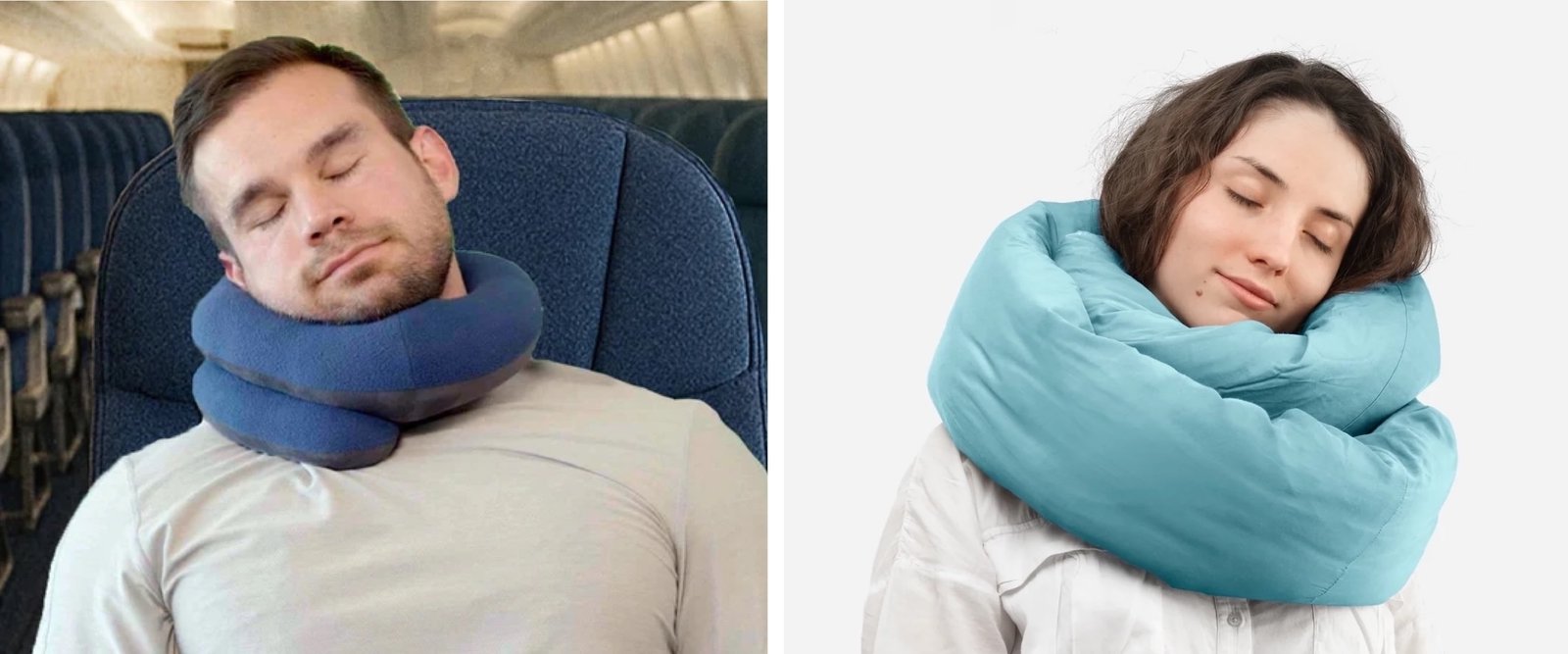
Infinity Pillow vs BCOZZY compares a loop-based pillow and an overlapping-arm pillow for neck support on flights. The Infinity Pillow relies on a continuous loop design to distribute load around the neck and shoulders, while the BCOZZY uses overlapping arms to build adjustable front support. This review examines how each system handles head stability, pressure points, and posture in real economy-class seating, where movement, limited recline, and fatigue expose design limits. The focus is on long-term in-flight performance, not short-term comfort or marketing claims.
Category: Travel Pillows
Author: Product Developer (Independent, No Sponsorships)
Written by a product developer who reviews travel gear with zero sponsorships.
Clear, technical breakdowns of materials, ergonomics, and real-world use.
Table of Contents
- Support Design: Continuous Loop vs Overlapping Arm Support
- Neck Support & Stability
- Ergonomics in Real Airline Seats
- Comfort Over Time
- Ease of Use & Adjustability
- Who Each Pillow Is Actually For
- Final Verdict
- FAQ
Support Design: Continuous Loop vs Overlapping Arm Support
The Infinity Pillow is built around a continuous fabric loop with no fixed geometry. Support is created by folding, twisting, and stacking sections of the loop until a usable contact surface forms. There is no internal frame, no defined support zone, and no preferred orientation. Stability depends entirely on how the user shapes the material and how still that position can be maintained.
The BCOZZY uses a different strategy. Its circular body and extended arms are designed to overlap and stack under the chin. Instead of redistributing material around the neck, it concentrates fill in the front to create a temporary support shelf. Tension, friction, and compression hold that structure in place.
These designs reflect different priorities. The Infinity favors adaptable surface contact and pressure distribution. The BCOZZY favors localized front support built through manual layering. One spreads load across the loop. The other builds it vertically at a single point.
Neck Support & Stability
How those structures behave under load becomes clearer once posture, seat angle, and movement are introduced.
Does It Prevent Forward Head Drop in Upright Seats?
The BCOZZY is designed primarily to address forward head drop. By stacking its arms beneath the chin, it creates a temporary lift point that slows forward collapse in upright economy seats. When overlap tension is maintained, this configuration is effective in the early stages of use. As the overlap loosens and the fill compresses, forward control diminishes.
The Infinity Pillow does not provide inherent forward restraint. Users must fold or stack sections of the loop to create a support shelf. This can work briefly when posture remains fixed, but the structure has no resistance to progressive slumping.
Which Design Controls Side Lean Better?
Side stability favors the Infinity. The continuous loop distributes pressure across a wider surface area and can be shaped against a window or shoulder. When external support is available, lateral control improves. Without it, the soft fill allows gradual drift.
The BCOZZY offers minimal lateral resistance. Its front-focused support does little to prevent sideways collapse, and the soft polyester fill flattens quickly under side load. Side sleeping is short-lived for most users.
What Happens When You Shift or Change Position?
Movement exposes both systems. On the Infinity, posture changes deform the folded structure. Support must be rebuilt manually, often several times per session. Small shifts are enough to undo the previous configuration.
On the BCOZZY, movement loosens the overlap and alters chin height. Switching sides or adjusting posture breaks the stacked section and requires full rewrapping. Each correction interrupts rest and shortens effective support duration.
Where Each Design Breaks Down First:
The Infinity fails through structural diffusion. As folds relax and fill migrates, defined support zones disappear. Stability fades without a clear failure point.
The BCOZZY fails through compression and slippage. As the overlap loosens and the stacked area flattens, forward and lateral control decline together. In both designs, breakdown is gradual, predictable, and driven by alignment drift rather than material failure.
Ergonomics in Real Airline Seats
How the Infinity Pillow and the BCOZZY perform depends heavily on seat geometry, available headrest contact, and lateral boundaries. Small differences in backrest angle and surrounding space change how each design transfers load through the neck and jaw. Seat differences change what each design can sustain
Does It Hold Your Head in Fully Upright Economy Seats?
In fully upright economy seats, both designs run close to their limits. The BCOZZY depends on maintaining a stable overlap height, while the Infinity depends on a folded configuration staying intact. What changes most in this posture is how little room you have to rebuild either setup once it starts drifting.
What Changes When the Seat Is Slightly Reclined?
Even modest recline reduces forward load for both designs. The BCOZZY becomes more forgiving, as less lift is required from the stacked section. Alignment remains easier to maintain for longer periods.
The Infinity benefits more noticeably from recline. With reduced gravitational pull, folded sections stay in place longer, and pressure is distributed more evenly across the loop.
Does Window vs Aisle Seating Change Stability?
Window seats improve performance for both pillows. The Infinity can be shaped against the cabin wall, increasing lateral stability. The BCOZZY relies less on arm stacking when passive side support is available.
Aisle seats remove that boundary. Both designs must manage side load independently, and instability becomes more apparent during service movement and passenger traffic.
Comfort Over Time
With both the Infinity Pillow and the BCOZZY, comfort changes gradually over multi-hour flights rather than failing abruptly. Early impressions are usually positive. Differences emerge as posture becomes harder to maintain and materials remain under sustained load.
On the Infinity Pillow, long-term comfort depends on how well the initial wrap configuration holds. The soft fabric and fiberfill distribute pressure evenly at first, which reduces localized soreness around the jaw and neck. Over time, repeated micro-movements flatten folded sections and loosen stacked areas. As structure diffuses, support becomes less defined, and users must periodically rebuild the configuration to restore alignment.
The BCOZZY follows a more predictable pattern. Early comfort comes from the stacked front section and soft fleece surface. As hours pass, compression reduces lift under the chin and overlap tension declines. The pillow remains soft, but its ability to maintain a stable contact pattern weakens. Restoring comfort requires tightening and re-layering, which becomes more frequent on longer flights.
In both designs, over long sessions, both designs shift from “support” to “maintenance.”
Ease of Use & Adjustability
Both the Infinity Pillow and the BCOZZY appear simple at first glance, but long-term usability depends on how much ongoing interaction they require to remain effective.
The Infinity offers wide theoretical flexibility. Its loop can be folded, twisted, and layered into many configurations without hardware or fasteners. Initial setup is intuitive, but achieving stable support takes experimentation. Small changes in posture often undo earlier arrangements, and restoring alignment requires reshaping the entire structure. Over time, users either settle into a preferred configuration or abandon frequent adjustments altogether.
The BCOZZY is faster to deploy. Wrapping and overlapping the arms under the chin is straightforward, and most users reach a workable setup within minutes. The limitation appears later. Maintaining that setup requires repeated tightening and re-layering as tension and compression change. Switching positions resets the system and demands a full rebuild.
In both designs, adjustment is less about range and more about tolerance. Minor anatomical mismatches or posture changes require active correction. In narrow economy seats, that interaction cost becomes increasingly difficult to sustain, especially during longer flights or deeper sleep.
Who Each Pillow Is Actually For
The Infinity Pillow fits travelers who prioritize soft contact, airflow, and positional flexibility over fixed stabilization. It works best for people who remain relatively still, lean against a window, or prefer shaping their own support rather than relying on built-in structure. It is most effective on medium to long flights where comfort and breathability matter more than strict alignment. Travelers who need hands-free stability or consistent upright support will usually find it unreliable.
The BCOZZY is better suited to upright sleepers who mainly struggle with forward head drop and are willing to manage overlap tension over time. It performs best on short to medium flights, in middle seats, and for users who stay in one position. Its soft fill and overlapping arms provide early comfort, but long-term consistency depends on frequent readjustment. Restless sleepers and side sleepers are unlikely to maintain stable support.
Neither pillow is broadly forgiving. Both reward specific travel habits and become frustrating when posture, seat geometry, or sleep patterns fall outside their narrow operating range.
Decision rule:
- If you value breathable comfort, window support, and flexible positioning → choose Infinity Pillow
- If you sleep upright and need front support in standard economy seats → choose BCOZZY
- If you shift positions often or need firm, hands-free stabilization → avoid both
Final Verdict
The Infinity Pillow and the BCOZZY solve comfort and stability through opposing compromises. The Infinity favors breathable, distributed cushioning that adapts to many postures but rarely holds alignment without continuous shaping. The BCOZZY delivers stronger early control against forward head drop, yet depends on sustained overlap tension and loses consistency as compression builds. Neither design offers durable, hands-free stability across long, variable flights. If you want adaptable comfort and tolerate manual shaping, choose Infinity. If you mainly sleep upright and need front support, choose BCOZZY. Otherwise, neither is a reliable long-haul solution.
FAQ
Does the Infinity Pillow work without a window seat?
Not reliably. Without side support from the cabin wall, the Infinity depends entirely on user shaping and posture control. In aisle or middle seats, stability is harder to maintain.
Can BCOZZY prevent chin-to-chest collapse while sleeping upright?
Partially and temporarily. The overlapping arms can slow forward collapse early on, but compression and strap drift reduce effectiveness over longer sessions.
Is the Infinity Pillow good for people with neck pain or stiffness?
It may reduce surface pressure, but it does not control cervical alignment. Users with posture-sensitive neck pain are unlikely to see consistent relief.
Does BCOZZY stay supportive on long overnight flights?
No. Over multiple hours, repeated adjustments are usually required. As tension declines, forward support becomes less reliable.
Which pillow is better for tall users or long necks?
Neither is well-optimized for long neck proportions. The Infinity lacks vertical structure, and the BCOZZY’s overlap height is limited by arm length.
Are these pillows allowed on all airlines and seats?
Yes, both are generally permitted. Neither attaches to the seat frame, so they avoid most airline restrictions applied to strap-based designs.
Is it worth switching from a standard U-shaped pillow to one of these?
Only if you need either flexible positioning (Infinity) or targeted chin support (BCOZZY). For side sleepers and frequent movers, traditional designs may remain more predictable.