


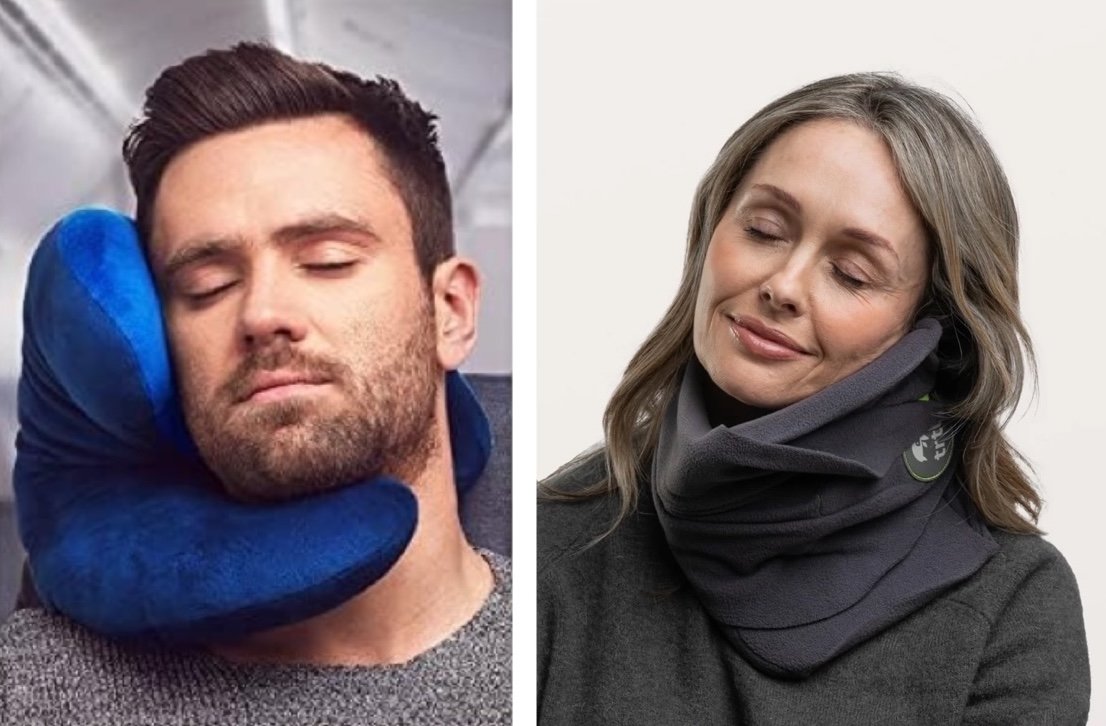
Choosing between the J-Pillow and the Trtl travel pillow is less about comfort claims and more about support mechanics. Both products approach neck stabilization differently: one relies on structured side-lean support, the other on a fixed internal brace. These design choices affect posture, fatigue, and long-flight usability in measurable ways. This comparison analyzes how each pillow manages head position in real economy seats, how they perform over time, and which types of travelers benefit most from each approach, so you can choose based on use case rather than marketing.
Category: Travel Pillows
Author: Product Developer (Independent, No Sponsorships)
Written by a product developer who reviews travel gear with zero sponsorships.
Clear, technical breakdowns of materials, ergonomics, and real-world use.
Table of Contents
- Support Design: Side-Lean Support vs Fixed Neck Brace
- Neck Support & Stability
- Ergonomics in Real Airline Seats
- Comfort Over Time
- Ease of Use & Adjustability
- Who Each Pillow Is Actually For
- Final Verdict
- FAQ
Support Design: Side-Lean Support vs Fixed Neck Brace
The J-Pillow and the Trtl are built around two fundamentally different support strategies. The J-Pillow relies on a soft, asymmetrical structure that combines under-chin support with lateral cushioning, forming a three-point contact system between the jaw, side of the head, and seat surface. Its stability depends on leaning against an external surface, typically a window, with support generated by fill volume rather than mechanical resistance. In contrast, the Trtl functions as a wearable support brace. An internal curved frame is tensioned against the jaw and neck through a wrap system, creating predictable lateral stability without relying on seat contact. Instead of distributing load through padding, it channels force through a fixed structural pathway. One design prioritizes posture-specific cushioning, the other prioritizes compact, repeatable mechanical alignment.
Neck Support & Stability
Both the J-Pillow and the Trtl are designed to control head movement in upright airline seats, but they do so using very different mechanical pathways. The J-Pillow relies on shape, fill volume, and external bracing, while the Trtl depends on an internal frame and wrap tension. These choices affect how well each pillow manages forward collapse, side drift, and long-term stability during real flights.
Does It Prevent Forward Head Drop in Upright Seats?
The J-Pillow limits forward head drop primarily through its extended lower arm, which sits beneath the chin and provides upward resistance when the head begins to slump. This works well when the pillow is properly seated and supported by a window or seat wall. However, because the resistance comes from compressible fiber fill, its effectiveness depends on how much the material has already flattened. Over time, sustained load reduces under-chin lift.
The Trtl approaches forward support differently. Its internal curved frame presses against the jaw and neck, creating a rigid pathway that resists downward movement. In upright seats, this produces more predictable early-stage stability. The limitation is that once seat angle changes through recline, the alignment between frame and jaw weakens, and forward control drops quickly.
Which Design Controls Side Lean Better?
Side stability is where the J-Pillow performs best in its intended environment. When paired with a window, its curved upper section distributes lateral load across the side of the face and jaw, allowing the neck to relax without active correction. The pillow becomes part of a three-point system: chin, head, and cabin wall. Without that external surface, lateral control declines sharply.
The Trtl provides side support internally through frame tension rather than external bracing. This allows it to function in aisle and middle seats more reliably. However, because support is concentrated at a narrow contact area, prolonged leaning can create pressure points and localized fatigue. Stability remains, but comfort becomes more variable over time.
What Happens When You Shift or Change Position?
The J-Pillow is highly posture-dependent. Changing lean direction requires manual repositioning and re-seating under the chin and along the head. For travelers who remain oriented in one direction, this is manageable. For restless sleepers, repeated adjustments interrupt rest and degrade overall stability.
The Trtl is even more restrictive in this respect. Switching sides requires fully unwrapping and rewrapping the device. In narrow economy cabins, this process is disruptive and usually wakes the user. While the structure holds its shape well once set, it offers little flexibility once sleep begins.
Where Each Design Breaks Down First
The J-Pillow’s first failure point is material compression. As polyester fill loses loft, both under-chin resistance and side bracing weaken, reducing long-haul consistency. The Trtl’s primary breakdown occurs when seat geometry changes. Recline, jaw pressure, and prolonged frame contact gradually reduce comfort, even when structural stability remains. In both cases, performance declines when real-world conditions drift away from the posture each design assumes.
Ergonomics in Real Airline Seats
In real economy cabins, pillow performance is shaped less by lab-style posture and more by seat pitch, recline limits, and lateral support availability. The J-Pillow and Trtl respond differently to these constraints because one depends on external bracing, while the other depends on internal structure. Their ergonomic behavior changes noticeably as seat geometry shifts.
Does It Hold Your Head in Fully Upright Economy Seats?
In fully upright seats, the Trtl maintains more consistent early-stage alignment. Its internal frame resists forward collapse even when the seat offers minimal contouring. This makes it more reliable during boarding delays, short naps, and restricted-recline situations. The trade-off is that contact pressure becomes noticeable faster when the seat remains rigid.
The J-Pillow performs acceptably in upright seats only when lateral support is present. Without a window or side panel, its fill-based structure compresses under load, and forward control weakens. In unsupported upright positions, stability becomes posture-dependent rather than mechanically enforced.
What Changes When the Seat Is Slightly Reclined?
Moderate recline shifts the head–neck angle and alters support pathways. For the Trtl, this often reduces alignment between the frame and jaw, weakening forward resistance. Support remains present, but becomes less predictable as posture drifts.
The J-Pillow benefits more from mild recline when paired with a window. Recline increases contact area between head and pillow, improving load distribution and reducing chin pressure. In this configuration, long-term comfort improves more than structural rigidity.
Does Window vs Aisle Seating Change Stability?
Seating position strongly favors the J-Pillow. Window seats complete its three-point support system and significantly improve lateral and vertical control. In aisle seats, that system collapses, and performance drops sharply.
The Trtl is less sensitive to seat location. Its internal brace allows it to function similarly in window and aisle seats. However, aisle movement, shoulder contact, and frequent disturbances still erode long-session comfort over time.
Comfort Over Time
Initial comfort and sustained comfort are not the same thing on long flights. Both the J-Pillow and the Trtl feel supportive when first positioned correctly, but their long-term comfort depends on how pressure, heat, and posture changes accumulate over several hours.
The J-Pillow tends to feel more forgiving early on. Its thick polyester fill and plush exterior distribute contact pressure across the jaw and side of the face, which reduces sharp pressure points during extended leaning. On medium-length flights, this creates a relaxed, pillow-like feel rather than a “support device” sensation. Over time, however, gradual compression reduces lift under the chin and softens lateral bracing. This makes it better suited for travelers who reposition occasionally rather than maintaining a fixed posture for an entire night.
The Trtl delivers more consistent structural support at first, but comfort evolves differently. The internal frame remains stable, yet localized pressure along the jaw and neck becomes more noticeable with prolonged use. Heat buildup from the fleece wrap can also affect comfort on warmer routes. For short and medium flights, this trade-off is usually acceptable. On longer routes, it favors users who value stability over softness and are comfortable staying in one position.
In practice, the J-Pillow prioritizes gradual comfort, while the Trtl prioritizes early-stage control. Which feels better over time depends on tolerance for pressure versus compression, with J-Pillow favoring comfort-first users and Trtl favoring stability-first travelers.
Ease of Use & Adjustability
Ease of use is where the design philosophies of the J-Pillow and the Trtl become very tangible in real cabins. Neither product is difficult to use, but both make different assumptions about how much setup effort a traveler is willing to tolerate once seated.
The J-Pillow is largely passive. There are no straps, buckles, or tension systems to manage. You position it under the chin, lean into it, and adjust orientation slightly if needed. This makes initial setup quick and non-intrusive, especially in tight economy rows. The trade-off is that support quality depends on correct placement and a stable lean direction. If posture changes, maintaining support usually means briefly waking to reposition the pillow rather than tightening or loosening anything.
The Trtl is more deliberate. Proper setup requires wrapping the support frame across the jaw and securing it with consistent tension. This takes longer and feels more conspicuous in narrow seats, but once adjusted, the structure stays in place reliably. There is little need for micro-adjustments during use, as long as posture remains consistent. The limitation is flexibility. Switching sides or changing sleep orientation requires fully removing and rewrapping the device, which is rarely seamless mid-flight.
In practice, the J-Pillow favors travelers who want minimal setup and don’t mind occasional repositioning. The Trtl suits users who prefer a “set it once” approach and are comfortable committing to a single lean direction for most of the flight.
Who Each Pillow Is Actually For
The J-Pillow and the Trtl succeed in different conditions because they are engineered around different assumptions about posture and seat environment. The J-Pillow is built for travelers who can reliably lean against a window and remain oriented in one direction for extended periods. In that context, its under-chin and lateral cushioning reduce muscle fatigue and allow longer rest without rigid pressure. It works best for medium to long flights where comfort matters more than pack size.
The Trtl is designed for travelers who prioritize portability and predictable upright stability. Its internal frame delivers consistent early-stage support in aisle and middle seats, especially on short and medium routes. It suits users who prefer minimal bulk and are comfortable maintaining a fixed lean direction, even if long-term softness is limited.
Neither product fits every travel style, but in the right seat and flight context, each can solve a very specific problem well. The J-Pillow favors stability through external bracing and cushioning. The Trtl favors structural alignment and compactness. Choosing correctly depends on seat position, sleep behavior, and tolerance for pressure versus compression.
Summary logic:
- If you usually book window seats and stay in one leaning position → choose J-Pillow
- If you fly light, economy class, and value packability → choose Trtl
- If you move frequently, recline deeply, or need multi-position support → avoid both
Final Verdict
The J-Pillow and the Trtl solve the same problem using different engineering priorities. The J-Pillow delivers better long-session comfort when external support is available, making it more reliable for window-seat sleepers on medium and long flights. The Trtl provides more consistent early stability in open seating environments and remains easier to carry, which favors frequent travelers who prioritize portability.
Neither design replaces good seat geometry, but each performs predictably within its intended use case. If your travel pattern matches the design assumptions, both products can reduce fatigue and improve rest quality. If your seat choice and sleep style don’t match these profiles, neither pillow will solve your problem.
FAQ
Is the J-Pillow or Trtl better for long-haul flights?
The J-Pillow is better for long-haul flights when you can secure a window seat and maintain a consistent side-lean position. Its cushioning reduces jaw and neck pressure over extended periods. The Trtl performs better on shorter long-haul segments where upright posture dominates, but extended wear may increase localized pressure. For overnight routes with stable seating, the J-Pillow is usually more comfortable.
Can either pillow prevent neck pain in economy class seats?
Both reduce neck strain when posture is stable, but neither works well for restless sleepers or deep recliners. The J-Pillow limits side collapse when external support is present, while the Trtl restricts forward drift in upright seats. They are most effective for travelers who remain in one posture, and perform poorly for sleepers who shift frequently.
Which travel pillow works better in aisle seats?
The Trtl performs more reliably in aisle seats because it does not depend on lateral contact with the cabin wall. Its internal brace provides consistent side support in open seating. The J-Pillow is better suited to window seats and loses stability in aisle positions unless paired with frequent repositioning.
Does the J-Pillow lose support over time?
The J-Pillow gradually compresses during extended use, which reduces under-chin lift and lateral firmness. This makes it better suited for medium-length flights and travelers who adjust position periodically rather than maintaining a fixed posture overnight.
Is the Trtl uncomfortable after several hours?
The Trtl maintains structural support over time, but localized jaw and neck pressure can become noticeable during long sessions. This makes it better suited for short and medium flights or for users who prioritize stability and portability over plush comfort.
Which pillow is better for side sleepers on planes?
Side sleepers generally benefit more from the J-Pillow when using window seats. Its curved design distributes weight across the face and jaw, reducing rotational strain. The Trtl works better for semi-upright sleepers who lean slightly rather than fully resting sideways.
Are these travel pillows worth carrying for frequent flyers?
Both are worthwhile only when matched to the right travel pattern. Outside those conditions, comfort drops quickly. The J-Pillow suits frequent window-seat travelers on longer routes, while the Trtl fits light packers who fly often on short and medium routes. Travelers who change posture frequently or recline deeply may find neither design optimal.