


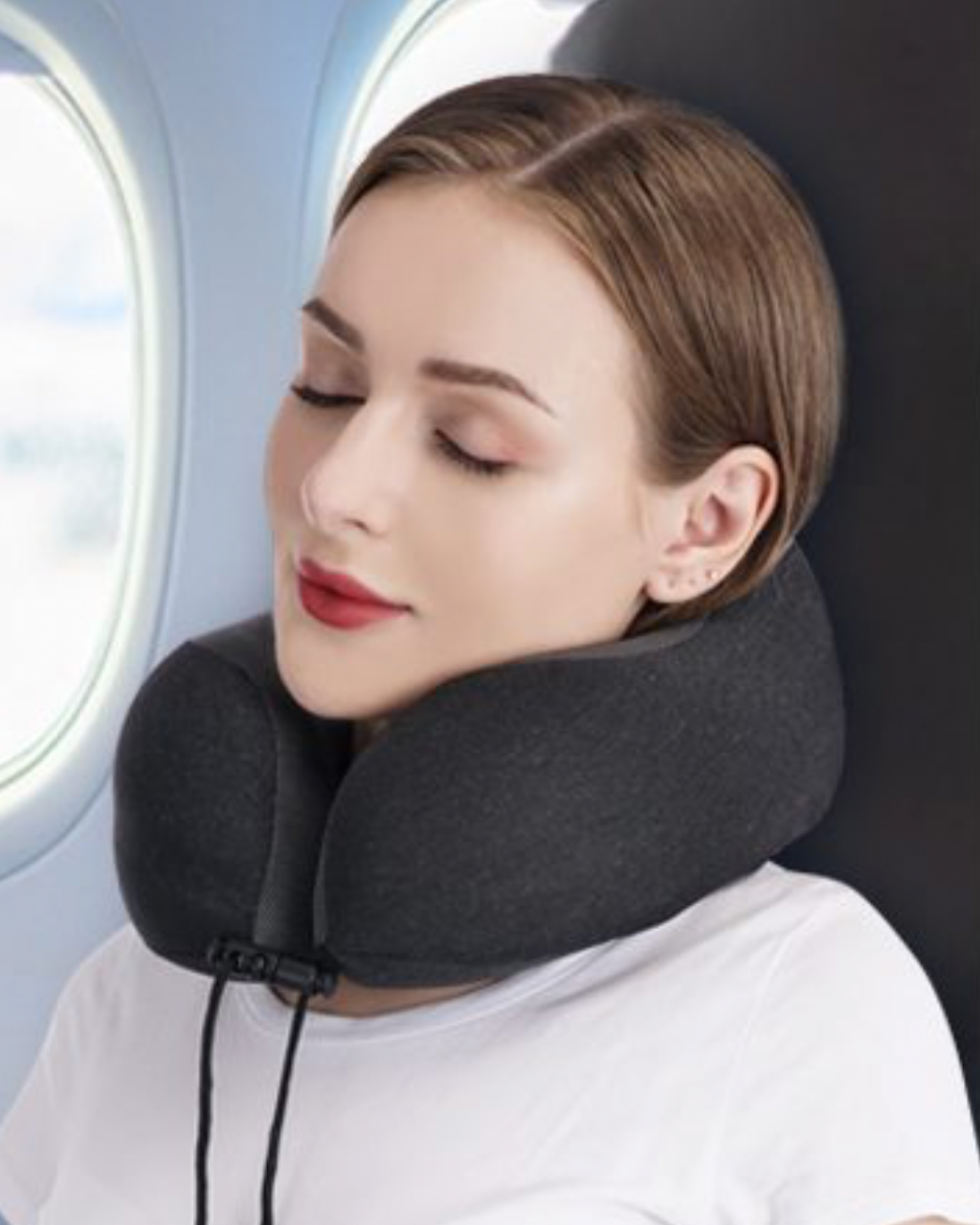
The MLVOC Travel Pillow follows a very straightforward formula: soft memory foam, a classic U-shape, a flat back panel, and a drawstring front meant to add a bit of chin support. It’s the kind of design people pick because it looks like what a travel pillow should be.
From a product-developer perspective, everything comes down to two factors: how the foam behaves once it warms up, and whether the inner cradle actually matches your neck geometry. Softer foams feel great at first, but they tend to lose structure quickly, which is why support can fade mid-flight.
In simple terms, this pillow prioritizes comfort over structure, and the experience varies widely depending on the person using it.
Below is the full breakdown.
Category: Travel Pillows
Author: Product Developer (Independent, No Sponsorships)
Written by a product developer who reviews travel gear with zero sponsorships.
Clear, technical breakdowns of materials, ergonomics, and real-world use.
Table of Contents
- Design Overview
- My Take (from a product developer)
- Real-World Limitations
- Why 4.3 Stars with over 35k reviews
- What Travelers Are Saying
- Final Scores
- Verdict
- FAQ
Design Overview
The MLVOC Travel Pillow uses a simple U-shaped memory-foam design with a flat, seat-friendly back panel and a low inner cradle that gradually rises toward the outer edges. It sits softly around the neck rather than locking it into position, and the drawstring front closure provides only mild chin support. The cover is removable and washable, and the overall structure is comfort-first rather than support-focused. It’s a straightforward, budget-friendly pillow that relies on softness more than engineered stability.
Key design elements:
- classic U-shape memory-foam structure
- flat, lower-profile back to reduce forward head push
- low inner cradle that rises toward the outer edges
- removable, washable zippered cover
- drawstring front closure for mild chin support
- compact carry pouch for travel
- soft foam with easy compression (packs small, supports lightly)
My Take (from a product developer) on the MLVOC Travel Pillow
The MLVOC pillow is built around one simple idea: make a soft, familiar U-shape that feels comfortable immediately. Structurally, it’s a “comfort-first” design, not a stability-first one, and that shows up fast once you start evaluating the geometry.
Here’s what the structure actually does:
Design & Structure
• Low inner cradle, higher outer wall
The inner ring sits low and dips toward the neck, while the height increases toward the sides. This shape feels gentle, but it doesn’t guide the head into a locked-in position the way a structured sidewall pillow does. If your head tilts sideways, the slope doesn’t catch it strongly.
• Flat, thinner back panel
This is the best part of the design. It reduces that annoying push-forward feeling you get with thick, overstuffed horseshoe pillows. The 2.5-inch rear thickness is just enough to keep shape, but thin enough to sit properly against most airplane seats.
• Soft foam that compresses easily
It feels nice at first, but once it heats up, it collapses and loses a good amount of height. For short naps, this is fine. For longer flights, support fades. This is consistent across budget memory-foam pillows.
• Drawstring closure = limited chin support
The front tightening system gives you some forward support, but not a lot. And if your neck is small, even at maximum tension it still sits loose and won’t give you that “held up” feeling.
• Ear and jaw alignment depends entirely on neck length
If your neck is longer, the raised outer sides may catch your cheek correctly. If your neck is shorter or average, the geometry sits too high and feels loose instead of supportive.
Overall, it is a soft, comfortable, predictable pillow. It’s not engineered for true stability, and that’s okay. Just don’t expect structured side support or real chin control. It’s designed to feel friendly to everyone, which means it never truly fits anyone perfectly.
Materials
The MLVOC pillow is built around a single block of molded memory foam wrapped in a removable fabric cover. The performance of this pillow comes entirely from the quality of that foam and the breathability of the cover. The product listing uses a lot of marketing language, so here’s what actually matters:
• “Magnetic therapy cloth”
This isn’t a real material classification. There is no active magnetic layer, no therapeutic effect, and no structural purpose for such a feature in a travel pillow. It’s simply a soft polyester knit with a marketing name added for perceived value.
• “Millions of tiny microbeads inside”
This pillow does not contain beads. It is a solid memory-foam core. The description mixes terms from other pillow types to sound more advanced than it is. Nothing in the structure suggests microbeads or any dual-material construction.
• Memory foam with “5-second return technology”
This phrase refers to soft, slow-recovery foam. That’s normal in low- to mid-density memory foam. Slow rebound does not equal strong support. It just means the foam feels plush at first and gradually warms and softens as you use it.
• Cover fabric
The removable cover is a soft, synthetic knit. It feels gentle on the skin and is easy to wash, but like most polyester blends it runs warm and holds heat as the flight goes on. The zipper is lightweight but works fine for a budget pillow.
• Foam density and long-term behavior
Because the exact density and ILD (indentation load deflection) aren’t disclosed, I infer performance from real-world behavior. The foam starts comfortable but softens quickly under body heat, and the support fades as the material compresses. This is typical for low-density molded foam used in mass-market pillows.
In simple terms: The materials are decent for the price, but most of the claims on the listing are marketing flourishes rather than technical features. The pillow feels soft, warm, and initially comfortable, but long-term stability depends entirely on how quickly the foam collapses during a real flight.
Durability
The MLVOC pillow is built to meet a price point, and its durability reflects that. The memory foam is soft and comfortable at first, but it breaks down faster than higher-density foams and loses firmness with repeated use. The removable cover holds up well to washing, though the zipper is lightweight and will need gentle handling over time.
Structurally, nothing here feels fragile, but the long-term performance of the foam is limited. Expect it to last a handful of trips, not years of heavy travel.
Ergonomics
This pillow feels soft and cozy at first, but the ergonomics drop as the foam warms up and collapses.
Front support is minimal: Even fully tightened, the drawstring rarely closes the gap under the chin.
Side support is weak: The inner cradle is low, so your head tends to roll outward instead of resting against a stable wall.
Back panel works well: It’s thin enough not to push your head forward on upright seats.
Fit varies by neck size: Smaller necks find it lose, broader necks get mild support.
It becomes more stable when you recline the seat, because the back panel finally lands in a more natural angle.
Overall, it’s comfortable but not structured. Good for short flights, not ideal for anyone needing firm, reliable head support.
Real-World Limitations
Here’s where the MLVOC starts showing its real boundaries:
• Foam softens quickly.
Once it warms up, support drops noticeably. This is common with low-density memory foam, but it matters on long flights.
• Front tightening system stays mild.
Even when you pull the drawstrings all the way, chin support never becomes truly secure. Smaller necks especially won’t get a snug fit.
• Side-sleeping stability is limited.
Because the inner cradle is low and the structure has no real sidewalls, your head can slide outward easily.
• A subtle forward push can still happen on upright seats, depending on posture.
The back panel is flatter than many budget pillows, but if your posture doesn’t match the contour exactly, you’ll still feel that subtle forward nudge.
• Foam compresses unevenly over time.
Long flights expose the difference between the softer inner region and the higher outer edges. Some travelers describe a “tilting” effect as the foam settles.
• Packing is not as effortless as it looks.
Getting the pillow tightly rolled and back into the pouch takes real force. It’s not a quick or elegant pack-down.
These aren’t deal-breakers for a budget pillow, but they explain why comfort varies so much between travelers and why the Amazon star rating doesn’t tell the full story.
Why 4.3 Stars with over 35k reviews
This rating actually makes perfect sense once you understand how people use and review this pillow.
Most travelers leave reviews:
- at the airport
- after a short flight
- or right after unboxing it
They’re comparing it to:
- no pillow at all
- a terrible airport pillow
- the stiff misery of flying without support
Against that baseline, the MLVOC feels amazing for the first 20–40 minutes. The foam is soft, the cover is cozy, and the kit feels “premium” for the price. That early comfort generates a huge wave of quick, enthusiastic reviews.
There’s also a price–expectation effect:
When a pillow costs under twenty dollars, people judge it on softness, portability, and the washable cover. Not long-haul ergonomics or foam density.
And those surface-level qualities are exactly what MLVOC does well.
The low-star reviews come from a different group entirely:
the travelers who actually tried to sleep on it for hours.
They’re the ones who report:
- foam collapse
- forward head push
- loose chin support
- inconsistent fit depending on neck size
They’re a smaller group, but they’re also the ones stress-testing the pillow in real conditions.
So, the 4.3★ score isn’t a mystery.
It performs well for casual travelers who want something soft, affordable, and immediately comfortable and it struggles when real support for long flights is the goal.
What Travelers Are Saying (Amazon, YouTube, Reddit)
Positive patterns:
- Soft, cozy memory foam that feels comfortable right away
- Cover feels good on the skin and users like that it’s removable and washable
- Good value for the price — most buyers feel it’s “worth it for twenty bucks”
- Better than airport pillows and noticeably more comfortable than no pillow at all
- Helps with light naps, especially on short flights or car rides
- Compact travel pouch is appreciated for packing and carrying
Negative patterns:
- Foam collapses quickly, especially after 30–60 minutes of real use
- Chin support is weak unless the drawstring is pulled very tight
- Loose fit for smaller necks, even at maximum tightening
- Pushes the head forward on many upright airplane seats
- Gets warm over time, especially around the jawline
- Not enough side stability, so the head still tilts or drifts
- Quality inconsistencies (foam density varies between units)
- Pouch is small, requires heavy compression to fit
Final Scores
Scores reflect engineering performance, not just comfort.
Support & Stability: 5.5/10
Soft and pleasant at first, but the foam collapses quickly and the front drawstring doesn’t create real chin support. Works for resting, not for keeping your head upright.
Material & Comfort: 6/10
Cozy cover, soft foam, and comfortable for the first stretch of the flight. Heat builds over time, and the foam consistency varies across units, which affects comfort.
Ease of Use: 6.5/10
Straightforward to use, easy to adjust, cover removes for washing, nothing complicated. Travelers with thinner or smaller necks often can’t cinch it enough to get real chin support, which makes the fit feel loose no matter how much they adjust it.
Packability: 5.5/10
Compresses well and fits into its pouch, but you have to squeeze it aggressively.
Long-Haul Performance: 5/10
Perfectly fine for short flights. On longer trips, the foam softens, the head starts drifting, and the forward push becomes noticeable. Not built for overnight stability.
Verdict
The MLVOC Travel Pillow succeeds at one thing extremely well: giving you a soft, cozy place to rest your head without spending a lot. For the first part of a flight it feels forgiving and comfortable, and the flat back is better executed than many budget pillows in this category. But this is not a structured-support pillow. Once the foam warms up and softens, stability drops fast and the front drawstring never becomes true chin support.
If your goal is real sleep on upright seats, this pillow won’t get you there. If your goal is something soft and simple that packs small and costs very little, it delivers exactly what most reviewers expect.
Best for:
Casual travelers, short flights, people who want softness over structure, and anyone who prefers a low-cost upgrade from “no pillow at all.”
Not ideal for:
Long-haul flyers, restless sleepers, shorter necks needing firm chin support, or anyone who wants real stability in an upright plane seat.
Bottom line:
A comfortable budget pillow that works well for short flights and quick naps. It’s not built for serious support, but for the price, many travelers still find it worth trying, especially if you just need something soft in your carry-on.
FAQ
Does the MLVOC pillow work for small neck sizes?
Not consistently. Even when tightened fully, the drawstring closure can still feel loose on thinner necks, which reduces chin support.
Does it push the head forward?
It depends on your seat angle. The back panel is flatter than many budget pillows, but on fully upright seats some travelers still feel a slight forward push.
Is the foam actually “5-second rebound”?
Not in a technical sense. It’s standard low-density memory foam. It softens with heat and rebounds slower over time.
Is the cover washable?
Yes. It has a zipper and can be machine-washed. The pillow core itself should not be washed.
Is it good for long flights?
Only if your priority is softness, not structure. It performs better on short flights than overnight trips.
Does it compress easily into the pouch?
It fits, but not effortlessly. The foam is soft, but compressing it fully takes both hands and some pressure.
Is it good for side sleeping on planes?
Not strongly. Support collapses after a while, especially if you lean into one side repeatedly.
Will it work for kids?
Only older kids with average neck length. Younger or smaller children may find the fit too loose.
How does it compare to more structured pillows like Trtl or brace-style designs?
The MLVOC is significantly softer and more forgiving, but far less stable. Structured designs use internal frames or rigid sidewalls to control head movement, while the MLVOC relies almost entirely on foam softness. Comfort is higher at first, but support drops much faster.
Is it suitable for frequent flyers?
Not ideal. Frequent flyers tend to notice foam fatigue, heat buildup, and declining support more quickly. This pillow is better suited for occasional travel rather than repeated long-haul use.
Does the pillow keep its shape after multiple trips?
Only partially. The foam does not fail suddenly, but it gradually loses height and resilience with repeated compression and heat exposure. Over time, the pillow feels flatter and offers less support than when new.