


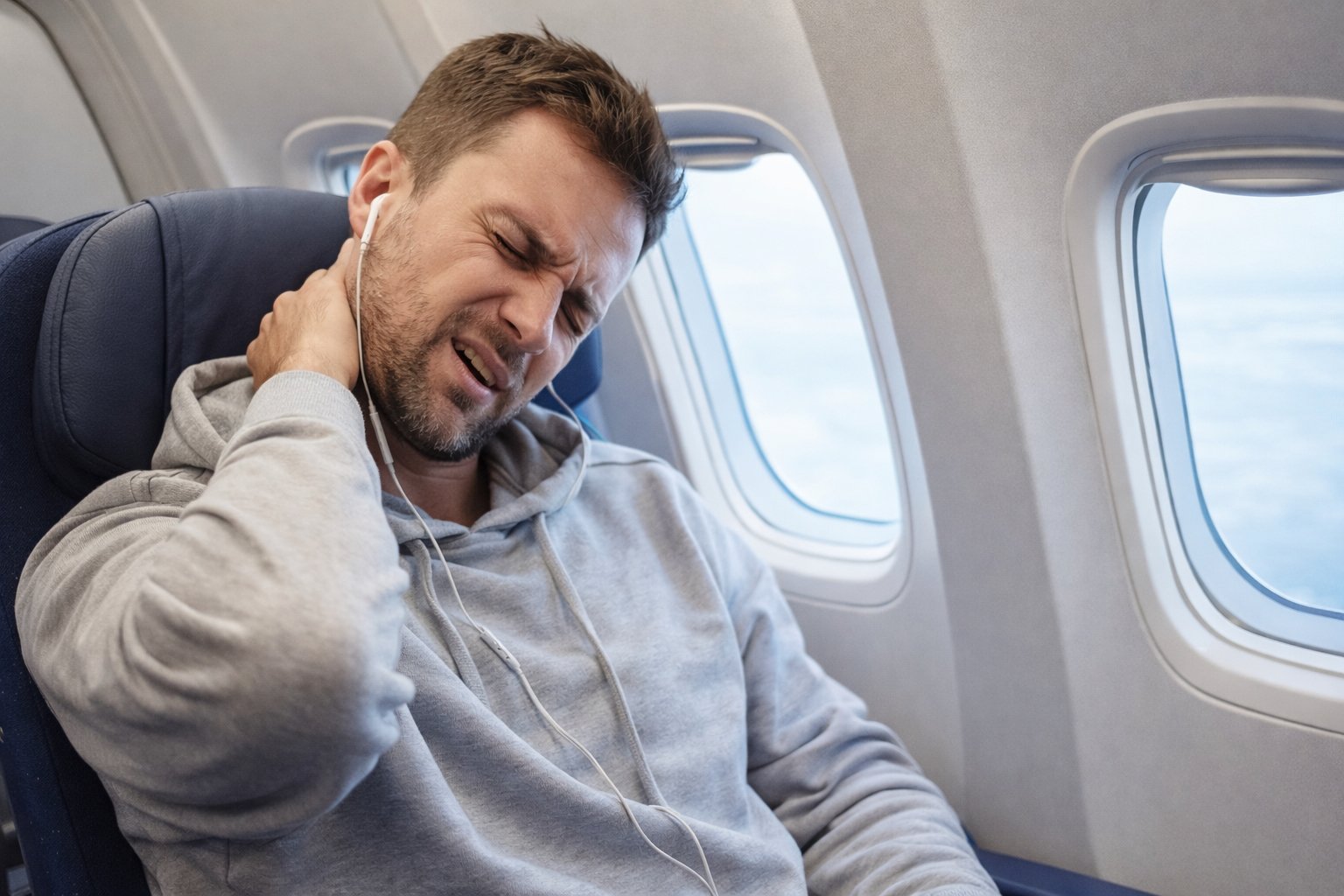
Neck hurts sleeping on a plane is something many travelers recognize the moment they wake up mid-flight. You close your eyes for a short nap, lean back in the seat or against the window, and drift off for a while. Then you wake up and your neck feels stiff, sore, or strangely tight. If you’ve ever tried to slowly rotate your head after a plane nap, you know the feeling. Most people assume they just slept in a bad position. In reality, the bigger problem is how airplane seats hold your body once your neck muscles relax.
If you’ve ever woken up on a flight and slowly tried to turn your head, you probably know that stiff, slightly alarming feeling.
Category: Travel Pillows
Author: Product Developer (Independent, No Sponsorships)
Written by a product developer who reviews travel gear with zero sponsorships.
Clear, technical breakdowns of materials, ergonomics, and real-world use.
Table of Contents
- Why Your Neck Hurts After Sleeping on a Plane
- What Happens to Your Neck When You Fall Asleep on a Plane
- Why Airplane Seats Make Sleeping Posture Worse
- Why Your Head Drops Forward or to the Side
- Why the Pain Shows Up After You Wake Up
- What Actually Helps Prevent Neck Pain When Sleeping on a Plane
- Final Takeaway / Sleeping on Planes Is Hard on the Neck
Why Your Neck Hurts After Sleeping on a Plane
Many travelers notice their neck hurts sleeping on a plane even after what seemed like a quick nap. You close your eyes for a while, maybe lean your head against the seat or the window, and drift off. Then you wake up and your neck feels stiff, sore, or oddly tight. Sometimes you slowly turn your head left and right just to check if it still moves normally.
The reason this happens has a lot to do with what sleep does to your muscles. While you’re awake, your neck muscles constantly make tiny adjustments to keep your head balanced over your shoulders. You don’t notice it, but they’re working all the time.
When you fall asleep, those muscles relax. Your head loses that active support, and gravity slowly pulls it forward or to the side. In a normal bed your pillow helps keep everything aligned. On an airplane seat, the neck usually ends up doing the hard work alone.
What Happens to Your Neck When You Fall Asleep on a Plane
When you’re awake on a flight, your body quietly keeps your head balanced without you thinking about it. Your neck muscles are constantly making tiny adjustments to keep your head centered over your shoulders. You might feel tired, but those muscles are still doing their job.
The moment you fall asleep, that control fades.
Sleep tells the body to relax, and the muscles that were holding your head upright start letting go. At first nothing dramatic happens. But after a few minutes your head slowly begins to drift out of its comfortable position.
Most travelers know that moment. Your head drops forward or tilts to the side, and you suddenly wake up again trying to lift it back into place.
On a bed, pillows keep the head supported once your muscles relax. On an airplane seat, that support is much weaker. So your neck ends up carrying the load while you sleep.
Why Do Neck Muscles Relax During Sleep?
When sleep begins, the nervous system reduces muscle activity throughout the body. It’s part of how the body rests and recovers. Unfortunately, it also means the muscles that stabilize your head are no longer actively working.
Why Does Your Head Lose Support on a Plane?
Once those muscles relax, gravity takes over. Without strong support from the seat or headrest, the head starts drifting forward or sideways. The neck muscles then have to catch the weight again, which is why that stiff feeling often appears when you wake up.
Why Airplane Seats Make Sleeping Posture Worse
Trying to sleep in an airplane seat feels deceptively simple. You lean back, close your eyes, and hope the seat will hold you comfortably for a while. For the first few minutes it often feels fine. But once sleep begins, the design of the seat starts to matter much more than people expect.
Airplane seats are built mainly for upright sitting, not for supporting the head during sleep. The seat design itself plays a major role in this problem, which is explained in more detail in Why Airplane Seats Cause Neck Pain. When you’re awake, you instinctively adjust your posture every few seconds without noticing. When you fall asleep, those small corrections stop. Your body stays still, while gravity quietly starts pulling the head out of its comfortable position.
Anyone who has tried to nap on a long flight knows that moment when the head slowly slips forward or tilts to the side and the neck suddenly carries the weight.
In other words, sleeping on a plane isn’t just uncomfortable. It quietly puts the neck in a position where gravity slowly wins, and the muscles end up carrying the load.
Why Do Airplane Seats Keep Your Body So Upright?
Economy seats keep passengers fairly upright to save space in the cabin. The position works reasonably well for sitting, but it places the head slightly forward compared to a relaxed sleeping posture.
Why Do Small Headrests Make Neck Support Worse?
Most airplane headrests are small and sit lower than people expect. Instead of fully supporting the head, they often touch only the lower part of the skull, leaving the neck to handle the rest once sleep begins. This is why most people wake up with their head either dropped forward or tilted sideways.
Airline headrests themselves can also make the problem worse depending on their shape and position, which is discussed in Why Airline Headrests Make Neck Pain Worse.
Why Your Head Drops Forward or to the Side
Once you fall asleep on a plane, keeping your head in a comfortable position becomes surprisingly difficult. While you’re awake, your neck muscles quietly keep your head balanced over your shoulders. You don’t notice it happening, but they are constantly making small adjustments.
Sleep changes that completely.
As your muscles relax, the head slowly begins to drift, and gravity usually chooses one of two directions.
The first is the familiar forward chin drop. Your head gradually tips forward until your chin ends up somewhere near your chest. Many travelers know the moment this goes too far. Your head suddenly dips, you wake up for a second, lift it back into place, and hope it doesn’t happen again.
The second common position is the sideways tilt. Without something solid to lean against, the head slowly rolls toward one shoulder. Sometimes the airplane window saves you. Other times your neck ends up carrying the full weight.
Neither position is especially comfortable, and after an hour or two, your neck usually lets you know it.
Why the Pain Shows Up After You Wake Up
The odd thing about sleeping on a plane is that the neck pain rarely appears while you’re actually asleep. You wake up thinking the nap was harmless. Then you try to turn your head, and suddenly something feels stiff, tight, or slightly wrong.
What happened is usually a slow build-up during the time you were sleeping. While your head was drifting forward or leaning to the side, the neck muscles were quietly working to keep it from dropping completely. They held that position the whole time, even though you didn’t notice.
There’s also the simple problem that your neck hasn’t moved for a while. When the neck stays in the same position for too long, the muscles stiffen and circulation slows a little. By the time you wake up and try to move normally again, your neck reminds you that it spent the last hour doing more work than it should have.
What Actually Helps Prevent Neck Pain When Sleeping on a Plane
After one or two flights with a stiff neck, most travelers start experimenting with ways to sleep more comfortably. You shift in the seat, try leaning against the window, or slowly recline a little further than before, hoping the next nap will be easier on your neck.
What usually helps most is simply keeping the head from drifting too far away from where it naturally wants to rest.
The neck actually handles sleep pretty well as long as the head stays roughly centered over the shoulders. Trouble begins when the head slowly slips forward or rolls too far to one side. Once that happens, the neck muscles end up working quietly the entire time you’re asleep.
A small amount of seat recline can reduce how easily the head falls forward. Sitting perfectly upright tends to push the head slightly ahead of the body, which makes the chin-drop position more likely.
Many travelers also discover that window seats offer an unexpected advantage. Being able to rest your head lightly against the cabin wall often prevents the sideways tilt that strains the neck. Seat position also matters, which is why some travelers sleep better depending on whether they choose the aisle or the window seat, something explored in Best Travel Pillows for Window vs Aisle Seats.
Taller travelers often struggle even more with airplane neck support because standard travel pillows don’t match longer neck proportions. This is explained in Best Travel Pillows for Tall People.
Some people also use structured travel pillows, not simply for softness, but to limit how far the head can wander once sleep begins. The reason many standard pillows struggle to fix the issue is explained in Why Travel Pillows Fail on Long Flights.
Final Takeaway / Sleeping on Planes Is Hard on the Neck
Sleeping on a plane always sounds easier than it actually is. You lean back, close your eyes, and hope a short nap will make the flight feel shorter. But airplane seats were designed mainly for sitting awake, not for keeping your head stable once sleep begins.
After a while the familiar pattern appears. Your head drifts forward, tilts to the side, and your neck quietly carries the weight until you wake up and try to move again.
Many travelers assume they simply slept in a bad position. In reality, the seat gives the neck very little support once the muscles relax, which makes that stiff, post-flight neck almost inevitable.