


Neck pain on long flights is something many travelers experience, especially after trying to sleep in an airplane seat. You close your eyes, lean back, and hope to wake up feeling rested. Instead, a few hours later your head has slipped forward or tilted sideways, and your neck feels stiff or sore. Most people blame the way they slept, but the bigger reason is usually the airplane seat itself. Economy seats are designed for upright sitting, not for keeping the head stable when the body starts to relax. Over several hours, that small mismatch between seat design and sleep posture can quietly turn into real neck pain.
Category: Travel Pillows
Author: Product Developer (Independent, No Sponsorships)
Written by a product developer who reviews travel gear with zero sponsorships.
Clear, technical breakdowns of materials, ergonomics, and real-world use.
Table of Contents
- Why Neck Pain Happens on Long Flights
- What Airplane Seats Do to Your Posture
- Why Neck Pain Gets Worse the Longer You Sit
- Why Economy Seats Make the Problem Worse
- Why Sleeping on a Plane Often Leads to Neck Pain
- What Actually Helps Reduce Neck Pain on Long Flights
- Final Takeaway / The Real Cause of Neck Pain on Long Flights
Why Neck Pain Happens on Long Flights
Neck pain on long flights is something many travelers recognize the moment they stand up after landing. Maybe you only closed your eyes for a few minutes. Maybe you never really slept at all. Yet your neck still feels stiff, tight, or oddly sore, like it spent the whole flight doing work you didn’t notice.
Most people assume they must have slept in a bad position. In reality, the problem usually starts with the airplane seat itself. If you want the broader seat-mechanics explanation behind this problem, see Why Airplane Seats Cause Neck Pain.
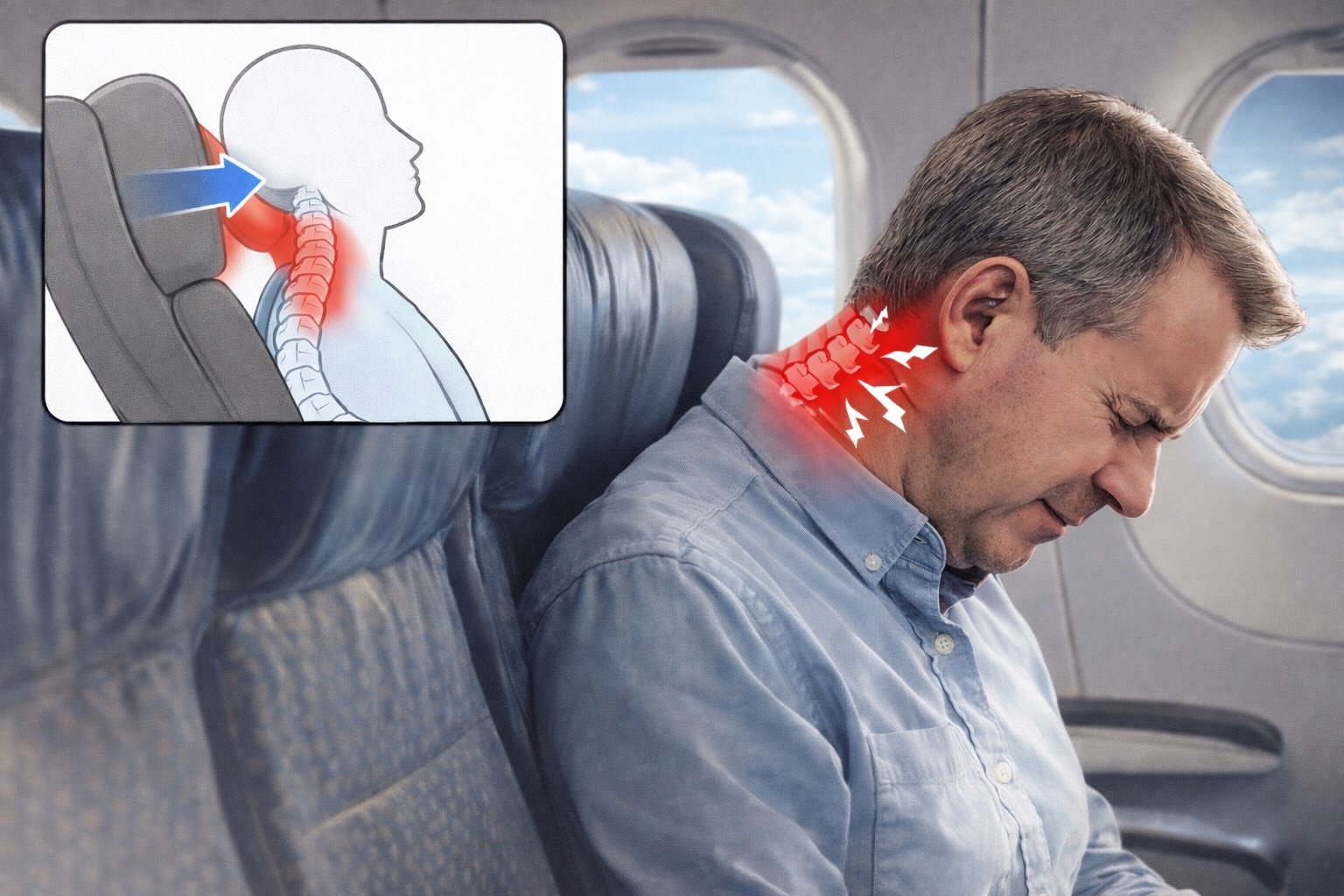
Airplane seats are built for sitting upright, not for keeping the head stable when the body starts to relax. As the flight goes on, the seat position gradually lets the head drift forward or sideways. Your neck muscles quietly try to hold everything in place.
At first you barely notice it. But after an hour or two, the small effort adds up. By the time the plane lands, your neck has been balancing the weight of your head the entire flight. That’s why neck pain on long flights often appears even when you barely slept at all.
What Airplane Seats Do to Your Posture
During the first hour of a flight, most airplane seats feel reasonably comfortable. You sit down, lean back, maybe scroll your phone or watch a movie. Nothing feels wrong yet. But if you stay in that same position for several hours, something subtle starts to happen to your posture.
Economy seats are designed primarily to fit many passengers into a small cabin, not to support the body during long periods of rest. The backrest angle, the shape of the seat cushion, and the small headrest all influence how your body holds itself.
At first your head sits more or less above your shoulders, which is where the neck prefers it. But as the flight goes on, the seat shape slowly encourages the upper body to shift forward a little. It’s not dramatic. You don’t suddenly notice your head leaning out in front of you.
Instead, it’s the kind of small change that builds quietly over time.
Your neck muscles then take over the job of keeping the head balanced. They keep making tiny adjustments the entire time you sit there. You might not notice the effort while you’re watching a movie or trying to rest, but your neck definitely does.
After two or three hours, that quiet work begins to add up. And when you finally stand up after landing, the stiffness suddenly makes sense.
Why do airplane seats push your head forward?
Many airplane seats include a slight forward curve in the upper seatback and headrest. The idea is to keep passengers stable during turbulence and prevent the head from snapping backward.
But that same design can gently push the head forward compared to a neutral sitting posture.
Even a small forward shift matters. The human head weighs around five kilograms. When it moves a little in front of the shoulders, the neck muscles have to work harder to keep everything balanced. Over time, that forward head position creates steady strain.
Airline headrests play a bigger role than many travelers realize. A closer breakdown of that design is explained in Why Airline Headrests Make Neck Pain Worse.
Why do the neck muscles stay under constant tension?
The neck works like a stabilizing system for the head. Its job is to keep the head balanced above the spine while allowing small movements in every direction.
When you sit in an airplane seat for several hours, those muscles rarely get a real break. They keep making tiny corrections to stop the head from drifting forward or tipping sideways.
At first the effort is barely noticeable. But after a long flight, many travelers recognize the result immediately: that familiar stiff feeling when you turn your head and realize your neck has been quietly working the entire time.
Why Neck Pain Gets Worse the Longer You Sit
Neck pain on long flights rarely appears right away. During the first hour or two, most people feel fine. You settle into the seat, adjust the headrest, maybe watch a movie or try to relax.
But something subtle starts happening as the hours pass.
Your neck muscles are quietly working the entire time to keep your head balanced. Even when you feel relaxed, they’re making tiny adjustments to stop your head from drifting forward or tilting to one side.
At first the effort is so small you barely notice it.
Then three or four hours go by.
Suddenly you shift your head a little and feel that familiar tightness in the neck. The kind where turning your head to the side makes you realize your neck has been doing quiet overtime the whole flight.
That’s the time factor most travelers underestimate.
Why do neck muscles get tired during long flights?
Your head weighs around five kilograms, and the neck muscles are responsible for keeping it balanced above your shoulders.
When airplane seats encourage a slightly forward posture, those muscles have to work harder to hold the head in place. Over several hours that small effort becomes steady fatigue.
It’s similar to holding a light weight in your hand. At first it feels easy. After a long time, even a small load becomes tiring.
Why does your head start drifting during sleep on a plane?
The moment you start to fall asleep, your neck muscles begin to relax. Gravity immediately takes advantage of that.
Without muscle support, the head slowly drifts forward or sideways. Many travelers recognize the moment their head suddenly drops and they wake up again.
It feels like you slept wrong. In reality, your neck simply ran out of ways to keep fighting gravity.
Why Economy Seats Make the Problem Worse
Neck pain on long flights is not only about how long you sit. It’s also about the kind of seat you’re sitting in.
Economy seats are built around one main priority: fitting a lot of passengers into a limited cabin space. Comfort is part of the design, but proper sleep posture is not the main objective. Anyone who has tried to rest in one of those seats for several hours already knows that feeling.
At first everything seems fine. You lean back, adjust the headrest, maybe try to relax. But as time passes, the limits of the seat start to show up.
One reason is seat width. Economy seats are fairly narrow, which means your shoulders often don’t have much room to settle naturally. When that happens, the upper body tends to shift slightly forward or inward. It’s a small change, but it moves the head away from its ideal position above the spine. The neck muscles quietly step in to keep everything balanced.
Shoulder support is another weak point. Most airplane seats don’t provide much structure around the upper back and shoulders. Over a long flight the body slowly leans, rotates, or slides a little. The neck ends up doing extra work just to keep the head upright.
Then there’s the headrest. For many passengers it simply isn’t tall enough to support the whole head. Instead of cradling the back of the skull, it often sits somewhere around the lower head or upper neck. Taller passengers often notice this first because their head sits above the support zone, which is exactly why Best Travel Pillows for Tall People becomes a separate problem to solve.
The result is familiar to anyone who has flown overnight: your head starts drifting forward, you wake up, readjust, and try again. By the time the plane lands, your neck has spent hours trying to compensate for a seat that never quite supported it in the first place.
Why Sleeping on a Plane Often Leads to Neck Pain
Neck pain on long flights often shows up the moment people finally start to fall asleep. While you’re awake, your neck muscles are quietly doing their job. They keep your head balanced above your shoulders and make tiny adjustments whenever your posture shifts.
But once sleep starts, that system begins to change.
As the body relaxes, the muscles that normally stabilize the head start letting go. That’s completely normal. When you sleep in a bed, the head is supported by a pillow and the neck doesn’t have to hold the weight of your head.
On an airplane, though, you’re still sitting upright.
So the moment those muscles relax, gravity steps in. The head slowly drifts forward or tilts to one side. Most travelers know the exact moment this happens. Your head suddenly drops, you wake up with a small jolt, and you instinctively sit back up again.
You adjust your position, maybe push your head into the headrest, and try to fall asleep again.
A few minutes later, the same thing happens.
Over the course of a long flight, that cycle can repeat again and again. The neck relaxes, the head drifts, the muscles snap back in to catch it. Each time the correction is small, but over several hours the strain builds up.
By the time the plane lands, your neck has spent half the night trying to stop your head from falling. This is also why many travel pillows don’t solve the issue. Most focus on softness rather than stabilizing the head during sleep. See Why Travel Pillows Fail on Long Flights.
What Actually Helps Reduce Neck Pain on Long Flights
Reducing neck pain on long flights usually comes down to one simple thing: keeping your head from wandering too far away from where it naturally wants to sit.
Quick Takeaway
If neck pain is your main issue on flights:
• avoid staying perfectly upright for the entire flight
• stabilize your head rather than just cushioning it
• a small seat recline can reduce forward neck strain
When your head stays roughly above your shoulders, the neck muscles can finally relax. But on a plane, the head rarely stays there for long. It slowly drifts forward, tilts sideways, or slumps a little as your body relaxes. Every time that happens, the neck muscles quietly step in to pull everything back into balance.
That constant correction is what makes your neck feel tired by the time the flight ends.
One small improvement is seat position. Reclining slightly can reduce how far your head tends to fall forward. Sitting perfectly upright might seem better at first, but it often forces the neck to hold the weight of the head the entire time.
Stabilizing the head is the other key piece. The goal isn’t just something soft to lean on. What actually helps is limiting how far the head can drift forward or sideways once you start relaxing. Many travelers find that window seats make this easier because the side wall provides an extra stabilization point, which is part of the logic behind Best Travel Pillows for Window Seats.
Support for the shoulders and upper back also matters more than people expect. When that part of the body is stable, the neck doesn’t have to keep correcting small shifts in posture.
None of this makes airplane seats magically comfortable. But when the head moves less, the neck usually complains a lot less too.
Final Takeaway / The Real Cause of Neck Pain on Long Flights
Neck pain on long flights is often blamed on sleeping in the wrong position. Many travelers wake up, stretch their neck, and assume they must have twisted it while dozing off.
But the bigger issue usually starts with the seat itself.
Airplane seats are designed for sitting upright, not for keeping the head stable once the body begins to relax. Over several hours, that mismatch between seat design and natural sleep posture slowly adds up.
The head drifts forward. It tilts to the side. The neck muscles keep stepping in to pull everything back into place.
Many travelers assume their neck hurts because they “slept wrong.” In reality, the seat simply gives the neck very little chance to stay stable for hours.