


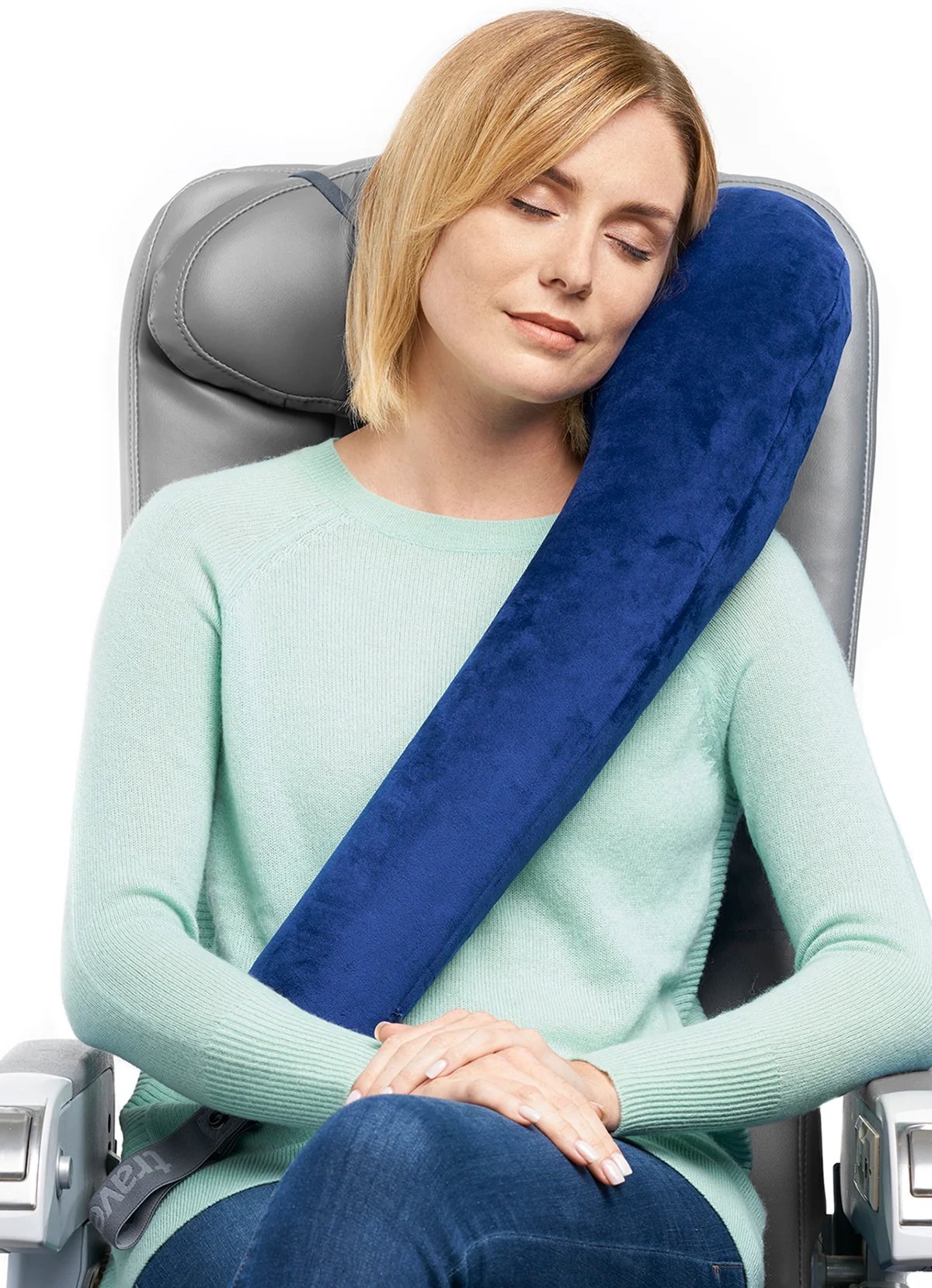
The Travelrest Ultimate Inflatable Travel Pillow is built around a different idea than most neck pillows. Instead of wrapping around the neck, it uses a long, diagonal support column designed to let aisle and middle-seat travelers lean forward or sideways without relying on a window wall.
The design depends entirely on inflation level and strap positioning, which makes it flexible but also highly seat-dependent. Whether that trade-off works in real flights is what this review breaks down.
Category: Travel Pillows
Author: Product Developer (Independent, No Sponsorships)
Written by a product developer who reviews travel gear with zero sponsorships.
Clear, technical breakdowns of materials, ergonomics, and real-world use.
Table of Contents
- Design Overview
- My Take (from a product developer)
- What Travelers Are Saying
- Final Scores
- Verdict
- FAQ
Design Overview
The Travelrest Ultimate Inflatable Pillow uses a long, diagonal body design instead of the traditional horseshoe shape. It creates support by anchoring across your torso or shoulder rather than wrapping around your neck.
Key design elements:
- long, inflatable support column
- diagonal cross-body or over-the-shoulder positioning
- adjustable inflation for firmness control
- optional microfiber cover (otherwise hand-wash only)
- quick-inflate and rapid-deflate valve
- integrated strap to anchor to the seat or secure around the torso
- clip attachment for hanging on luggage
- slim packed form compared to traditional foam pillows
The design is praised in past reviews by Wirecutter, NYT, and CNN for aisle/middle-seat usability. Let’s see if it deserves that.
My Take (from a product developer) on the Travelrest Ultimate Inflatable Travel Pillow
Design & Structure
The Travelrest Ultimate is built on a diagonal support concept instead of the usual horseshoe shape. Structurally, it’s more like an inflatable beam that runs along your torso and gives you a surface to lean into. This design is clever because it solves the classic aisle-and-middle-seat problem: nowhere to rest your head.
Here is how the structure behaves in real use:
• Inflation level = support level.
Slight under-inflation makes it cushy but unstable. Full inflation makes it supportive but firm.
• Diagonal support changes with shoulder angle.
If your posture shifts even slightly, the pressure point moves, which changes the comfort instantly. This is the natural trade-off with any inflatable beam design.
• Best for travelers who stay in one posture.
If you fidget or shift a lot, you lose the “sweet spot” and have to readjust.
• Switching sides is not effortless.
Because the pillow is tethered to one anchor point (cross-body or clipped to the seat), you can’t quickly slide it from one side to the other. You have to detach and re-anchor it, which breaks rest. And because the diagonal support sits high on the face, it can press against AirPods or glasses.
• Inflating is easy; deflating is the real win.
You can drop the air in seconds, roll it tight, and clip it to your bag. Portability is excellent.
• Washing depends on which version you buy.
Without the optional fabric cover, you’re stuck with hand-wash only. Not ideal for heavy travelers.
• The strap system works, but only to a point.
Clipping it cross-body or around the seat keeps it from sliding away, but the real stability still comes from your posture, not the strap itself.
The Travelrest Ultimate can be stabilized against the airplane seat, which introduces the same enforcement considerations seen with other seat-mounted accessories. Real-world incidents, including an Alaska red-eye flight, show how these designs can be questioned by crew depending on airline policy and flight phase. It’s not inherently unsafe, but it does add an extra variable to be aware of.
Structurally, this pillow is trying to answer one very specific problem:
What do you do when you’re stuck in an aisle or middle seat with no wall to lean on?
It’s a smart idea with real potential, but it’s also sensitive to posture, shoulder angle, and inflation accuracy. Travelers who can stay still tend to love it. Travelers who move a lot tend to fight it.
Materials
Because the manufacturer does not publish full fabric composition, shell thickness, or interior film specifications for the Travelrest Ultimate Inflatable Pillow, I avoid making precise claims about material types. What we can evaluate is the functional profile.
This is a pure inflatable system, which means all performance comes from:
- the air chamber
- the shell texture
- the outer cover (if you buy the upgraded version with plush velour cover)
The standard model (no cover): The basic version uses a smooth synthetic shell. It’s light, wipe-clean, and dries quickly, but it also warms up fast because there’s no fabric buffer between your skin and the PVC-like surface. And like all inflatables, the internal air shifts whenever you move, which changes firmness moment-to-moment.
Version with removable velour cover: The upgraded model adds a plush fabric layer. It’s softer, less sticky, and gives the pillow more grip against clothing, which can help stability. The trade-off is familiar: more warmth, slightly more bulk, and no real improvement in structural support because the pillow still relies on air pressure, not foam density.
Since the pillow has no foam core, comfort is entirely driven by:
- inflation level
- your shoulder angle
- the integrity of the air chamber
- how stable the surface friction is against your shirt or jacket
In short, the materials are chosen for portability, easy cleaning, and predictable inflation behavior. They’re not here to create plush comfort or rigid structural support, and understanding that makes the pillow’s strengths and limitations very clear.
Durability
The Travelrest Ultimate is typical of well-made inflatables: durability depends far more on air-pressure management than on hardware failure. The PVC/vinyl chamber is sturdy enough for repeated use, but like all inflatables, its lifespan is tied to seam stress and over-inflation. The diagonal support line concentrates pressure along a single reinforced seam, which makes this the area most prone to long-term weakening if the pillow is consistently inflated to maximum firmness.
The valve is reliable and empties quickly, though it remains the component most likely to degrade after years of bending and travel. The optional fabric cover significantly improves longevity because it prevents direct friction against the PVC surface. With reasonable care and avoiding full inflation, the pillow holds up well across trips. Over-inflation, heat exposure, and folding the pillow sharply at the seam line shorten its usable life.Overall: durable for an inflatable, but still an inflatable. Handle with some care.
Ergonomics
Ergonomics for the Travelrest Ultimate depend entirely on posture, shoulder angle, and how steady you can stay during sleep.
The diagonal beam concept gives more surface area than a standard U-shape, but it only works when your body stays leaned into it at a consistent angle. If you move, shift, or adjust your seat posture, the support point changes and the comfort resets. Travelers who stay still get stable support; restless sleepers spend more time repositioning.
Because the pillow anchors at one point (cross-body or to the seat), side switching is not seamless. You have to unclip and re-anchor, which breaks rest. People wearing AirPods or glasses will feel pressure along the side of the head because the support zone sits high and contacts the frame/earbud area directly.
The pillow shines most in aisle and middle seats, where there is no wall support. It is less effective for side sleepers, reclined positions, or anyone who prefers shifting between sides during long flights. Comfort is also sensitive to inflation accuracy: even a small change in air level dramatically alters support, firmness, and lean angle.
In short: ergonomically strong for one specific sleeping style, and inconsistent for anything outside that narrow use case.
What Travelers Are Saying (Amazon, YouTube, Reddit)
Positive patterns:
- Massive upgrade for aisle and middle seats. People who can’t lean against a window say this is the only pillow that actually keeps their head from bobbing forward.
- Easy inflate/deflate. “Two breaths and done.” Deflation is especially praised because it packs small instantly.
- Better support than U-shaped pillows. Many say typical memory-foam pillows collapse or push the head forward, while this one creates an angle you can actually lean into.
- Works well if you stay in one position. Travelers who don’t toss around report real, stable comfort.
- Portable and light. Reviewers love that it clips to a bag and weighs almost nothing.
- Praised by major reviewers. Several buyers purchased it because Wirecutter, NYT, and CNN recommended it.
Negative patterns:
- Not great for people who move a lot. If you shift positions, you lose the support angle and have to readjust.
- Presses on AirPods / earbuds. Many say the diagonal lean makes earbud pressure noticeable.
- Can push eyeglasses. The cross-body lean presses the frame unless you remove them.
- Awkward to switch sides. You’re tethered to one side; swapping sides mid-flight isn’t smooth.
- Bare PVC version gets warm or “sticky.” Travelers strongly recommend the version with the fabric cover.
- Inflation sweet spot is tricky. Too firm = uncomfortable; too soft = collapses. Several comments say it takes a few tries to get right.
- Not ideal for broad shoulders. Some larger-framed travelers say the angle feels too tight or compressed.
Final Scores
Scores reflect engineering performance, not just comfort.
Support & Stability: 6/10
When you hit the perfect inflation level and keep a steady lean, the support is surprisingly good. But the diagonal beam collapses the moment your posture shifts. Side pressure also moves the entire support zone, so stability varies minute by minute.
Material & Comfort: 6.5/10
Inflatable comfort always has a ceiling. It avoids foam collapse, but brings warmth, rubbery feel (if you skip the cover), and pressure points if you use glasses or earbuds. With the fabric cover, comfort improves, but it’s still “medium.”
Ease of Use: 7/10
Inflation is fast, deflation is excellent, and clipping it cross-body is simple. The friction strap helps prevent sliding, but dialing in the inflation level takes trial-and-error. The washing difference between cover/no-cover versions also matters.
Packability: 9/10
This is the Travelrest superpower. Rolls tiny, weighs little, clips to anything, and drops into a bag easily. Zero contest. It’s one of the most portable pillows on the market.
Long-Haul Performance: 6/10
Great early in the flight. Less predictable after hours. PVC warms, pressure drifts, posture shifts, and the diagonal lean becomes harder to maintain if you move or fatigue. Best for short/medium flights, less reliable for overnight.
Verdict
The Travelrest Ultimate isn’t a universal pillow, but it is one of the few designs that actually solves a real structural problem: how to sleep when you’re stuck in the aisle or middle seat with nowhere to lean. If you’re the type who can hold a steady posture and prefers minimal bulk, this inflatable beam design can outperform most memory-foam U-shapes in that specific scenario.
It comes with trade-offs. The comfort depends on your posture and inflation level, the diagonal lean is sensitive to small movements, and the bare-PVC version gets warm unless you buy the removable cover. And yes, it looks unconventional, but unconventional is often the price of function.
Best for:
Travelers who want true support in aisle or middle seats, people who stay still while sleeping, and anyone prioritizing packability over appearance.
Not ideal for:
Fidgety sleepers, window-seat travelers who prefer side-leaning, and anyone who dislikes inflatable feel or precise adjustment.
Bottom line:
If you need a compact pillow that genuinely works in tight seating and you don’t mind its unique look, this is one of the more structurally effective inflatables available. It won’t suit everyone, but for the travelers it does fit, it delivers better support than many bulkier pillows. If you’re curious how it compares to more traditional shapes, check the other options I’ve reviewed before deciding.
FAQ
Does the Travelrest Ultimate come with a removable cover?
Yes, if you buy the version that includes it.
Travelrest sells two versions:
- the bare inflatable (hand-wash only)
- the inflatable with a removable fabric cover (machine washable)
Can I attach it to the airplane seat?
Technically yes, but use caution.
The strap lets you anchor it to a seat, but as I explain in my Alaska Red-Eye post, attaching anything to airline seats can get flagged by crew depending on airline policy. Always double-check your carrier’s rules.
Is it good for middle-seat or aisle-seat sleepers?
That’s what it’s built for.
The diagonal, cross-body design gives you something to lean on when there’s no wall. If you stay in one posture, it works. If you shift around a lot, you’ll be adjusting it constantly.
How fast is inflation and deflation?
Fast.
It inflates in a few breaths and deflates in seconds. Portability is one of the biggest advantages over memory-foam pillows.
Will it press on my AirPods or glasses?
Yes, it can.
The diagonal lean puts pressure against the side of your head, which can press earbuds or the arms of glasses into your ear. People with sensitive ears notice it more.
Is it comfortable for long flights?
It depends on your posture.
Travelers who lean consistently in one direction do well. Travelers who fidget or sit upright for long stretches usually find the “support zone” moves too much.
Is this better than a traditional U-shaped pillow?
For aisles and middle seats: often yes.
For window seats or reclined sleepers: usually no.
It solves a different problem than U-shapes.
Is the material safe for skin contact?
Yes.
The bare PVC can feel warm or slightly tacky, which is why the fabric-cover version is far more comfortable.
Does it come with a travel bag?
Yes.
The inflatable rolls tight and clicks into its included carrying strap, making it easy to clip onto luggage or a backpack.