


The Trtl Travel Pillow isn’t actually a pillow. It’s a neck brace disguised as a scarf. From a product development standpoint, it is a clever engineering solution to the ‘head-bob’ problem, using an internal thermoplastic rib to create a cantilevered support system. However, its effectiveness depends entirely on the physics of the ‘wrap.’ Having stress-tested this design across multiple long-haul flights, I’ve analyzed where this mechanical support holds up and where the ergonomics fail once you’re trapped in a cramped economy seat for eight hours. This review breaks down how the Trtl performs in real airline seats, where it succeeds, where it fails, and who it actually makes sense for. I also compare its wrap-style design with seat-strap and cushioned alternatives in my airline pillow rules analysis.
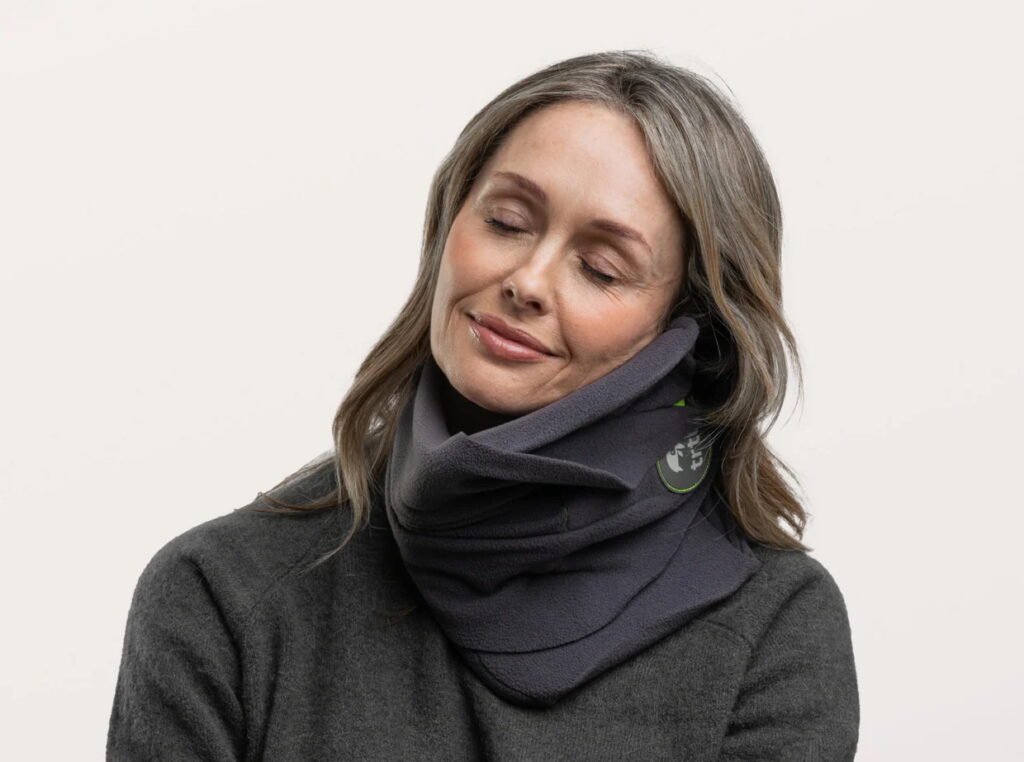
Image credit: trtltravel.com (used for product review purposes only).
Category: Travel Pillows
Author: Product Developer (Independent, No Sponsorships)
Written by a product developer who reviews travel gear with zero sponsorships.
Clear, technical breakdowns of materials, ergonomics, and real-world use.
Table of Contents
- Design Overview
- My Take (from a product developer)
- Real-World Limitations
- What Travelers Are Saying
- Final Scores
- Verdict
- FAQ
Design Overview
The Trtl Pillow is essentially a structured support brace wrapped in a soft fleece shell. Instead of cushioning your head from all sides, it uses a built-in internal frame to support your chin and jaw on one side. This creates a stable leaning posture without requiring bulk behind your neck.
Key design elements:
- a curved internal support frame
- a tension wrap that fastens with Velcro
- fleece exterior fabric
- flat, lightweight form factor
- side-specific support rather than 360-degree cushioning
This design makes the Trtl fundamentally different from U-shaped memory foam pillows. It is closer to a wearable brace than a pillow. This wrap-style approach contrasts with softer, chin-support designs like the BCOZZY travel pillow review, and loop-style designs such as my Infinity Pillow review, which distribute pressure very differently.
In contrast, strap-based designs like the Cabeau Evolution S3 interact directly with the seat.
My Take on the Trtl Travel Pillow (from a product developer)
The Trtl succeeds at one core goal: providing lateral head stability in a compact, lightweight form. For travelers who prioritize portability and predictable support, it offers a consistent experience. However, its performance depends heavily on seat geometry, posture, and flight duration. The design works best in narrow conditions and becomes less forgiving as those conditions change.
Does Setup Feel Easy in Tight Economy Rows?
Fitting the Trtl requires stretching the wrap horizontally across the jaw and cheek before securing it around the neck. In narrow economy rows, this movement happens close to neighboring passengers.
The process is not technically difficult, but it is not effortless. Once positioned, the structure holds its shape reliably and rarely loosens during use.
Is Packability Actually Its Biggest Advantage?
It folds flat, weighs very little, and fits into spaces where traditional U-shaped pillows cannot. For travelers who care most about minimizing bag volume, this is one of the most efficient neck-support designs available.
Does It Feel Like a Real Pillow Over Time?
Not entirely.
The internal support frame does its job, but you feel it. The fleece covering softens contact points, yet the experience remains closer to wearing a structured support device than resting on a cushion.
After about two hours, I became aware of the frame rather than forgetting it was there.
Does Reclining Reduce How Well It Supports Your Head?
The support works best when the seat is almost upright.
On a recent 8-hour overnight flight, I noticed the support dropped the moment the seat behind me reclined unexpectedly. The wrap stayed tight, but the internal frame no longer aligned with my jaw angle. That was the first time the limitation felt obvious rather than theoretical.
Once you recline even slightly:
• the forward-lean angle changes
• the support weakens
• the head can still fall forward
This is the most common ergonomic limitation. It is stable, but not universally adaptive.
Can You Switch Sides Without Waking Up?
No! The most practical limitation is that you pick a side. In other words, before you fall asleep you consciously have to decide which side you want to lean on. If you want to switch sides mid-flight, you must:
- twist it
or - unwrap it fully and re-wrap it again
In a tight cabin, this feels inconvenient.
Memory foam pillows do not have this issue.
Is It Comfortable Enough for Long-Haul Flights?
Only to a point.
On long flights, the pressure of the wrap and the internal frame becomes noticeable over time. It is reliable for short and medium flights, but continuous use for 6–10 hours brings fatigue. This is a common long-flight failure pattern, and it’s one of the reasons many designs struggle to stay comfortable over several hours, as explained in my analysis of why most travel pillows fail on long flights. For a direct comparison of how different designs behave over time, see my Trtl vs Infinity breakdown.
This is why my own rating is:
- Short flights: 7/10
- Long flights: more challenging
Real-World Limitations
Beyond design, there are practical considerations that show up only during use.
1. Heat buildup
The fleece exterior can feel warm, especially in cabins with limited airflow.
2. Limited use in reclined seats
The ergonomic angle breaks down quickly if your seat reclines unexpectedly or unevenly. This becomes more complicated on airlines that restrict seat-attached accessories, as explained in my seat-strap rules guide.
3. Not ideal for people who turn during sleep
The device works only with still, side-leaning posture.
4. Jaw pressure can be noticeable
People with jaw sensitivity report mild discomfort over time.
5. Taller travelers lose support
If your head sits higher than the designed angle, the brace no longer aligns well.
What Travelers Are Saying (Amazon, YouTube, Reddit)
What Do Users Like About the Trtl Travel Pillow?
- extremely packable
- surprisingly stable for upright seats
- lightweight and easy to carry
- good for buses, trains, and short-haul flights
- washes easily and dries quickly
What Complaints Appear Most Often in Reviews?
- switching sides mid-flight is difficult
- jaw pressure becomes noticeable
- not suitable for fully reclined seats
- can feel warm against the face
- support is less effective on long flights
- some users feel the internal frame too clearly
Surprising Patterns in User Feedback
- many travelers buy it as a backup pillow they pair with something softer
- several users say it works better on trains than planes due to seat angle
Final Scores
Scores reflect engineering performance, not just comfort.
How Good Is the Support and Stability?
Support & Stability: 6.5/10
Good lateral support; weak adaptability in reclined positions. Works well only in upright seating positions.
How Comfortable Are the Materials?
Material & Comfort: 7/10
Light and soft on the outside, but structured internally.
Is It Easy to Use in Tight Seats?
Ease of Use: 7/10
Setup is simple, but switching sides is not.
How Portable Is It for Travel?
Packability: 9/10
One of the strongest points of the product.
Does It Stay Comfortable on Long Flights?
Long-Haul Performance: 6/10
Stable early on, but less comfortable over several hours.
This post contains affiliate links. If you purchase through them, I may earn a small commission at no extra cost to you.
Verdict
The Trtl Pillow does exactly what it was engineered to do: give upright, side-leaning support with almost no bulk. If you fly short or medium distances, stay upright, and prefer something lightweight that doesn’t take space in your bag, this design hits its mark.
But it has limits. You feel the internal frame, switching sides requires waking up, and once the seat reclines, support drops fast. So it is not a “sleep all night” pillow. It’s a stability tool for one-side leaning.
If you’re unsure how this pillow compares across seat types and sleep positions, my guide on how to choose the right travel pillow walks through the full decision framework.
If you want to check the Trtl Pillow specifications and current pricing, you can see it here on Amazon.
Best for:
Minimalist travelers, aisle seats, upright sleepers, short-haul flights.
Not ideal for:
Reclined sleepers, people who move a lot in their sleep, anyone who needs cushioning rather than structure.
Bottom line:
For the right traveler profile, the Trtl is absolutely worth the price. If you want soft, adaptive comfort or multi-position support, choose a cushioned memory-foam pillow instead. My reviews of the Infinity Pillow and J-Pillow show how those designs perform in real cabins.
The Bottom Line:
As an independent developer, my takeaway is that the Trtl is a masterpiece of packability, but a failure for those who need soft, traditional cushioning. If you are a minimalist who wants a rigid ‘stop’ for your head to prevent neck strain, it is mechanically superior to almost any foam pillow. But if you have a shorter neck or sensitive jawline, the internal brace will feel like a medical device rather than a comfort item. Personally? It’s the only pillow I pack when I’m flying ‘one-bag’ only, but I’m fully aware I’m choosing stability over ‘coziness. And if I want soft, adaptive comfort or multi-position support, I choose a cushioned memory-foam pillow instead. My reviews of the Infinity Pillow and J-Pillow show how those designs perform in real cabins.
FAQ
Does the Trtl Travel Pillow work for side sleepers?
For most full side sleepers, no, not reliably. The Trtl is designed for upright, one-directional leaning rather than true side-lying positions. While some users can rest briefly in a semi-side posture, sustained side sleeping usually leads to pressure points and reduced stability compared to cushioned memory foam pillows.
Does the Trtl work in reclining airplane seats?
In real airline seating, support becomes inconsistent as soon as moderate recline is introduced. When the seat angle changes, the internal support frame no longer aligns correctly with the jaw and neck. As a result, forward stability weakens and head position becomes less predictable, especially on longer flights where posture shifts over time.
Is the Trtl Travel Pillow comfortable for long flights?
It is usable, but for long hauls the structured brace can become noticeable over time, especially during prolonged recline. Usually pressure and warmth become noticeable over several hours.
Does the Trtl Travel Pillow work for tall or short people?
Fit varies with neck length. Shorter or longer necks may need to adjust positioning or choose a variant (e.g., Trtl Plus) for better alignment.
Is the Trtl better than memory foam travel pillows?
In practice, this depends more on how you actually sleep than most people expect. Trtl wins on size and portability. Memory foam wins on softness and positional freedom.
Is the Trtl worth the price compared to cheaper alternatives?
This usually comes down to whether space or comfort matters more to you. If compactness and stability are your priority, the price makes sense.
What makes the Trtl Travel Pillow different from other travel pillows?
Unlike bulky U-shaped pillows, the Trtl uses a hidden support frame that holds head and neck alignment while being ultra-compact and packable.
How does the Trtl Travel Pillow actually work?
The Trtl pillow uses an internal support frame that you position against your neck, wrap with the scarf-like cover, and fasten to hold your head in a neutral position without forward bobbing.
Is the Trtl Travel Pillow easy to wear and adjust?
Setup requires horizontal tension across the jaw and then a wrap around the neck. It isn’t instant, but once positioned it holds shape reliably, even during slight movement.
How do you put on and adjust the Trtl Pillow for best support?
Undo the fastening, position the support where your head leans, then wrap and secure the scarf. Slight adjustments in position can improve fit for different neck lengths.
Can you switch sides easily?
No. You must fully unwrap and rewrap the pillow to change sides. In narrow economy cabins, this process is awkward and usually wakes you up, which makes mid-flight adjustments impractical.
Can you wash the Trtl Travel Pillow?
Yes, the outer fleece cover is machine washable after you remove the internal support. Wash cold and drip-dry to keep it fresh without damaging the structure.
Is the Trtl Pillow good for red-eye flights?
It can work on short overnight flights where you remain mostly upright. On longer red-eye routes with extended recline, comfort and stability tend to decline.
Can you wear the Trtl Pillow during takeoff and landing?
In most cases, yes. Because it does not attach to the seat, it is usually permitted during safety phases, though some crew may ask for adjustment if it interferes with posture.
Does the Trtl Pillow help with neck pain?
It can reduce forward head drop in upright seats, which helps some users with mild neck strain. However, it does not provide full cervical support like thicker memory foam designs.
Is the Trtl better than inflatable travel pillows?
The Trtl offers more consistent lateral support than most inflatable pillows, but inflatable models provide greater softness and adaptability when properly inflated.