


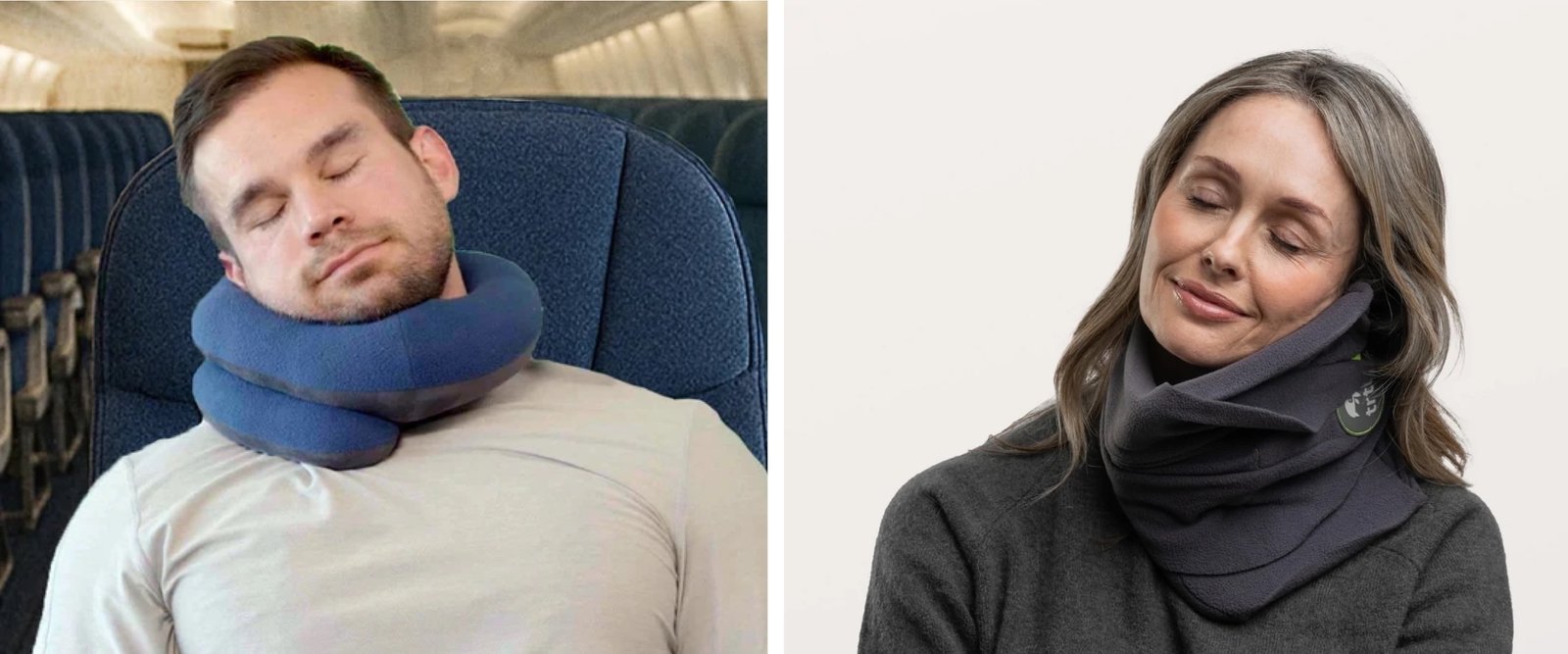
Trtl vs BCOZZY is a comparison between two fundamentally different travel pillow designs. Trtl uses a brace-style wrap to mechanically stabilize the head during upright sleep, while BCOZZY relies on a soft, adjustable U-shape with overlapping arms to provide chin and front support. Both aim to prevent head drop on planes, but they solve the problem through opposite approaches: structure versus softness. This comparison focuses on how each design behaves in real airline seats, where neck stability, pressure buildup, and repositioning matter more than first-touch comfort.
Category: Travel Pillows
Author: Product Developer (Independent, No Sponsorships)
Written by a product developer who reviews travel gear with zero sponsorships.
Clear, technical breakdowns of materials, ergonomics, and real-world use.
Table of Contents
- Support Design: Brace Wrap vs Overlapping Arm
- Neck Support & Stability
- Ergonomics in Real Airline Seats
- Comfort Over Time
- Ease of Use & Adjustability
- Who Each Pillow Is Actually For
- Final Verdict
- FAQ
Support Design: Brace Wrap vs Overlapping Arm
Trtl and BCOZZY start from opposite assumptions about how travel pillows should work. Trtl treats head support as a stability problem. Its wrap exists to anchor a rigid internal brace in a fixed position, forcing the head into a controlled side lean. The fabric is secondary. It provides tension and skin comfort and to hold the brace in place, but the structure does the work. Support is predictable, narrow in scope, and intolerant of misalignment.
BCOZZY treats head support as a comfort and positioning problem. Its looped, overlapping design has no internal structure. Support is created by stacking soft material under the chin and relying on wrap tension and fill compression to hold shape. The loop allows flexibility and multiple configurations, but all support is temporary and load-dependent. As the fill compresses or the wrap loosens, support degrades.
In simple terms, Trtl prioritizes mechanical stability over adaptability. BCOZZY prioritizes adaptability over sustained stability. One behaves like a wearable brace, the other like a configurable cushion. Each philosophy defines its failure modes as clearly as its strengths.
Neck Support & Stability
Neck support differences between Trtl and BCOZZY only become obvious once the pillow is under load. Gravity, time, and small movements expose where each design holds and where it gives way. The sections below break that down by forward collapse, lateral stability, and movement tolerance.
Does It Prevent Forward Head Drop in Upright Seats?
BCOZZY’s strongest behavior is forward support. By stacking its overlapping arms under the chin, it creates a soft barrier that limits forward collapse in upright seating. Early in a flight, this works well, especially for still sleepers. Over time, the polyester fill compresses and the stacked section flattens, reducing lift and requiring re-tightening.
Trtl does not directly cradle the chin. Instead, its rigid internal brace intercepts head movement once the head begins to lean. Forward drop is limited indirectly, provided the seat remains upright. As recline increases, this interception point shifts and effectiveness drops.
Which Design Controls Side Lean Better?
Side support is where the designs diverge sharply. Trtl is built for lateral stability. The internal brace transfers head load into the shoulder, maintaining a fixed lean angle with minimal collapse. As long as alignment is correct, side support remains consistent over time.
BCOZZY has no structural resistance to side load. The soft fill deforms quickly under lateral pressure, causing the pillow to flatten and the head to sink. Side support degrades faster than forward support and does not recover without manual repositioning.
What Happens When You Shift or Change Position?
Neither pillow adapts passively, but the consequences differ. With Trtl, movement breaks alignment. Any change in lean direction or posture requires unwrapping and re-securing the brace. Stability is high, but only while you stay still.
With BCOZZY, movement breaks shape. Shifting compresses different sections of the loop, redistributing fill unevenly. Support fades gradually rather than failing immediately, but frequent adjustments are needed to rebuild the stacked front section.
Where Each Design Breaks Down First:
Trtl fails when posture changes or seat angle increases beyond its designed range. BCOZZY fails when softness can no longer resist load. One fails abruptly due to geometry. The other fails slowly due to material collapse.
Ergonomics in Real Airline Seats
Seat geometry matters more than pillow design intent. Upright back angles, limited headrest depth, and asymmetric space between seats expose how each pillow behaves once it is actually loaded. Trtl and BCOZZY respond very differently to those constraints.
Does It Hold Your Head in Fully Upright Economy Seats?
In fully upright economy seats, both designs are at their strongest. Trtl performs predictably when the seatback stays close to vertical. The rigid brace intercepts lateral head movement early and transfers load into the shoulder without requiring bulk behind the neck. BCOZZY works best here as well, using its stacked front section to limit forward head drop. Over time, however, fill compression reduces lift, and support depends increasingly on re-tightening the wrap.
What Changes When the Seat Is Slightly Reclined?
Once the seat reclines even slightly, divergence increases. Trtl’s brace relies on a specific lean angle. Recline shifts that angle backward, reducing effective interception and allowing the head to fall forward past the brace. Support weakens quickly. BCOZZY tolerates slight recline better because its support is positional rather than angular. The chin-resting stack still functions, but compression accelerates and the pillow loses height faster.
Does Window vs Aisle Seating Change Stability?
Seat position changes the experience. Trtl favors window seats, where the wall limits outward movement and reinforces the side-lean posture. In aisle seats, unsupported outward lean increases reliance on the brace alone. BCOZZY is less seat-position dependent. It performs similarly in window and aisle seats, but switching sides or re-stacking the loop interrupts rest in both.
Neither design adapts gracefully across all seat configurations. Trtl is more stable when geometry aligns. BCOZZY is more forgiving when it does not.
Comfort Over Time
Comfort over time exposes the core difference between structured support and soft containment. Initial impressions matter less than how each pillow behaves after muscles relax, fabric warms, and gravity does its work.
With Trtl, comfort is stable but limited. The fleece exterior softens contact, but the internal brace remains perceptible throughout use. Pressure is concentrated along the jaw and side of the neck, and that pressure does not migrate or dissipate. Over short periods, this predictability is tolerable. Over longer stretches, static load becomes noticeable, especially for users sensitive to jaw or facial pressure. Comfort does not degrade quickly, but it does not improve either. Once fatigue sets in, relief requires removal or repositioning.
BCOZZY feels more comfortable at the start. The soft polyester fill and fleece surface distribute pressure across a wider area, reducing sharp contact points. Early in a flight, this feels forgiving and relaxed. Over time, however, compression changes the experience. The stacked front section gradually flattens, wrap tension loosens, and support drops. Comfort shifts from supportive to merely cushioned, prompting frequent re-tightening.
Neither design adapts passively. Trtl maintains shape but accumulates pressure. BCOZZY relieves pressure but loses structure. Over long flights, both interrupt rest, just for different reasons.
Ease of Use & Adjustability
Ease of use is defined less by how quickly a pillow goes on and more by how often it forces you to intervene once you are tired. Trtl and BCOZZY sit on opposite ends of that spectrum.
Trtl has a steeper initial setup. The wrap needs horizontal tension and accurate placement of the internal brace along the jawline before fastening the Velcro. In tight rows, this takes a moment of space and intention. Once secured, however, the system is stable. There are no fine adjustments to manage and nothing to tune gradually. The trade-off is commitment. If alignment is off or you want to switch sides, the only fix is to unwrap and start again.
BCOZZY is easier to put on. You wrap it around the neck, overlap the arms, and tighten until the front stack feels supportive. This process is intuitive and forgiving. Adjustability is continuous rather than fixed. You can tighten, loosen, or rebuild the stack incrementally without fully removing the pillow. That flexibility helps early on.
Over time, adjustability becomes maintenance. As the fill compresses and the wrap loosens, support fades and requires repeated re-tightening. Each adjustment interrupts rest. Trtl demands fewer interventions but offers fewer options. BCOZZY offers more options but demands more attention. Which feels easier depends on whether you prefer one deliberate setup or ongoing small corrections.
Who Each Pillow Is Actually For
Trtl is the better choice for travelers who need consistent lateral stability and are willing to commit to one sleeping position. It works best for upright sleepers who stay mostly still, prefer structured support over cushioning, and want a pillow that maintains its shape for the duration of a flight. If you fly short to medium routes, value packability, and can tolerate localized jaw and neck pressure, Trtl fits this profile. It is especially effective for window-seat sleepers who can maintain a fixed lean angle. It is not suitable for frequent side-switchers or anyone who expects the pillow to adapt to posture changes.
BCOZZY is better suited to travelers who prioritize initial comfort and positional flexibility over long-term stability. It works well for people who tend to fall forward when sleeping upright and prefer soft, non-intrusive contact against the face and neck. It suits short flights, lighter sleepers, and users who want to fine-tune support gradually rather than lock into one position. It is easier for children and for users who dislike rigid devices. It is not designed for multi-hour stability. If you need support that holds without repeated adjustments, BCOZZY’s softness becomes a limitation.
Final Verdict
Trtl and BCOZZY address head drop with opposite design priorities, but only one approach maintains usable support past the first few hours.
If you want stable, low-maintenance support that holds its shape for most of a flight, choose Trtl. Its internal brace provides consistent lateral control when posture and seat angle align. It requires correct setup and tolerance for localized pressure, but once positioned, it delivers predictable support with minimal intervention. For still sleepers who value structure over comfort, Trtl is the more dependable option.
If you value early comfort and frequent micro-adjustments, choose BCOZZY. Its soft, overlapping design reduces forward collapse and feels easier to tolerate at first, but compression and loosening steadily erode support. It works best on short flights and for users who expect to readjust regularly.
For most long-haul and overnight travelers seeking sustained stability, Trtl is the safer default. BCOZZY is best treated as a comfort-first, short-duration solution rather than a long-term sleep system.
FAQ
Is Trtl or BCOZZY better for neck support on planes?
They support the neck in different ways. Trtl provides lateral stability using a rigid brace and works best for upright, still sleepers. BCOZZY reduces forward head drop using soft, stacked chin support but offers limited side stability over time.
Which should most travelers choose: Trtl or BCOZZY?
Most travelers who want consistent overnight support should choose Trtl. BCOZZY is better suited to short flights and comfort-first users.
Does BCOZZY actually prevent your head from falling forward?
Yes, initially. The overlapping front stack is effective at limiting forward collapse in upright seats. Over time, the soft fill flattens, reducing lift and requiring re-tightening to maintain the same level of support.
Can you switch sleeping positions easily with Trtl?
No. Trtl locks you into a single side-lean posture. Switching sides requires unwrapping and re-securing the brace, which usually interrupts sleep, especially in tight economy rows.
Is Trtl comfortable if you don’t sleep completely still?
Comfort drops quickly with movement. Any posture change breaks alignment, reducing support and increasing pressure along the jaw or neck until the brace is repositioned.
Which pillow is easier to use mid-flight?
BCOZZY is easier to adjust incrementally. You can tighten or rebuild the front stack without full removal. Trtl requires fewer adjustments but offers no partial corrections once set.
Who should avoid both designs?
Restless sleepers, side-switchers, and anyone who relies on cushioning rather than structure will struggle with both. These designs work best for specific postures, not for people who move frequently during sleep.