


The J-Pillow Travel Pillow takes a different approach than traditional U-shaped neck pillows by focusing on upright sleep rather than passive neck cushioning. Its J-shaped design is meant to support the chin, side of the face, and neck at the same time, reducing forward head slump during long periods of sitting. This makes it especially effective for window-seat travelers who can lean into the pillow for added stability. Comfort comes from thick polyester filling rather than rigid structure, so performance depends heavily on seat position and posture. Below is a detailed breakdown of how the J-Pillow works in real travel conditions and where its design helps or falls short. The J-Pillow is not a universal solution. It is engineered for one specific sleeping posture, and its effectiveness drops quickly outside that use case.
Below is the full breakdown.
Category: Travel Pillows
Author: Product Developer (Independent, No Sponsorships)
Written by a product developer who reviews travel gear with zero sponsorships.
Clear, technical breakdowns of materials, ergonomics, and real-world use.
Disclosure: Some links in this article may earn a small commission at no extra cost to you. This does not affect how products are reviewed or rated.
Table of Contents
- Design Overview
- My Take (from a product developer)
- Design-Level Constraints (Independent of User Preference)
- What Travelers Are Saying
- Final Scores
- Verdict
- FAQ
Design Overview
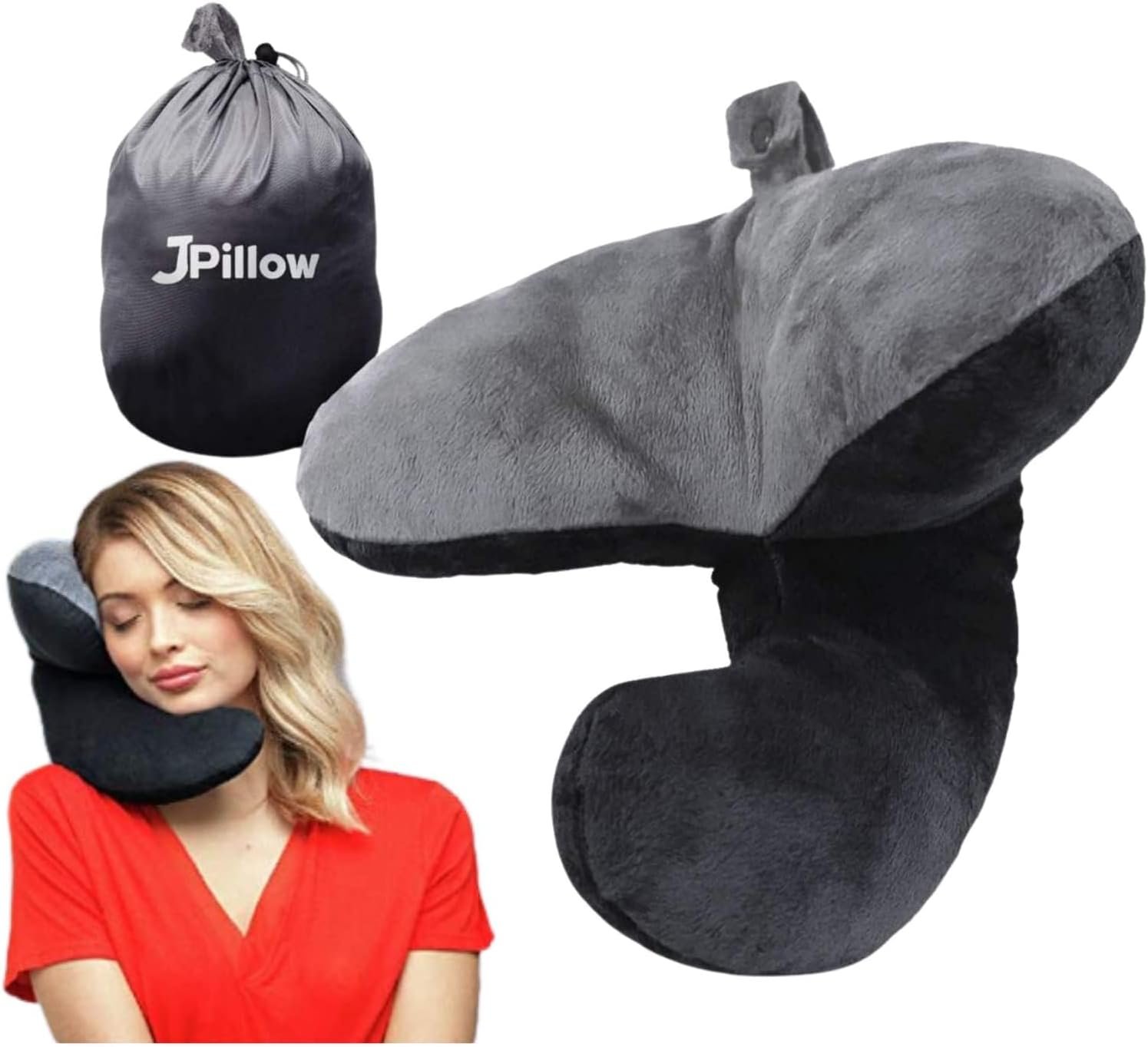
The J-Pillow is built around a very specific sleeping posture: leaning sideways while seated, ideally against a window. Instead of a symmetrical U-shape, it uses a J-shaped profile that combines under-chin support with lateral head bracing. The longer vertical section sits beneath the chin to reduce forward head drop, while the curved upper section presses against the side of the head when you lean. This creates a three-point support system between chin, jaw, and seat side.
Unlike adjustable or wrap-style pillows, the J-Pillow does not rely on tightening, threading, or repositioning during sleep. Its support comes from shape and fill volume, not mechanical tension. The design can be rotated to better match different head shapes, but it remains posture-dependent. It works best when you commit to a side-leaning position rather than shifting frequently.
Key design elements:
- Asymmetrical J-shaped structure
- Extended lower arm for under-chin support
- Curved upper section for side-of-head bracing
- Designed to work best with window or seat-side support
- Thick polyester fill for cushioning and shape retention
- No straps, buckles, or adjustment mechanisms
- Integrated travel snap / loop for attaching to luggage or seat-back storage
- Fully machine washable construction
- Included drawstring travel pouch for packing and transport
My Take (from a product developer) on the J-Pillow Travel Pillow
From a design standpoint, the J-Pillow is a very intentional product. It doesn’t try to accommodate every sleeping position or seat type. Instead, it commits fully to one specific use case and builds its structure around that. Whether it works well or not depends less on softness or materials and more on how closely your seating situation matches the posture it was designed for.
Here’s what the structure actually does:
Design & Structure
The J-Pillow is built around a fixed J-shaped geometry rather than a flexible or adjustable system. Its structure is designed to support the head from below and from the side at the same time, using one continuous padded form.
The longer vertical section sits under the chin to reduce forward head drop, while the curved upper section rests against the side of the head. This creates a three-point contact system: chin, jaw, and side of the head. Unlike U-shaped pillows, there is no thick rear section pushing the head forward against the seat.
The design assumes a stable external surface, such as a window or side wall, to work against. Because the shape is fixed, support quality depends heavily on seat position and orientation rather than user adjustment. There are no straps, drawstrings, or modular elements. The pillow works as intended when the geometry lines up with your posture, and offers limited compensation when it does not.
Structurally, the J-Pillow prioritizes directional support over adaptability.
How Do the Materials Affect Long-Flight Comfort?
The J-Pillow uses a traditional polyester fiber fill rather than foam or inflatable chambers. The fill is soft, compressible, and springy, which gives the pillow a plush feel when you first lean into it but offers limited structural resistance over time.
The exterior is a plush fabric that feels warm and soft against the skin. It’s comfortable for long contact, especially in cooler cabins, but it can trap heat on warmer flights. Stitching and finishing are straightforward and functional, not premium.
Because there is no foam core or internal structure, the entire pillow is fully machine washable. The materials are chosen for comfort and ease of care rather than long-term shape retention or firm support.
Does the J-Pillow Hold Its Shape Over Time?
The J-Pillow’s durability is typical of fiber-filled travel pillows. The polyester fill holds up well initially but gradually loses loft with repeated compression and use. Over time, this reduces how much resistance the pillow provides, especially under the chin and along the side where pressure is concentrated.
There are no rigid components to fail or crack, which helps avoid sudden breakdown. Wear shows up slowly as softening rather than structural damage. The plush exterior tolerates washing well, though frequent laundering can accelerate flattening of the fill.
In practical terms, it’s durable enough for regular travel, but performance declines gradually. It’s not a long-term, shape-retaining support pillow.
Does the J-Pillow Prevent Head Slumping in Window and Aisle Seats?
The J-Pillow’s ergonomics are built around single-side support, not continuous repositioning. It works best when you lean consistently in one direction, most commonly against a window.
When positioned correctly, the long arm supports the chin to limit forward head drop, while the upper section cushions the side of the head. In this setup, the pillow distributes load well and allows the neck muscles to relax without needing active correction.
The plush fleece exterior feels soft against the skin, but it can be slightly slippery, especially on smoother clothing or seat surfaces. This means positioning matters. If the pillow isn’t seated firmly against the window or seat wall, it can shift subtly over time rather than locking the head in place.
The design is also side-specific. If you change lean direction, the pillow does not adapt automatically. You need to wake briefly, rotate it, and re-seat it under the chin and along the opposite side of the head. This makes it less suitable for restless sleepers who shift sides frequently.
For travelers who plan to use the window as a stable support point and stay oriented in one direction, these limitations largely fade into the background. In that context, the J-Pillow’s ergonomics feel natural and effective rather than restrictive.
Design-Level Constraints (Independent of User Preference)
Here’s where the J-pillow starts showing its real boundaries:
• Fixed directional support geometry
The J-Pillow’s J-shaped form defines how support is applied: under-chin support combined with lateral side bracing. While the pillow itself is soft, the support pathway is fixed to a specific leaning posture and does not adapt dynamically to other orientations without manual repositioning.
• Dependence on an external contact surface
The design assumes a stable lateral surface, such as an aircraft window or seat wall, to complete the support triangle. Without that external reference point, the pillow provides limited resistance to head movement.
• No adjustable structural tension
The J-Pillow has no straps, toggles, or tensioning elements that allow support to be fine-tuned once in position. Support is determined entirely by how the pillow is placed and oriented, not by incremental adjustment. As posture shifts during a flight, maintaining support requires manual repositioning rather than simple tightening or loosening.
• Fill-dependent resistance, not engineered resistance
Support comes from compressible polyester fill rather than shaped foam, molded geometry, or internal structure. Under sustained load, the fill compresses rather than pushing back progressively.
• Low-friction plush surface at contact points
The fleece exterior reduces pressure points. Without anchoring or tension, this can allow gradual slippage during long, static lean positions, especially as the fill softens over time.
• Static fill geometry cannot compensate for posture changes
Once positioned, the pillow does not self-correct or redistribute support if posture shifts. Any meaningful change in head position requires waking and manual repositioning.
• Shape is posture-specific, not posture-agnostic
The J-shape is engineered to prevent forward head slump in one defined posture. Outside of that posture, the design lacks a continuous support pathway.
What Travelers Are Saying (Amazon, YouTube, Reddit)
What Do Users Like About the J Pillow?
- Excellent for window-seat sleeping
The J-shape works exactly as intended when there’s a solid side surface. Leaning into a window lets the pillow stabilize the head without fighting gravity. - Forward head slumping is noticeably reduced
The lower arm under the chin does a better job preventing chin drop than open-front U-shaped pillows, especially during upright rest. - Comfortable for long contact
The plush fleece exterior is widely described as soft and pressure-friendly for extended leaning, especially compared to stiffer foam pillows. - No setup or adjustment required
Travelers like that there are no straps, toggles, or inflation steps. You place it, lean, and it works as long as posture matches the design. - Rotatable to fit different head shapes
Some users note that rotating the pillow slightly changes how the chin and jaw are supported, helping fine-tune comfort without complex adjustments. - Easy to clean and maintain
Being fully machine washable is frequently appreciated, especially by frequent travelers who use it on long trips.
What Complaints Appear Most Often in Reviews?
- Effectiveness drops without a window or side support
Travelers consistently note that the J-Pillow loses much of its benefit in aisle or middle seats, where there’s no stable surface to lean against. - Limited usefulness for restless sleepers
People who shift positions during sleep report that the pillow requires waking up and repositioning, which interrupts rest and reduces overall effectiveness. - Bulky Design
Despite being soft and compressible, its asymmetric shape makes it harder to pack neatly, and it takes up more space than simple horseshoe designs. - Plush fabric can feel slippery during movement
Some users mention that the fleece surface slides slightly against clothing or seat fabric, especially when posture changes gradually. - Support fades as fill compresses over time
Longer-term users report that the polyester fill softens with repeated use, reducing under-chin resistance and side support. - Not ideal for upright, unsupported sleeping
In fully upright economy seats without recline or side contact, many travelers find it insufficient to prevent head slump on its own. - Learning curve for correct positioning
While simple in concept, several users note it takes experimentation to find the orientation that actually provides support for their body and seat setup.
Final Scores
Scores reflect engineering performance, not just comfort.
How Good Is the Support and Stability?
Support & Stability: 7/10
Very effective at reducing forward head slump when used in its intended side-leaning posture with window support. Loses effectiveness outside that use case.
How Comfortable Are the Materials?
Material & Comfort: 6.5/10
Soft polyester fill and plush fleece feel comfortable initially, but the fabric can be slippery and the fill compresses over time. Comfortable, not premium.
Is It Easy to Use in Tight Seats?
Ease of Use: 6.5/10
Simple concept, but correct positioning matters. Switching sides requires waking up and repositioning, which limits hands-off usability.
How Portable Is It for Travel?
Packability: 5.5/10
Compressible but awkwardly shaped. Bulkier to pack than standard U-pillows, even with the included carry pouch.
Does It Stay Comfortable on Long Flights?
Long-Haul Performance: 6.5/10
Works well for long flights if posture stays consistent and a window is available. Performance drops with movement, posture changes, or upright unsupported seating.
Verdict
The J-Pillow is a highly posture-specific travel pillow that works best when its design assumptions are met. It’s engineered to support the head from below and from one side at the same time, which makes it particularly effective for window-seat travelers who plan to lean in one direction for most of the flight. In that context, it does a genuinely good job reducing forward head slump without pushing the head forward from behind. If you want to check current pricing or availability, you can see the J-Pillow on Amazon here.
Outside of that setup, its limitations become clearer. Because the pillow relies on side bracing rather than adjustable tension or structural resistance, it can feel unstable or less supportive when it isn’t pressed against something solid. It doesn’t adapt automatically if you change positions, and support quality depends heavily on how consistently you maintain the intended posture.
Best for:
Window-seat travelers, side-leaning sleepers, and people who know they’ll rest in one direction for long periods. Especially useful for those who struggle with forward head slump but don’t want a rigid or bulky pillow.
Not ideal for:
Aisle or middle-seat travelers, restless sleepers who change sides frequently, or anyone looking for hands-free, posture-agnostic support that works equally well without external bracing.
Bottom line:
If you consistently lean against a window and struggle with forward head drop, the J-Pillow can outperform most traditional U-shaped designs. If you sleep upright without side support or change positions frequently, it will likely feel unstable.
FAQ
Does the J-Pillow really work on airplanes?
Yes, when used as intended. The J-Pillow works best on planes when you can lean against a window or seat side, where its shape can support the chin and side of the head at the same time.
Is the J-Pillow good for long flights?
It can be comfortable on long flights if you stay in one position. It’s less effective for frequent position changes or fully upright aisle seating.
Does the J-Pillow stop your head from falling forward?
It reduces forward head slump by supporting the chin, but only when the pillow is correctly positioned and backed by a solid surface like a window.
Is the J-Pillow better than a U-shaped travel pillow?
For window-seat sleepers, yes. The J-Pillow provides better chin and side support than most U-shaped pillows, which often lack front structure.
Can you use the J-Pillow without a window seat?
You can, but support is weaker. Without something solid to lean against, the pillow feels less stable and relies mostly on cushioning rather than structure.
Is the J-Pillow comfortable to sleep in?
The plush fleece fabric and thick fill feel comfortable initially, though the soft surface can feel slightly slippery during longer use.
Does the J-Pillow work for side sleepers on planes?
Yes, if “side sleeping” means leaning against the window. It’s not designed for free-floating side sleeping without external support.
Is the J-Pillow washable?
Yes. The entire pillow is machine washable, which makes it easier to maintain than foam or structured travel pillows.