


You close your eyes for a bit on the flight and honestly think you slept. Maybe even pretty well. The cabin is dark, the engines turn into background noise, and at some point you drift off without really noticing. Then the plane lands and your body feels awful. Your neck is stiff, your mouth feels dry, your brain feels foggy, and somehow you’re more exhausted than before you fell asleep. That’s the weird part. On paper, sleeping on a plane sounds like rest. In a real seat it’s different. Your body spends most of that flight fighting posture, dehydration, noise, shallow sleep, and constant tiny interruptions you barely remember afterward. And that’s where things start to fall apart.
Category: Travel Pillows
Author: Product Developer (Independent, No Sponsorships)
Written by a product developer who reviews travel gear with zero sponsorships.
Clear, technical breakdowns of materials, ergonomics, and real-world use.
Table of Contents
- Why Does Sleeping on a Plane Feel Restful at First?
- Why Is Airplane Sleep Usually Low-Quality Sleep?
- Why Do Reduced Oxygen and Dry Cabin Air Leave You Feeling So Drained?
- Why Does Your Body Never Fully Relax in Economy Seats?
- Why Do You Keep Waking Up Mid-Flight?
- Why Do Jet Lag and Circadian Disruption Make Airplane Sleep Feel Worse?
- What Actually Helps You Feel Less Destroyed After Flying?
- Quick Reality Check
- Final Verdict
Why Does Sleeping on a Plane Feel Restful at First?
At first, airplane sleep honestly feels kind of amazing.
You’ve been awake for hours, dragging bags through terminals, sitting at the gate, staring at screens, listening to announcements, and suddenly the cabin goes quiet. The lights dim, the engines settle into this constant low noise, and your body finally gets a second to stop.
Then you close your eyes for “a minute.”
And somehow you wake up thinking, okay… maybe I actually slept.
That’s the trap.
For a little while, your body really does start relaxing enough that it feels like rest. Your thoughts slow down, your eyes get heavy, and the exhaustion from the travel day finally catches up to you. In theory, anyway.
But most people notice this after about half an hour. The sleep feels real at first. Then the small interruptions start showing up one by one.
Why Is Airplane Sleep Usually Low-Quality Sleep?
You sleep… but never deeply enough
That’s what catches people off guard.
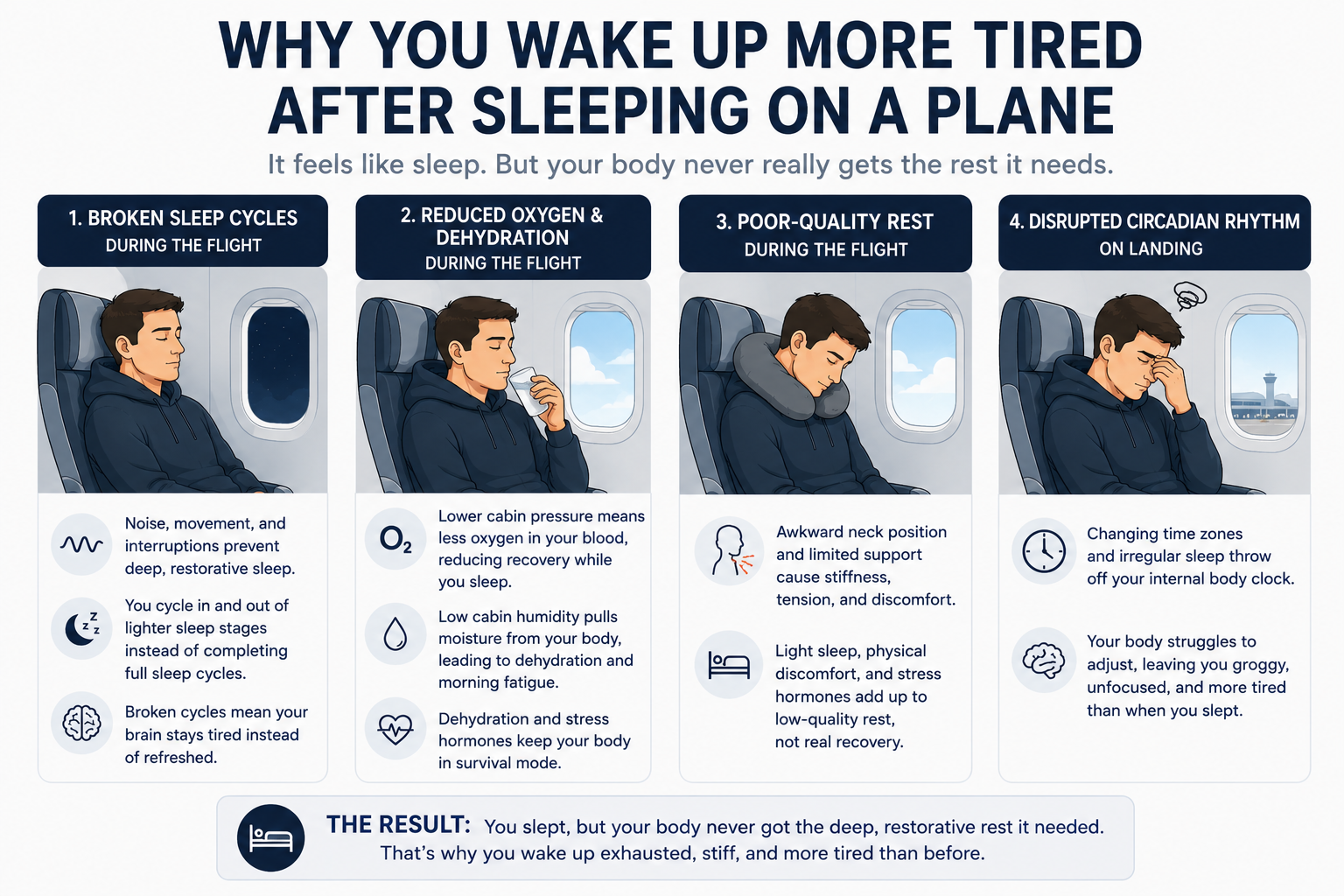
You wake up after the flight thinking you slept for a decent amount of time. Maybe even a few hours. But your body feels like it barely got any rest at all. Your eyes feel heavy, your neck is stiff, your mouth feels dry, and mentally you feel weirdly drained instead of refreshed.
That’s the catch.
On paper, sleeping on a plane sounds simple. You close your eyes, fall asleep, wake up later. In a real seat it’s different.
Your body never fully lets go
Even when you’re asleep, your body usually stays half-alert the whole flight.
There’s always something small pulling you back up again. A cart hitting the aisle. Someone squeezing past your seat. Turbulence. Cabin lights turning on. Your neck slipping into a bad angle. The seat pressing into the same spot for too long.
None of these things sound dramatic on their own. But together, they keep interrupting the deeper stages of sleep your body actually needs to recover.
That’s usually when the sleep stops feeling restorative.
The sleep keeps breaking into pieces
You notice this more on overnight flights.
After a while, it stops feeling like one long stretch of sleep and starts feeling more like dozens of little fragments stitched together. You drift off, wake up slightly, adjust your position, fall asleep again, then repeat the same cycle later.
At some point, your body spends more energy managing the seat than recovering from the day.
Why Do Reduced Oxygen and Dry Cabin Air Leave You Feeling So Drained?
A lot of people think they feel terrible after a flight just because the seat was uncomfortable. The cabin itself quietly wears you down too.
You usually notice this a few hours into the flight. Your mouth starts feeling dry no matter how much water you drink, your eyes burn a little, your skin feels tight, and your body starts feeling strangely heavy and sluggish.
That’s not just lack of sleep.
Airplane cabins run at lower pressure than normal ground level, so your body gets slightly less oxygen the entire flight. Not enough to panic your body or anything dramatic like that. But enough that your system never fully relaxes the way it normally would during real recovery sleep.
That’s when the exhaustion starts compounding.
Your body is already dealing with awkward posture, broken sleep, noise, and constant little interruptions. Then dehydration and lower oxygen get layered on top of all that. Sounds manageable on paper. On an overnight flight it feels very different.
By the time the plane lands, your body often feels less rested and more like it spent hours quietly fighting the environment around it.
Why Does Your Body Never Fully Relax in Economy Seats?
Economy seats always feel a little more comfortable before your body fully settles into them.
That’s usually how it starts.
You lean back, shift around for a few minutes, cross your arms differently, maybe shove a hoodie or jacket behind your neck, and eventually you land on a position that feels “good enough.” For a little while, anyway.
Then the seat slowly starts fighting back.
You notice this more on longer flights. One hip starts hurting from the same pressure point, your lower back stiffens up, your shoulders creep forward, and your neck keeps tightening every time your head slips out of position again.
It doesn’t happen all at once. It slowly builds in the background while you’re trying to sleep.
Most people don’t realize this while it’s happening. Even when your eyes are closed, your body often never fully switches into real recovery mode. Your muscles are still quietly working the whole time trying to hold your posture together in a seat that was designed more for fitting passengers than supporting sleep.
Sounds reasonable until you try it on an overnight flight.
After a few hours, the body stops feeling relaxed and starts feeling managed.
Why Do You Keep Waking Up Mid-Flight?
This is usually the point where airplane sleep starts feeling weird.
Not terrible. Just… broken.
You fall asleep for a bit, then wake up again without fully understanding why. Maybe the plane moved. Maybe your neck slipped forward. Maybe your arm went numb against the armrest. Sometimes nothing obvious even happened. You just suddenly open your eyes, shift around, and try again.
Then the same thing happens later.
And later again.
That’s what a lot of overnight flights actually feel like. Not one long sleep. More like dozens of small unfinished naps stitched together between discomfort, noise, posture corrections, and random interruptions your brain barely remembers afterward.
You notice this especially after a few hours. The sleep starts feeling lighter and thinner, almost like your body never fully trusted the environment enough to let go completely.
At some point, you stop feeling like someone who’s sleeping and start feeling like someone repeatedly trying to get back to sleep.
Why Do Jet Lag and Time Zones Make Plane Sleep Feel So Useless?
Sometimes the weirdest part is waking up after technically sleeping for hours and still feeling completely destroyed.
Your body just feels off.
That’s because airplane sleep isn’t only fighting the seat, the noise, or the constant interruptions. A lot of the time, your body clock is completely confused too. You’re trying to fall asleep while your system still thinks it should be eating dinner, working, or fully awake in another time zone.
At that point, the body clock and the sleep itself stop lining up.
You might sleep for five or six hours on the flight and still wake up feeling like none of it counted. Your brain feels foggy, your body feels heavy, and the exhaustion feels strangely disconnected from how long you were actually asleep.
Sounds unreasonable until you experience it yourself.
Your body didn’t just get bad sleep. It got bad sleep at the wrong biological time too.
What Actually Helps You Feel Less Destroyed After Flying?
Honestly, the people who handle long flights best usually aren’t the ones sleeping deeply the whole time. They’re the ones whose body never completely falls apart during the flight.
That’s the difference.
A more stable sleeping position helps more than people expect. Not necessarily the softest setup. Stable. Once your neck keeps slipping out of place or your body starts constantly correcting itself, the sleep slowly turns into work instead of recovery.
You notice this after a few hours.
The people who wake up feeling completely wrecked are often the ones who spent the whole flight half-twisting, readjusting pressure points, waking up to fix posture, then trying to fall asleep again over and over.
Hydration matters too. More than most people realize, honestly. Dry cabin air quietly drains you the entire flight, especially overnight.
And small movement resets help. Standing up for a minute, loosening your legs, resetting your posture before things stiffen too much. Sounds basic. In practice, that’s usually where things start helping again.
Because airplane sleep rarely becomes amazing. The goal is making it less physically exhausting.
Quick Reality Check
You can sleep on a plane for six hours and still wake up feeling like your body never actually rested.
That’s what catches people off guard.
From the outside it looks like sleep. Eyes closed. Quiet cabin. Blanket on. But underneath all that, your body is usually still dealing with bad posture, broken sleep, dry air, tension, noise, and constant little interruptions the whole flight.
In theory, it’s rest. Your body often experiences it more like interrupted recovery.
Final Verdict
Sleeping on a plane can feel surprisingly convincing while it’s happening. You close your eyes, drift off for a while, and genuinely think you finally got some rest.
Then the plane lands and your body tells a completely different story.
Your neck hurts, your brain feels foggy, your body feels heavy, and somehow you’re still exhausted after “sleeping” for hours. That’s the part people don’t expect.
In theory, airplane sleep sounds like recovery. In practice, your body spends most of the flight quietly trying to survive the environment instead of fully relaxing inside it.