


You’ve probably noticed it before.
One economy flight feels perfectly manageable. Nothing amazing, but you get off the plane feeling reasonably human.
Then a different flight, with a similar flight time, leaves you sore, tired, and wondering why every minute seemed to take forever.
Most people blame the airline.
Sometimes they’re right.
But not always.
That’s what makes this so confusing.
Two flights can look almost identical when you’re booking them. Similar schedules. Similar seats. Similar flight times.
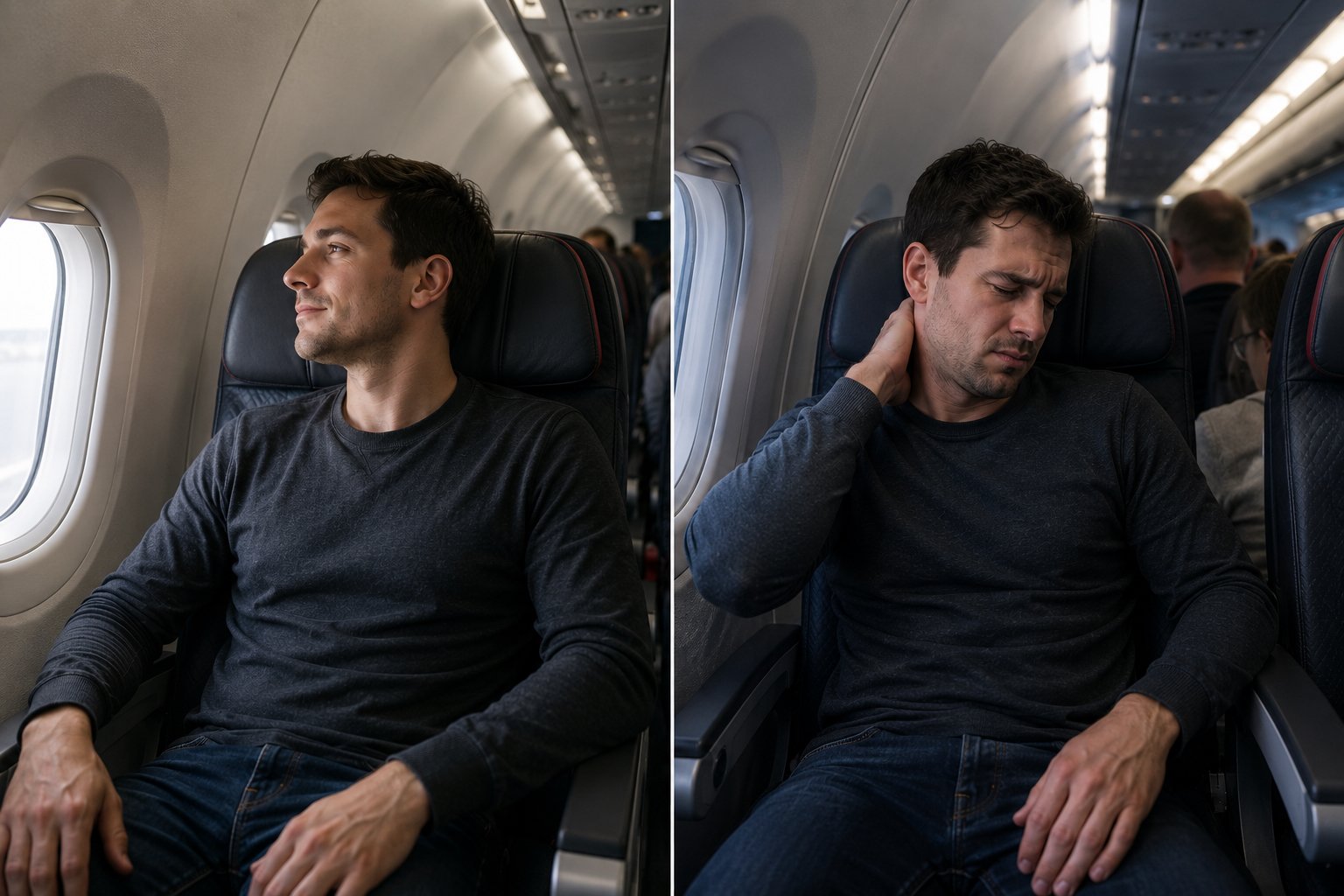
Yet one feels surprisingly comfortable and the other feels like a six-hour argument between your body and the aircraft. We explored this in more detail in why some flights leave you rested and others leave you exhausted.
The strange part is that the difference often comes from things most travelers never think about. The aircraft itself. The seat design. The cabin environment. The departure time. Even small details like where the window sits beside your shoulder.
Which sounds insignificant.
It isn’t.
That’s why two economy flights can feel completely different, even when they look almost the same on paper.
Category: Travel Pillows
Author: Product Developer (Independent, No Sponsorships)
Written by a product developer who reviews travel gear with zero sponsorships.
Clear, technical breakdowns of materials, ergonomics, and real-world use.
Table of Contents
- Why Most Travelers Blame the Airline First
- Do Airlines Actually Use Different Seats?
- Why Aircraft Type Often Matters More Than Airline
- Why Headrests Quietly Change Everything
- Why Seat Geometry Matters More Than Cushion Softness
- Why Cabin Environment Changes Comfort More Than Most People Realize
- Why Flight Timing Can Make a Comfortable Airline Feel Uncomfortable
- What Travelers Can Actually Control
- Quick Reality Check
- Final Verdict
Why Most Travelers Blame the Airline First
Most of us decide how comfortable a flight was before we even realize we’re doing it.
A good experience gets attached to the airline.
A bad experience gets attached to the airline too.
Maybe you flew with Singapore Airlines a few years ago and slept surprisingly well. Maybe you had a miserable overnight flight with another carrier and spent six hours trying to find a position that didn’t make your neck hurt.
Those memories stick.
The next time you book, you already have a favorite. And you already have a suspect if things go wrong.
The funny thing is that we rarely remember the details. We don’t remember the exact seat, the aircraft type, the cabin temperature, or whether we happened to be exhausted before boarding.
We remember the logo on the boarding pass.
So when one flight feels comfortable and another doesn’t, the airline usually gets the credit or the blame.
It feels logical.
But it’s often only part of the story.
Do Airlines Actually Use Different Seats?
They do.
Just not as much as most people think.
If you board a flight with an airline known for comfort, it’s easy to imagine they have their own special seat that nobody else uses.
The reality is usually a lot more ordinary than that.
Most airlines buy their economy seats from the same handful of manufacturers. They choose different models, fabrics, headrests, padding, and cabin layouts, but they’re often starting from a surprisingly similar place.
Two airlines can market completely different travel experiences and still be using seats from the same supplier.
That’s not to say all economy seats feel the same.
They definitely don’t.
Some have better padding. Some have better headrests. Some feel supportive for the first hour and strangely uncomfortable by hour four. A few seem determined to remind you exactly where every bone in your lower back is located.
That’s where things get interesting.
The differences are real.
They’re just usually smaller and more subtle than most travelers expect.
Why Two Economy Seats Can Feel Completely Different
The interesting part is that comfort rarely comes down to one big feature.
It’s usually a collection of small things.
Which is frustrating, because small things are hard to spot when you’re booking a flight.
A headrest that holds your head a little more securely. A seat shell that gives your shoulders slightly more room. A backrest shape that doesn’t push your head forward quite as aggressively.
None of those differences jump out when you sit down.
You notice them later.
Usually a few hours into the flight.
One moment you’re reasonably comfortable. The next you’re shifting positions every fifteen minutes trying to find a spot your neck actually likes.
Meanwhile, the passenger beside you seems perfectly fine.
That’s often the clue.
Comfort on planes isn’t usually decided by one dramatic feature.
It’s decided by lots of small details quietly working together.
Or working against you.
Why Aircraft Type Often Matters More Than Airline
This is one of those things most travelers don’t realize for years.
You have a great flight on an airline.
A few months later you book the same airline again, choose a similar seat, fly a similar route, and somehow the experience feels completely different.
The seat feels tighter.
The window isn’t where you expected it to be.
Your shoulder keeps touching the wall.
For some reason you just can’t get comfortable.
That’s usually when people blame the airline.
But sometimes the airline isn’t the reason.
The aircraft is.
And that’s where things get interesting.
Most of us barely look at aircraft types when booking a flight. We notice departure times. Prices. Maybe seat maps if we’re feeling ambitious.
An Airbus A320, Airbus A321, or Boeing 737 just looks like a string of letters and numbers.
Until you’re stuck inside one for six hours.
Then those little details start mattering surprisingly quickly.
The cabin might be slightly wider. The wall beside the window might curve differently. The window itself might sit a little farther forward or farther back than you’re used to.
Which sounds tiny.
It isn’t.
You notice this after a couple of hours when you’re trying to recreate a comfortable position from a previous flight and somehow it just isn’t working.
Same Airline, Completely Different Experience
This is why people sometimes swear an airline has “gone downhill.”
In reality, they may have flown on a completely different aircraft.
Same airline.
Same economy cabin.
Sometimes even the same seat number.
Yet one flight feels perfectly manageable while the other feels like you’re constantly adjusting your neck, shoulders, or lower back.
That’s the clue.
The airline didn’t necessarily change.
The airplane did.
And once you start paying attention to aircraft types, a lot of those mysterious good flights and bad flights suddenly become much easier to explain.
Not all economy cabins are created equal.
Even when the logo on the tail is exactly the same.
Why Headrests Quietly Change Everything
Most people barely notice the headrest when they sit down.
They notice the seat.
They notice the legroom.
They notice whether the person in front immediately reclines.
The headrest is usually an afterthought.
Then they try to sleep.
That’s when it suddenly becomes one of the most important parts of the seat.
If you’ve ever fallen asleep for a few minutes on a plane and then jerked awake because your head dropped sideways, you’ve already experienced the problem. Your neck spends the entire flight trying to keep your head stable while you’re sitting upright. Eventually it gets tired.
Some airlines use winged headrests that fold inward slightly and help keep your head from wandering. Others offer very little support once you relax and drift off, which can leave your neck doing far more work than it should.
The difference sounds minor.
It doesn’t feel minor at two in the morning somewhere over the ocean.
A good headrest won’t turn economy into business class.
But it can make the difference between arriving a little tired and arriving with a neck that feels like it worked the entire flight.
Why Seat Geometry Matters More Than Cushion Softness
Most people think a comfortable seat is a soft seat.
It’s a reasonable assumption.
When you first sit down, softness is usually the first thing you notice.
But a flight isn’t five minutes long.
It’s four hours. Six hours. Sometimes longer.
That’s where the shape of the seat starts to matter more than the cushioning.
The angle of the backrest, the shape of the lower back support, the position of the headrest, and the way your weight is distributed all influence how your body sits for the next several hours.
The strange thing is that you rarely notice good seat geometry.
You notice bad seat geometry.
You notice it when you can’t get comfortable no matter how many times you shift position. When your lower back starts complaining. When neck pain starts showing up halfway through the flight.
Why Soft Seats Can Still Feel Terrible
A seat can feel wonderfully soft during boarding and still leave you uncomfortable before the flight is over.
That’s because softness and support aren’t the same thing.
If the seat places your body in an awkward position, the padding can only do so much. Eventually pressure starts building somewhere. Your lower back. Your shoulders. Your neck.
And once that starts, people tend to blame the airline.
The seat was soft.
The problem was the position it quietly put them in for the last six hours.
Why Cabin Environment Changes Comfort More Than Most People Realize
Sometimes you board a flight and everything just feels… easier.
You settle into the seat.
The cabin feels calm.
You don’t spend the entire flight adjusting your position or wondering how much time is left.
Then you take another flight a few weeks later and something feels off from the beginning. Not terrible. Just slightly less comfortable in a way that’s difficult to explain.
That’s often the cabin environment at work.
The seat might be nearly identical, but the cabin can feel completely different.
A quieter cabin is usually easier to relax in. Less vibration means your body isn’t constantly responding to small movements. Temperature matters too. Most travelers have been on flights that felt strangely warm, strangely cold, or somehow both within the same hour.
Then there’s the dryness.
You don’t always notice it during the flight. You notice it when you land feeling tired, thirsty, and less rested than you expected.
Even the age of the cabin can have an effect. Newer aircraft often feel brighter, cleaner, and more pleasant to spend time in, even before you look at the seat itself.
None of these things sounds important on its own.
Together, they can completely change how a flight feels.
Why Flight Timing Can Make a Comfortable Airline Feel Uncomfortable
Here’s something most travelers don’t like to admit.
Sometimes the airline did nothing wrong.
You’ve probably had flights where everything felt uncomfortable from the start. The seat felt smaller than it should have. You couldn’t settle in. Every hour seemed longer than the last.
Then you’ve had other flights that felt surprisingly manageable, even though the seat wasn’t any different.
A lot of that comes down to timing.
A red-eye flight sounds good in theory because you’re flying during normal sleeping hours. The problem is that sleeping in an economy seat is still very different from sleeping in a bed. Your body understands that immediately.
Departure time matters too.
A flight that leaves at 10 a.m. often feels very different from one that leaves after a full workday, an early alarm, a stressful connection, or a long wait at the airport.
Fatigue changes everything.
Small annoyances feel bigger. Minor discomforts become impossible to ignore. A seat that felt acceptable last month suddenly feels terrible.
Sometimes we blame the airline.
Sometimes we blame the aircraft.
And sometimes we’re simply tired before the flight even begins.
What Travelers Can Actually Control
The frustrating part about airline comfort is that a lot of it is outside your control.
You can’t redesign the seat.
You can’t change the cabin humidity.
You can’t convince the airline to install a different headrest five minutes before boarding.
But you can influence a few things.
If the airline shows the aircraft type during booking, it’s worth paying attention. Sometimes the biggest comfort difference isn’t the airline at all. It’s whether you’re flying on one aircraft or another.
Seat choice matters too. Some travelers swear by the window seat. Others don’t. Others would happily trade the wall for the freedom to stretch an aisle leg every hour. In some cases, choosing the best seat to sleep on a plane matters more than choosing the airline.
It’s also worth being realistic.
No travel pillow can completely fix a bad seat. No airline can make a red-eye feel exactly like a night in your own bed.
The goal isn’t perfection.
The goal is giving yourself a better chance of arriving feeling reasonably human.
And in economy, that’s often a win.
Quick Reality Check
That flight you loved?
It might not have been the airline.
It might have been the aircraft.
Or the seat.
Or the fact that you boarded well-rested and actually managed to sleep for a few hours.
The flight you hated might have had the same airline logo on the boarding pass.
That’s what makes airline comfort so difficult to judge.
We tend to remember the airline.
But what we actually experienced was a combination of dozens of small factors that happened to come together on a particular day.
Final Verdict
Most travelers spend a lot of time looking for the most comfortable airline.
The truth is a little messier than that.
Some of the most comfortable flights happen because a lot of small things happen to go right at the same time. The aircraft suits you. The seat works for your body. The cabin feels comfortable. You’re not already exhausted before boarding.
And sometimes the opposite happens.
That’s why two flights on different airlines can feel surprisingly similar, while two flights on the same airline can feel completely different.
Airlines absolutely matter.
They just aren’t the whole story.
Sometimes the flight you remember for years wasn’t better because of the airline.
It was better because, for a few hours, your body and the aircraft happened to get along.