


You recline your seat expecting it to finally work. It feels better for a moment.
Then your head drops forward anyway.
It doesn’t happen immediately. It creeps in after a few minutes. You adjust, try again, and end up in the same position.
That’s where it starts to break down. Reclining changes the seat, not the support. And that’s why it doesn’t fix head drop on flights.
This is also why certain seat positions make the problem worse. That shows up even more clearly in other setups.
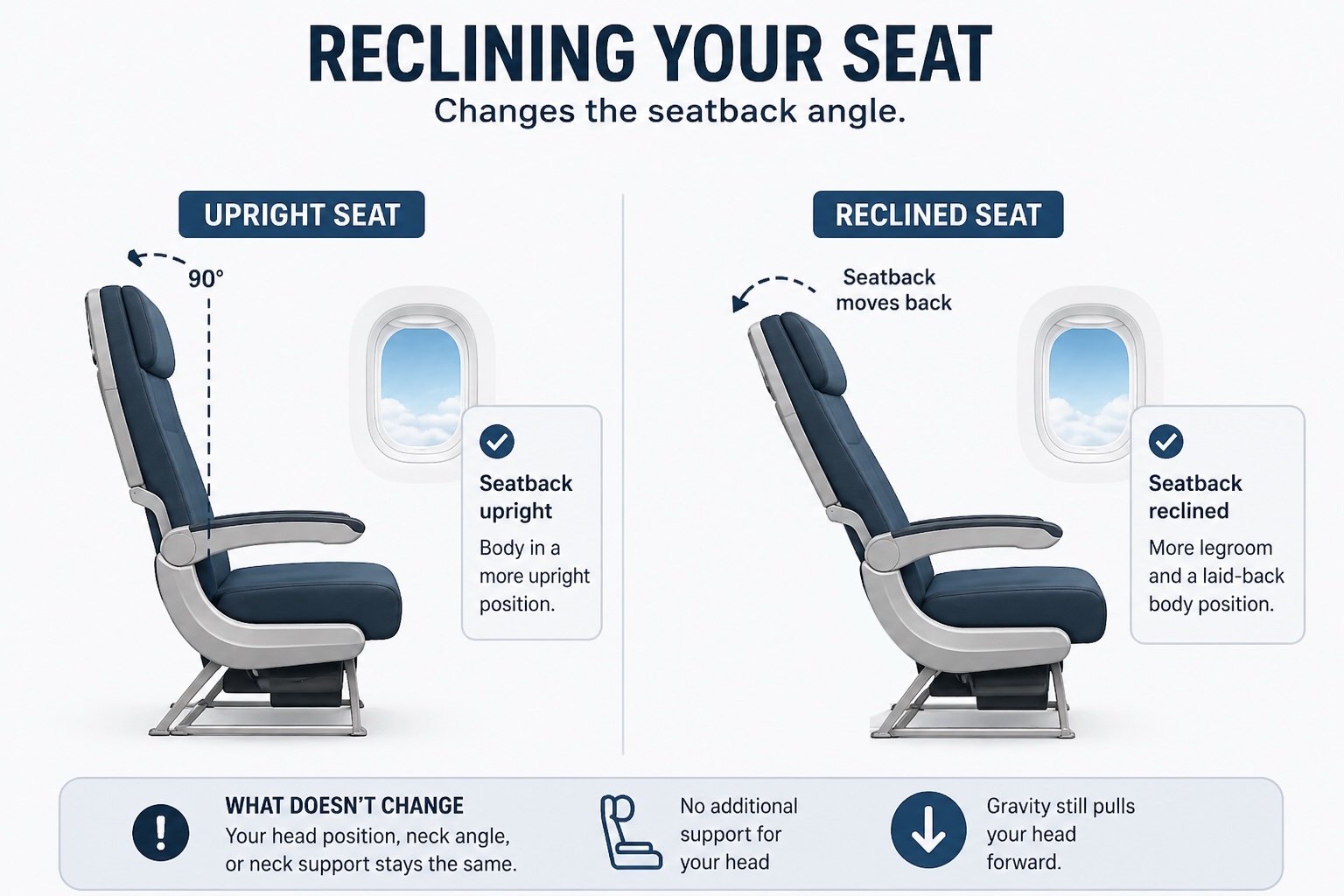
Short answer: reclining your seat doesn’t stop head drop on flights. It only changes your angle, not your neck support.
Category: Travel Pillows
Author: Product Developer (Independent, No Sponsorships)
Written by a product developer who reviews travel gear with zero sponsorships.
Clear, technical breakdowns of materials, ergonomics, and real-world use.
Table of Contents
- What Does Reclining Actually Change on a Plane?
- Why Does Your Head Still Drop When You Recline?
- Why Does Reclining Feel Like It Should Work?
- Why It Fails Over Time
- When Does Reclining Actually Help?
- What Actually Prevents Head Drop
- Quick Reality Check
- Final Verdict
What Does Reclining Actually Change on a Plane?
The seat moves, not your support
When you recline, the back of the seat tilts a little and your upper body goes with it.
Your weight shifts, your back settles in more, and it feels better at first. In theory, anyway.
For a few minutes, it even feels like you’ve fixed something.
What doesn’t move with it
Your head and neck don’t really change.
They’re still unsupported, still free to drift forward or to the side. There’s nothing holding them in place, nothing stopping those small movements from building up.
That’s where it starts to break down.
So yes, the seat moves. Your body follows. But the part that actually causes head drop stays exactly the same.
That’s the catch.
Why Does Your Head Still Drop When You Recline?
There’s still no real neck support
It feels like it should.
You lean back, get a bit more comfortable, and for a moment it seems like your head might finally stay put. Then it doesn’t.
A few minutes later, it starts drifting again.
There’s still nothing holding your head
Reclining doesn’t suddenly give your neck support.
Your body moves back, but your head is still doing its own thing. It’s not resting on anything solid, not really supported, just kind of balancing there.
Most people only notice this after a while. You adjust once, maybe twice, and then realize you’re still fighting it.
Gravity didn’t go anywhere
Leaning back changes the angle, but not the direction things fall.
Your head still wants to tip forward. It just does it more slowly now. It doesn’t drop all at once, it creeps in. And part of that is the seat itself. That forward push is actually built into most seat design.
And once it starts, there’s nothing to catch it.
That’s the part reclining never fixes.
Why Does Reclining Feel Like It Should Work?
“The seat moved, so it must be better… right?”
That’s the logic, even if you don’t think about it.
You press the button, the seat goes back, and something changes. It feels like progress. Like you’ve done the right thing.
In theory, anyway.
It actually does feel better… for a bit
Your back settles in, your body relaxes, and that stiff upright feeling disappears. For a moment, it feels like you’ve finally found a position that might work.
Most people stop thinking about it right there.
Then it slips back
It doesn’t fail all at once.
A few minutes later, your head starts drifting again. You adjust it, maybe lean it back, try to find that “better” position again.
And that’s where it gets obvious.
The seat moved. But the thing you were trying to fix didn’t.
That’s the illusion.
Why It Fails Over Time
It starts off fine
At first, it actually feels like it might work.
You lean back, settle in, and for a few minutes nothing really moves. You think you’ve found a better position this time.
Then your head dips forward a little.
You bring it back without thinking. No big deal.
Then it keeps coming back
It doesn’t drop all at once.
It’s more like it slowly drifts. A few minutes later, it’s forward again. You fix it again. Maybe lean back harder this time, like that’ll help.
It just doesn’t.
Your neck gets tired
At some point, you start doing the work.
Your neck is holding your head in place, even if you don’t notice it at first. After a while, that effort builds up.
Which sounds small, but it isn’t.
That’s usually when it gets harder to keep your head where you want it.
You end up in a loop
This is the part most people recognize.
Head drops. You fix it. It drops again.
Somewhere halfway through the flight, you realize it’s not going to stay put. That’s the same pattern most people run into when trying to sleep on planes in general.
Reclining helped for a few minutes. Then everything went back to the same problem.
When Does Reclining Actually Help?
It does feel better … at first
Reclining isn’t useless.
You lean back, and that stiff upright feeling eases up a bit. Your back settles in, your body relaxes, and for a moment it feels like you’ve improved something.
Which you have, just not the part you were hoping for.
It slows things down
You notice this pretty quickly.
Your head doesn’t drop right away. It takes a bit longer, like you’ve bought yourself a few extra minutes before it starts drifting again.
In theory, that feels like progress.
But it doesn’t fix the actual problem
That’s the catch.
The comfort is real, just limited. Your body feels better, but your head is still unsupported.
So yes, reclining helps. Just not in the way people expect.
What Actually Prevents Head Drop
So what actually works then?
If reclining doesn’t fix it, something else has to. Most travel pillows struggle here for the same reason.
The difference is simpler than it sounds. Your head needs something that stays with you. Not just something soft behind it, but something that doesn’t lose contact the moment you shift.
It has to move with you
This is where most setups quietly fail.
You settle in, everything feels fine, and then you move a little. Not much, just enough. Suddenly there’s a gap again.
That’s when your head starts drifting.
You notice this after a while. It doesn’t happen instantly. It shows up once you’ve been sitting there for a bit.
If the support isn’t connected to your body in some way, it falls out of position the second you do.
It’s not just forward
People think it’s only about your head falling forward.
It isn’t.
Sometimes it tilts to the side. Sometimes it shifts slightly forward and sideways at the same time. Those small movements add up.
And once they start, nothing really stops them.
It’s about limiting movement
The setups that actually work don’t feel dramatically different.
They just keep your head from wandering too far. Not locked in place, just stable enough that it can settle somewhere and stay there.
That’s the difference.
Not softer. Not bigger.
Just less movement.
If your head isn’t supported, it will move. If it moves, it will drop.
Quick Reality Check
Reclining changes the angle. Not the problem.
It feels like progress for a minute. You lean back, settle in, and think this might finally work.
Then your head starts drifting again.
That’s the part people don’t expect.
The seat moved. The support didn’t.
And after a while, it shows up again.
Final Verdict
Reclining does make things feel better. Just not in the way you’re hoping.
It changes your position, not the problem.
If your head still has nothing to rest on, it’s going to drift. Maybe a bit later, maybe a bit slower, but it will.
If something actually holds it in place, that’s when it works.
Reclining can buy you a little time. It just doesn’t fix what causes the drop.