


You probably know this feeling.
One flight, you somehow manage to sleep for a few hours and think:
That actually wasn’t too bad.
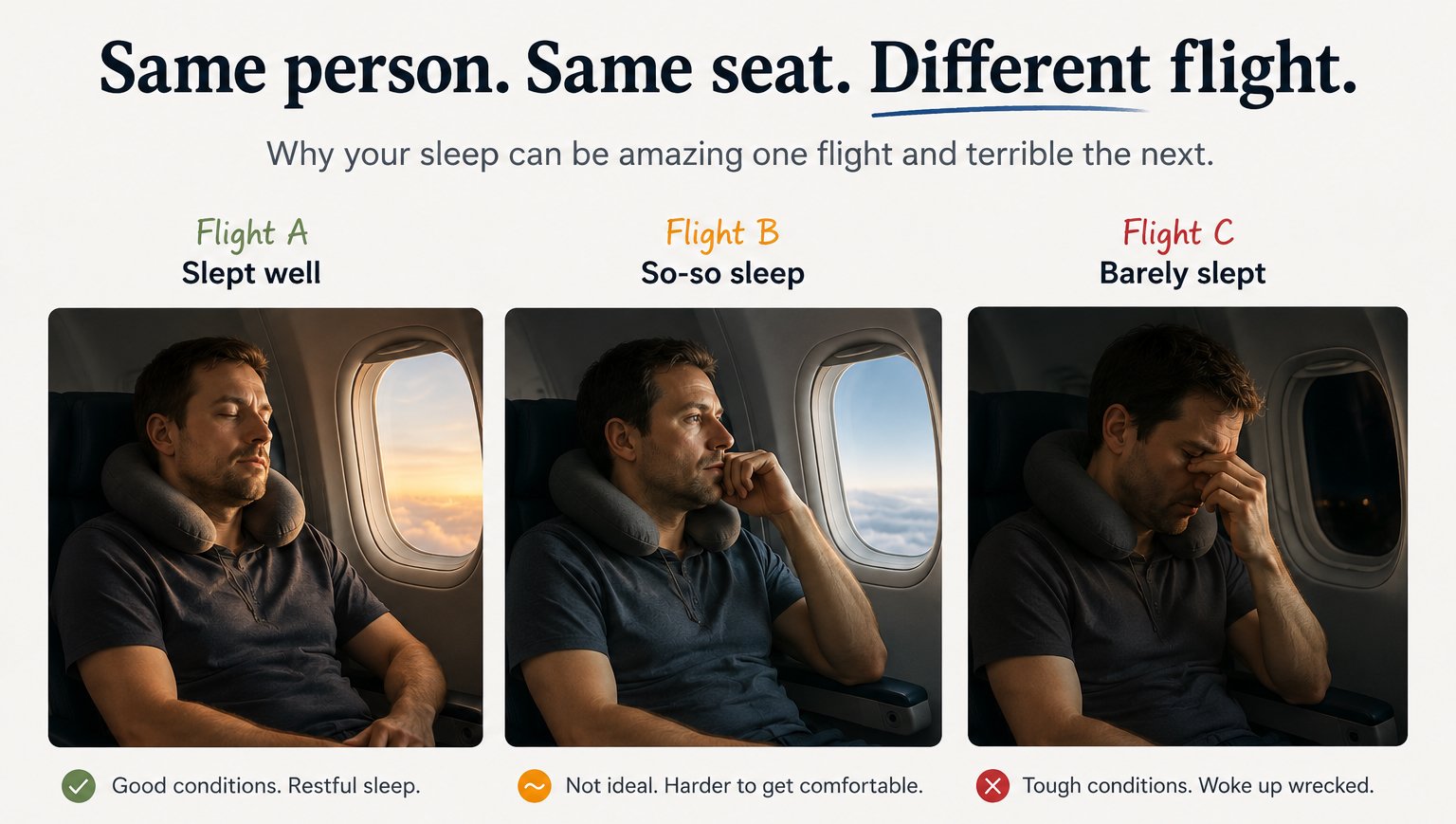
Then a few weeks later, same airline, same economy seat, same travel pillow… and suddenly you land feeling like you barely slept at all.
Stiff neck.
Heavy eyes.
That strange exhausted feeling where your body feels tired, but not rested.
And that’s the confusing part.
Most people assume sleeping on planes is either something you’re good at or bad at.
In reality, airplane sleep is much messier than that.
Tiny things you barely notice, seat shape, timing, space, noise, even the aircraft itself, quietly change how your body handles sleep. It doesn’t happen immediately. It happens slowly.
Category: Travel Pillows
Author: Product Developer (Independent, No Sponsorships)
Written by a product developer who reviews travel gear with zero sponsorships.
Clear, technical breakdowns of materials, ergonomics, and real-world use.
Table of Contents
- Why Some Flights Feel Easier to Sleep On Than Others
- Why Do Some Economy Seats Feel Much Worse Than Others?
- Why Does Legroom Matter So Much for Sleep on Planes?
- Why Does Aircraft Type Matter More Than Most People Realize?
- Why Do Temperature, Noise, and Flight Timing Affect Sleep So Much?
- Why Can the Same Travel Pillow Feel Great on One Flight and Terrible on Another?
- What Can You Actually Control?
- Quick Reality Check
- Final Verdict
Why Some Flights Feel Easier to Sleep On Than Others
If you’ve flown enough, you’ve probably had this happen.
You take a flight, fall asleep for a few hours, and wake up thinking:
Honestly, that wasn’t too bad.
Then a few weeks later you do almost the exact same thing. Same travel pillow. Same airline. Same type of seat.
And somehow everything falls apart.
You can’t get comfortable.
You keep waking up.
Your neck hurts.
You spend half the flight shifting around trying to find a position that worked perfectly last time.
That’s the part most people find confusing.
It feels like sleep on planes should either work for you or not work for you.
But it doesn’t really work that way.
A flight is a collection of small conditions that either help sleep or quietly fight against it. A little less space. A noisier cabin. Worse timing. A seat that feels slightly different. None of it seems like a big deal at first.
You usually notice it a few hours later.
That’s when the flight that felt promising turns into one of those nights where you never seem to settle properly.
Why Do Some Economy Seats Feel Much Worse Than Others?
Have you ever been on a flight where the seat felt perfectly fine at takeoff, then somehow became unbearable three hours later?
Not broken.
Not terrible.
Just increasingly annoying.
You keep shifting. Adjusting. Crossing your legs differently. Sitting up. Leaning back. Trying the same position again because it worked twenty minutes ago and maybe it’ll work now.
It usually doesn’t.
That’s because small differences in seat design matter far more than they seem to.
Some seats let you settle into them naturally. Others seem to push your body into a position that feels slightly wrong from the start. Not wrong enough to notice immediately. Just wrong enough that your neck, shoulders, lower back, and hips spend the next few hours arguing about it.
And that’s where things slowly start falling apart.
A slightly different headrest. A little less recline. Firmer cushioning. A seat shape that doesn’t quite match how your body wants to sit. Each one sounds insignificant on its own.
Together, they can completely change how a flight feels.
You usually notice it halfway through the flight.
One seat disappears into the background.
The other never lets you forget you’re sitting in it.
Why Does Legroom Matter So Much for Sleep on Planes?
You’ve probably had a flight where you just couldn’t settle.
Not because anything was seriously wrong.
You just never felt comfortable for very long.
You move one leg.
Then the other.
Cross your ankles.
Uncross them.
Shift your hips.
Sit up.
Lean back.
For a few minutes, it feels better.
Then you’re right back where you started.
That’s usually when space becomes the problem.
Most people think legroom is about stretching out. In reality, it’s often about having enough room to make all those little unconscious adjustments your body wants to make throughout the night.
When that space disappears, you get stuck.
And that’s where things start getting messy.
The same pressure points stay under load for too long. Your knees stay bent. Your hips stop changing position. Small discomforts that would normally disappear start hanging around.
You notice this halfway through the flight.
The seat hasn’t changed.
Your pillow hasn’t changed.
In some cases, even your seat location can change how much room your body has to settle comfortably.
But your body is running out of places to go.
At that point, sleep starts feeling less like rest and more like a series of negotiations with the seat.
Why Does Aircraft Type Matter More Than Most People Realize?
Have you ever taken a flight that just felt… easier?
You can’t really explain why.
The seat wasn’t dramatically better.
The airline wasn’t different.
Nothing obvious stood out.
Yet somehow you slept better, felt calmer, and arrived less exhausted.
Then you take another flight and spend the entire trip feeling slightly uncomfortable without knowing exactly what’s bothering you.
That’s the strange part.
The aircraft itself can quietly change the experience.
Some cabins feel noticeably quieter. Others have a constant background noise that never seems to stop. Some aircraft feel smooth enough that you forget you’re moving. Others send a steady stream of little vibrations through the seat for hours.
You rarely notice these things right away.
You notice them later.
Maybe your sleep feels lighter. Maybe you wake up more often. Maybe you just feel more drained than expected when the flight ends.
And that’s where things get interesting.
Sometimes the reason one flight felt better than another wasn’t the seat, the pillow, or even you.
It was the airplane.
Why Do Some Airlines Feel Better for Sleep Than Others?
People often say they sleep better on certain airlines.
Sometimes they’re right.
But it isn’t always the airline itself.
Different airlines often use different seat designs, cabin layouts, headrests, cushioning, lighting schedules, and service routines. Even when two flights are the same length, the overall experience can feel surprisingly different.
You notice this after a few trips.
One airline seems easier to relax on. Another always leaves you feeling slightly more tired by the end of the flight.
That’s not necessarily your imagination.
Sometimes what you’re experiencing isn’t better sleep habits or a better travel pillow.
It’s a cabin environment that happens to work a little better with the way your body sleeps.
Why Do Temperature, Noise, and Flight Timing Affect Sleep So Much?
Sometimes you board a flight completely convinced you’re going to sleep.
You’re tired.
The cabin lights are dim.
You have your pillow.
Maybe it’s even a red-eye flight, which should make things easier.
And yet somehow you spend the next few hours drifting in and out of sleep without ever really getting there.
That’s what makes airplane sleep so frustrating.
Nothing seems wrong.
The cabin is a little warm. Or maybe a little cold. Someone opens a window shade for a minute. The meal service starts just as you’re getting comfortable. A light turns on somewhere behind you. The engine noise never stops, even after you’ve stopped consciously hearing it.
Each thing feels small.
Individually, it probably is.
But sleep is surprisingly sensitive to small interruptions. That’s the part most people don’t realize.
You don’t always wake up because of one big thing.
Sometimes it’s ten tiny things happening over and over again.
And then there’s the timing.
Your body doesn’t care that the airline calls it a night flight. If your internal clock thinks it’s still afternoon, it may not be ready to cooperate. In theory, you’re exhausted. Reality is less cooperative.
That’s why two overnight flights can feel completely different, even when they look almost identical on paper.
Why Can the Same Travel Pillow Feel Great on One Flight and Terrible on Another?
This is one of the most confusing things about travel pillows.
You take a trip and the pillow works beautifully. You sleep for a few hours, your neck feels okay, and for once you don’t spend the entire flight fighting for a comfortable position.
So naturally, you think you’ve finally found the right pillow.
Then the next flight comes along.
Same pillow.
Same person.
Same airline.
And somehow you’re adjusting the thing every fifteen minutes wondering what happened.
That’s the part that catches people off guard.
Most travel pillows don’t work independently. They work as part of a much bigger system. The seat matters. Your posture matters. The amount of recline matters. Whether you’re by the window or stuck in the aisle matters.
Even your body angle can change everything.
You notice this after a while. On one flight, your head seems to settle naturally into the support. On another, it keeps drifting, slipping, or finding new ways to become uncomfortable.
And that’s where a lot of people misjudge the pillow.
Sometimes the product didn’t get worse.
The conditions around it did.
The pillow just happened to take the blame.
What Can You Actually Control?
After all this, you might be thinking:
Great. So sleeping on planes is basically a lottery.
It can feel that way sometimes.
The good news is that a few of the things that matter most are still under your control.
Seat choice is probably the biggest one. A window seat gives you something to lean against and usually means fewer interruptions. Anyone who’s been woken up three times because their aisle neighbor needed the bathroom knows exactly what that feels like.
Timing matters too.
Some flights line up reasonably well with when your body wants to sleep. Others feel like you’re forcing yourself to sleep at completely the wrong time. That’s usually where things get messy.
And then there’s the travel pillow.
A lot of people expect a pillow to solve everything. Most can’t. That’s not really their job. The best ones simply make a difficult situation a little easier.
Hydration helps. Getting up occasionally helps. Making small adjustments before you’re already uncomfortable helps.
You don’t need a perfect flight.
Most of the time, you just need enough things working in your favor that your body finally gets a chance to relax.
Quick Reality Check
Two economy flights can look almost identical and still produce completely different sleep experiences.
That’s what catches people off guard.
The seat, the timing, the space around you, the aircraft, and dozens of small details quietly shape how well you sleep.
Sometimes the difference between a good flight and a miserable one is much smaller than it seems.
Final Verdict
A lot of people spend years thinking they’re just bad at sleeping on planes.
Then one random flight comes along and they sleep surprisingly well.
That’s usually the clue.
The difference was never just the pillow. And it was never just you.
Some flights simply give your body a better chance to relax than others. More space. Better timing. Less noise. A seat that works with you instead of against you.
The frustrating part is that you rarely notice those things while they’re happening.
You only notice them when the flight is over and you realize you feel completely different than the last time.