


Seat-strap travel pillows are not banned by the FAA. But if you attach one to your seat, a flight attendant can still make you remove it at any time.
The reason is simple: the moment your pillow connects to the seat, it stops being a personal item and becomes something that can interfere with certified aircraft equipment.
That’s why enforcement feels inconsistent. It’s not about the pillow. It’s about the attachment.
If you’re deciding between strap-based and body-worn designs, I break down the practical differences in my travel pillow selection guide.
Short answer:
Seat-strap travel pillows are not banned by the FAA, but airlines and cabin crew can ask you to remove them at any time if they attach to the seat.
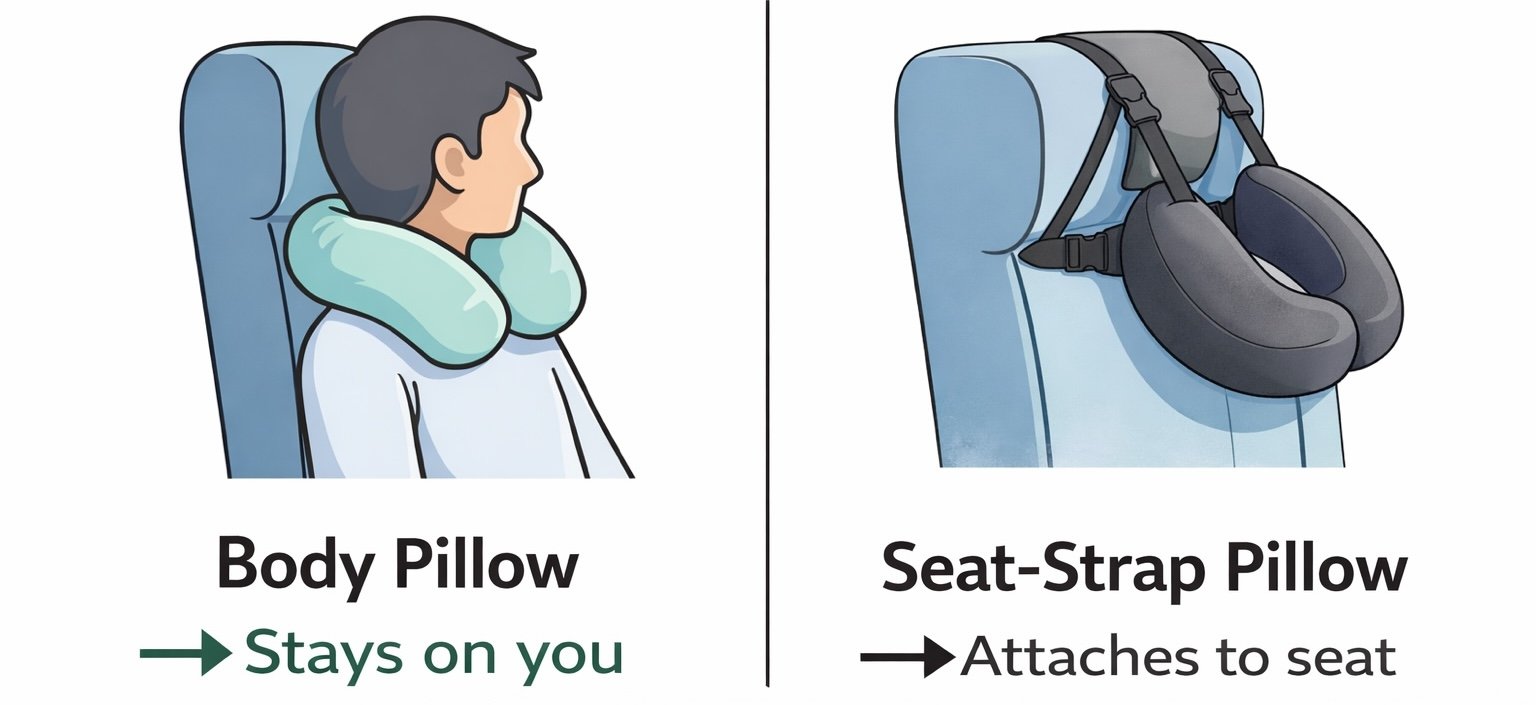
The key difference: one stays on your body, the other attaches to the aircraft. If it touches the seat, it becomes their problem.
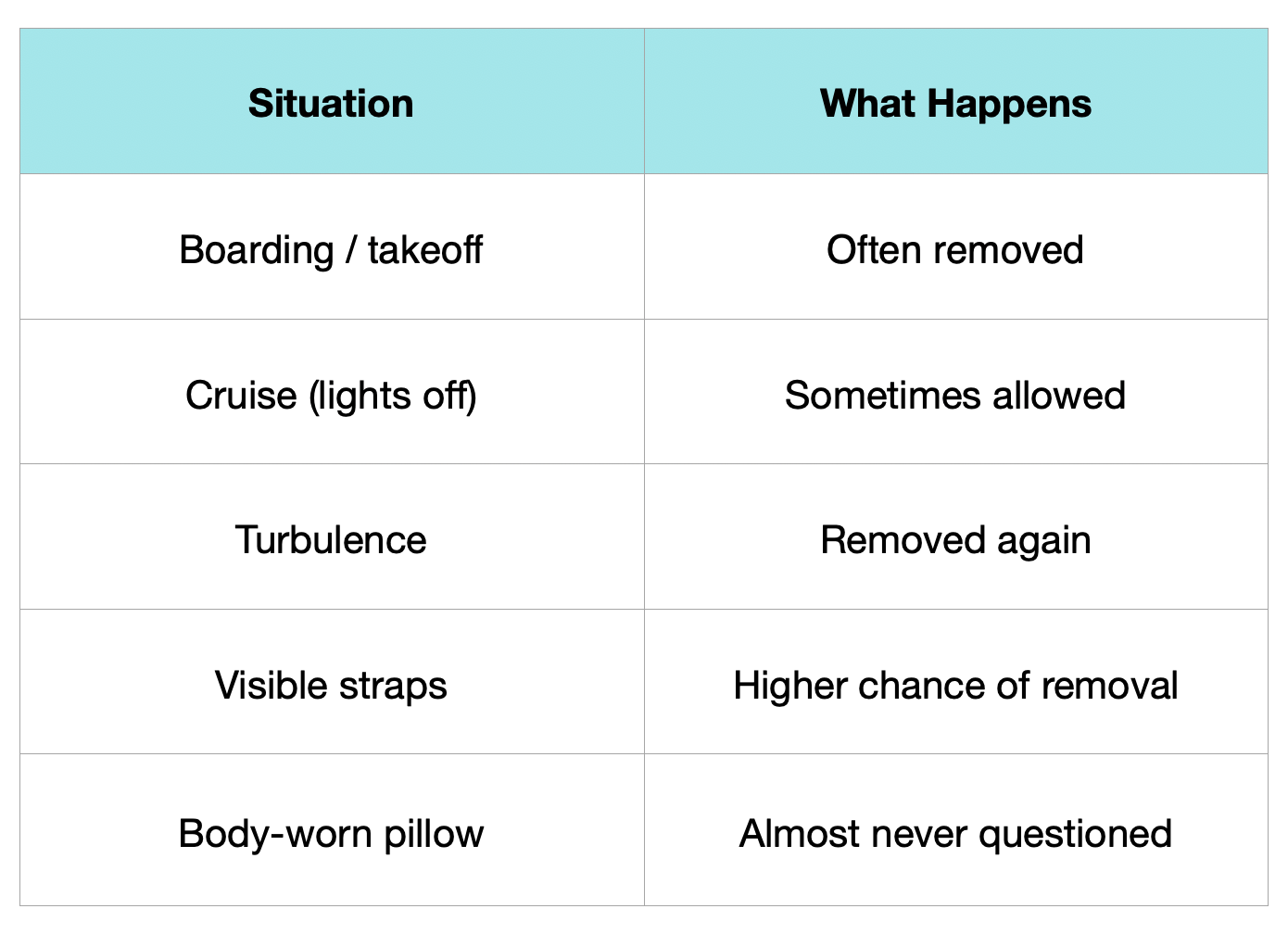
When Seat-Strap Pillows Get Removed (Quick Reality)
Category: Travel Pillows
Author: Product Developer (Independent, No Sponsorships)
Written by a product developer who reviews travel gear with zero sponsorships.
This post contains affiliate links. If you purchase through them, I may earn a small commission at no extra cost to you.
Table of Contents
- Why Seat-Strap Travel Pillows Are Being Questioned
- The Qantas Reddit Incident: What Actually Happened
- The 2026 Reality: Why “Official” Rules Don’t Matter Anymore
- What FAA Rules Say About Seat-Strap Travel Pillows
- Airline Enforcement vs FAA Rules
- Do Airlines Like Qantas Actually Allow Them?
- Why Seat-Strap Pillows Attract Crew Attention
- What Travelers Should Expect (Practical Advice)
- Why Seat-Strap Pillows Get Flagged (in one glance)
- Final Takeaway: Are Seat-Strap Travel Pillows Worth It?
- FAQ
Why Seat-Strap Travel Pillows Are Being Questioned
Seat-strap travel pillows are being questioned because they sit in a gray area between personal comfort items and objects attached to the aircraft itself. Unlike standard neck pillows that stay on your body, seat-strap designs anchor to the seat or headrest, which immediately raises safety, compliance, and enforcement concerns.
From a passenger’s point of view, the idea sounds logical. If the pillow is fixed to the seat, your head should stay supported without constant readjustment. From a cabin safety perspective, however, anything attached to the seat becomes more than just a comfort accessory. Aircraft seats are certified safety components, and crews are trained to be cautious about items that wrap around, clip onto, or alter how those components function.
The issue is not that seat-strap pillows are explicitly banned. There is no FAA rule that names them directly. The problem is that they interact with areas of the aircraft that crews are responsible for keeping clear, accessible, and predictable during critical phases of flight. Headrests, seatbacks, and tray mechanisms are all part of that system.
This is why seat-strap pillows tend to trigger questions, inspections, or removal requests more often than body-worn designs. Their visibility, attachment points, and perceived impact on seat movement make them stand out to crew, especially during boarding, taxi, takeoff, and landing. This is also why body-worn designs tend to avoid this scrutiny entirely. Pillows like the BCOZZY and Infinity Pillow stay on the passenger’s body rather than interacting with the seat, which keeps them outside this gray area.
In short, seat-strap travel pillows are being questioned not because they are inherently unsafe, but because they cross a line that standard travel pillows never touch: they connect personal comfort directly to aircraft hardware.
The Qantas Reddit Incident: What Actually Happened
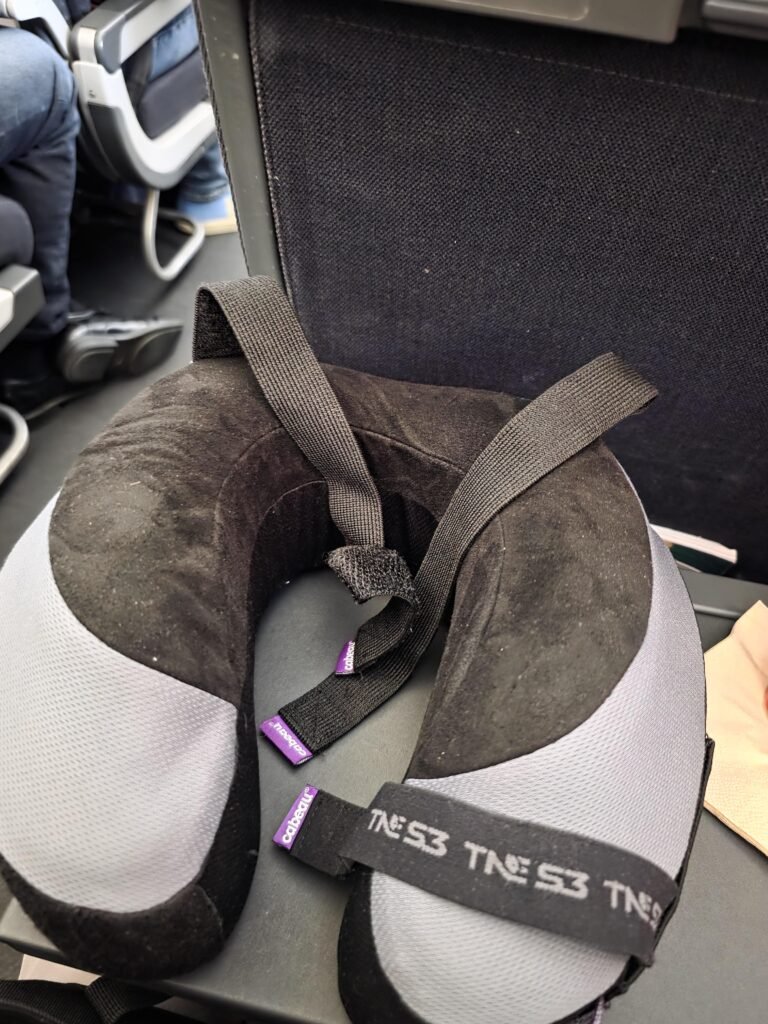
Source: Reddit user report on r/QantasFrequentFlyer (used for discussion and analysis)
The discussion started with a post on the Qantas Frequent Flyer subreddit describing a passenger being asked to remove a travel pillow that used elastic straps attached to the seat headrest. According to the account, cabin crew instructed the passenger to remove the pillow during the flight, citing safety concerns related to seat attachments. The passenger complied, but the incident sparked confusion and debate among other travelers reading the thread.
What matters here is not whether the pillow itself was “dangerous,” but why it drew attention in the first place. The pillow design relied on elastic straps looping around the seat structure rather than staying fully on the passenger’s body. That single design choice changed how the product was perceived by crew.
In the comments, some users assumed this meant Qantas had officially banned seat-strap travel pillows. Others argued that similar products had been used without issue on different flights. This disagreement highlights a common misunderstanding: airline enforcement is often situational, not universal.
The Reddit thread itself does not establish a formal policy change. Instead, it provides a real-world example of how seat-attached accessories can trigger intervention, even when passengers believe the product should be allowed. Crew members are trained to assess anything attached to the seat as a potential interference risk, especially during takeoff, landing, or turbulence.
The key takeaway from the incident is not that Qantas issued a blanket ban, but that seat-strap designs increase the likelihood of scrutiny. Once an accessory is physically connected to the aircraft seat, it moves from being a personal comfort item to something crew may feel obligated to address.
The 2026 Reality: Why “Official” Rules Don’t Matter Anymore
As we move into 2026, the gap between what is “allowed” and what is “enforced” has widened. Airline crews are under more pressure than ever to speed up boarding and deplaning.
The current trend: Flight attendants are no longer just checking if a pillow is “safe”—they are checking if it’s “attached.” If they see a strap, their default reaction is now to ask you to remove it, regardless of the brand, based on recent flights and consistent traveler reports.
The Bottom Line for 2026: Don’t argue the FAA rules with the crew. Even if you’re right, you’ll lose. Instead, switch to a “stealth” approach: use your seat-strap pillow as a traditional wrap-around until the lights go down. Only then should you use the straps.
What FAA Rules Say About Seat-Strap Travel Pillows
The FAA doesn’t explicitly mention pillows, but they give crews ‘final authority.’ In plain English? That means even if the law is on your side, if a flight attendant thinks your strap might slow down an evacuation, you’re losing that pillow. It’s frustrating, inconsistent, and depends entirely on who is working your flight that day.
The FAA does not publish a rule that explicitly mentions travel pillows, elastic straps, or headrest attachments. Instead, FAA cabin safety guidance focuses on a broader principle: items brought onboard must not interfere with aircraft seats, safety equipment, or passenger evacuation.
In practice, this translates to one thing: if it’s attached, it can be removed. These documents emphasize that anything attached to an aircraft seat must not alter how the seat functions, block access, or impede movement during normal operation or emergency situations. Seats and headrests are certified safety components, and airlines are required to keep them in their approved configuration.
Because seat-strap travel pillows attach directly to the seat structure, they fall into a gray area. The FAA does not ban them by name, but the guidance gives airlines and crew authority to remove or restrict items that interact with certified seat components. This is why enforcement often varies by situation rather than by product category.
Another important point is timing. Even items that might be tolerated during cruise can be restricted during critical phases of flight such as takeoff, landing, or turbulence. During these phases, the threshold for “potential interference” becomes much lower.
In practical terms, FAA rules are written to be flexible rather than prescriptive. That flexibility allows airlines to interpret safety standards conservatively. Seat-strap travel pillows are not illegal under FAA rules, but they are not explicitly protected either. Once an item attaches to the seat, crew members are well within their authority to question or remove it under FAA safety guidance.
A real example of how this plays out in practice is covered in my analysis of the Alaska red-eye incident.
Airline Enforcement vs FAA Rules
A key source of confusion for travelers is the difference between FAA rules and airline enforcement. The FAA sets safety standards, but it does not micromanage how every object is handled in the cabin. Airlines are responsible for interpreting those standards and training crews to apply them in real-world situations.
The FAA sets the big safety rules. Airlines decide how strict to be with them. This means two things can be true at the same time: an item may not be explicitly prohibited by the FAA, and a crew member may still be correct in asking you to remove it.
From an operational standpoint, airlines train crews to prioritize consistency and risk reduction. If an object is attached to a certified seat component, crew members are encouraged to treat it as a potential safety concern, even if it looks harmless. The goal is not to evaluate product design on the spot, but to prevent any modification of seat behavior, access, or evacuation paths.
This is why enforcement can feel inconsistent. One flight may allow a seat-strap pillow during cruise, while another removes it immediately. The difference often comes down to aircraft type, headrest design, turbulence expectations, or how visible the attachment is to the crew.
Importantly, crew authority is absolute once an instruction is given. FAA regulations require passengers to comply with crew instructions related to safety, regardless of whether the rule seems ambiguous. At that point, the issue is no longer the pillow itself, but compliance.
The practical takeaway is this: FAA rules create the framework, but airline enforcement determines the outcome. Seat-strap pillows sit at the intersection of those two systems, which is why travelers experience unpredictable results.
Delta Air Lines: Travel Pillow Enforcement in Practice
Delta generally allows standard neck pillows, but passengers report that bulky or loose pillows may be treated as extra items at busy gates.
Enforcement varies by agent, airport, and flight load. Travelers carrying large or rigid pillows are more likely to be asked to consolidate or stow them. For a detailed breakdown, see our analysis of Delta Air Line‘s boarding practices.
Southwest is a little clearer when it comes to ordinary neck pillows, but seat-attached designs can still create a separate issue once you’re onboard. I broke down the current Southwest travel-pillow rules and what can actually happen at boarding here.
Do Airlines Like Qantas Actually Allow Them?
Airlines rarely publish explicit lists approving or banning specific travel pillow designs. Instead, most rely on broad cabin safety rules that give crew discretion. Qantas is a good example of how this plays out in practice.
Based on reported passenger experiences, including the Reddit thread that sparked this discussion, Qantas does not appear to have a public policy that names seat-strap travel pillows outright. However, crew members have asked passengers to remove pillows with elastic straps attached to the seat, particularly when those straps loop around the headrest or seat frame.
This aligns with how airlines typically operate. Anything that alters how a seat behaves, restricts movement, or attaches to certified seat components can be treated as non-compliant, especially during taxi, takeoff, landing, or turbulence. From the airline’s perspective, the safest approach is to avoid allowing attachments altogether rather than evaluating each product design individually.
What matters is not whether the pillow is marketed as “airline-approved,” but whether the attachment is visible and interacts with the seat structure. A strap that wraps tightly around a headrest is more likely to be questioned than a pillow worn entirely on the body.
In short, airlines like Qantas may allow seat-strap pillows in some situations, but they do not guarantee acceptance. Approval is conditional, situational, and ultimately up to the crew on that flight. Travelers should expect variability rather than a clear yes-or-no rule.
Why Seat-Strap Pillows Attract Crew Attention
Seat-strap pillows draw attention from cabin crew because they cross a clear behavioral line: they interact with the aircraft, not just the passenger. From a crew perspective, anything attached to the seat becomes part of the cabin environment rather than a personal item.
Aircraft seats are certified safety components. Their movement, access paths, and clearances are tested under specific conditions. When a passenger adds straps, loops, or buckles to that system, crew cannot quickly assess whether it affects recline, headrest movement, or evacuation access. The safest operational response is to remove the attachment rather than analyze the product.
Visibility also matters. A pillow worn on the body is passive. A pillow strapped to the seat is visible to crew during walk-throughs, takeoff checks, and turbulence scans. Visibility increases scrutiny, especially when crews are trained to look for items that could interfere with safety procedures.
Another factor is consistency. Crew members must apply rules uniformly. Allowing one seat attachment while asking another passenger to remove a different device creates enforcement ambiguity. Removing all seat-attached accessories simplifies decision-making and reduces the risk of disputes.
Finally, compliance itself becomes the issue. If a passenger questions or resists an instruction, the situation escalates regardless of the object involved. At that point, the concern is no longer the pillow, but the passenger’s response.
Seat-strap pillows attract attention not because they are dangerous by default, but because they introduce uncertainty, visibility, and enforcement complexity into an environment designed to minimize all three.
This interaction between strap design, seat geometry, and real-world use is examined in detail in my Cabeau Evolution S3 review.
What Travelers Should Expect (Practical Advice)
If you choose to travel with a seat-strap pillow, the most important thing to understand is that enforcement is situational, not theoretical. Whether the pillow is allowed often depends less on written rules and more on seat design, flight phase, and crew judgment in that moment.
In practice, expect this:
- Allowed sometimes during cruise
- Often removed during takeoff and landing
- More likely questioned if straps are visible
- Always subject to crew discretion
During boarding and takeoff checks, crew typically scan for loose or attached items around seats. A visible strap around a headrest stands out immediately during that walk-through.
On a recent flight, I waited until after takeoff to clip the strap in place and had no issues for the rest of the flight.
Be prepared to remove it immediately if asked. The fastest way to avoid escalation is simple compliance. Arguing policy rarely helps, even if you believe the product is safe or previously allowed.
In practice, any item that attaches to the seat can be questioned or removed at crew discretion, regardless of when it is used or how carefully it is positioned. Travelers should assume that seat-strap systems may be restricted at any point during the flight.
For frequent flyers, the safest option is choosing pillows that stay entirely on your body. These designs rarely attract scrutiny and remain usable throughout the flight.
Finally, assume inconsistency. The same pillow may be ignored on one airline and questioned on another, or even by different crews on the same airline. If uninterrupted rest matters more than a specific design feature, seat-independent pillows offer the most predictable experience.
The practical rule is simple: the more a pillow interacts with the aircraft, the more likely it is to be challenged.
Why Seat-Strap Pillows Get Flagged (in one glance)
- They attach to certified seat components
- Crew cannot assess them quickly
- They are visible during safety checks
- They create inconsistency across passengers
- FAA rules give crew full discretion
If it touches the seat, it becomes their problem.
Final Takeaway: Are Seat-Strap Travel Pillows Worth It?
Seat-strap travel pillows are not inherently unsafe, illegal, or banned by FAA rules. But they exist in a gray zone where design intent, airline policy, and crew discretion overlap. That alone makes them a higher-friction choice compared to body-worn pillows.
From a design perspective, anchoring support to the seat can reduce forward head fall more effectively than many traditional pillows. When the seat geometry is compatible and the strap positioning is correct, the system can feel stable. The problem is that those conditions are not guaranteed and often change during a flight.
Operationally, seat-strap pillows introduce variables travelers cannot control: headrest shape, recline angle, strap visibility, and enforcement differences between airlines and crews. Any product that interacts directly with certified seat components is more likely to draw attention, especially during critical phases of flight.
For travelers who prioritize maximum support and are comfortable adapting to seat constraints and crew instructions, seat-strap pillows can work in specific scenarios. For those who value predictability, uninterrupted rest, and minimal friction with airline rules, body-worn designs remain the safer choice.
The key takeaway is this: seat-strap pillows are a niche solution, not a universal upgrade. They can help when everything aligns, but they demand flexibility and awareness from the user. Knowing that trade-off before boarding matters more than the pillow itself.
Don’t attach the straps until after the initial drink service.
So, are seat-strap pillows worth the $60? If you’re a window-seat sleeper who is tired of waking up with a kink in your neck, yes. But here is my ‘grumpy traveler’ advice: don’t attach the straps until after the initial drink service. Once the cabin lights go down and the crew retreats to the galley, nobody is going to bother you about a piece of fabric on your headrest. Just be ready to unclip it the second the ‘prepare for landing’ announcement hits so you don’t give them a reason to nag you
If you want to see a current example of a seat-strap design that uses this approach, you can check the Trtl travel pillow here on Amazon.
For a broader framework on choosing travel pillows based on seat type, neck length, and sleeping position, see my full travel pillow selection guide.
FAQ
Can you strap a neck pillow to an airplane seat?
While traditional neck pillows rest entirely on your shoulders, a seat-strap travel pillow physically wraps around or attaches to the aircraft seat structure. Because these devices attach directly to the airline property, flight crews are much more likely to flag them during taxi, takeoff, and landing due to sudden evacuation safety guidelines.
Are inflatable pillows allowed on airplanes?
Yes, inflatable travel pillows are 100% allowed on airplanes and do not violate any cabin rules. In fact, they are highly recommended for packing light because they can be completely deflated and stored away in your carry-on bag when not in use. Just remember to deflate them slightly before or during takeoff, as changing cabin air pressure can cause the air inside the pillow to expand.
Are seat-strap travel pillows allowed by the FAA?
The FAA does not specifically ban seat-strap travel pillows by name. However, its safety guidance allows crew members to restrict any item that interferes with aircraft seats, safety equipment, or evacuation paths. Because seat-strap pillows attach to certified seat components, they fall into a gray area where removal is allowed at crew discretion.
Can airlines confiscate or force me to remove my travel pillow?
Airlines generally do not confiscate travel pillows, but crew members can require you to remove them during a flight. This is most common during taxi, takeoff, landing, or turbulence. Once a safety instruction is given, passengers are legally required to comply, even if the rule seems unclear or inconsistent.
Can I use a seat-strap travel pillow on international flights?
Yes, but enforcement varies even more on international routes. While many countries follow similar safety principles to the FAA, individual airlines and crews apply their own interpretations. A pillow that is tolerated on one flight may be questioned on another, even with the same airline. Travelers should expect inconsistency.